

Over this backbone, p.1
Over This Backbone, page 1


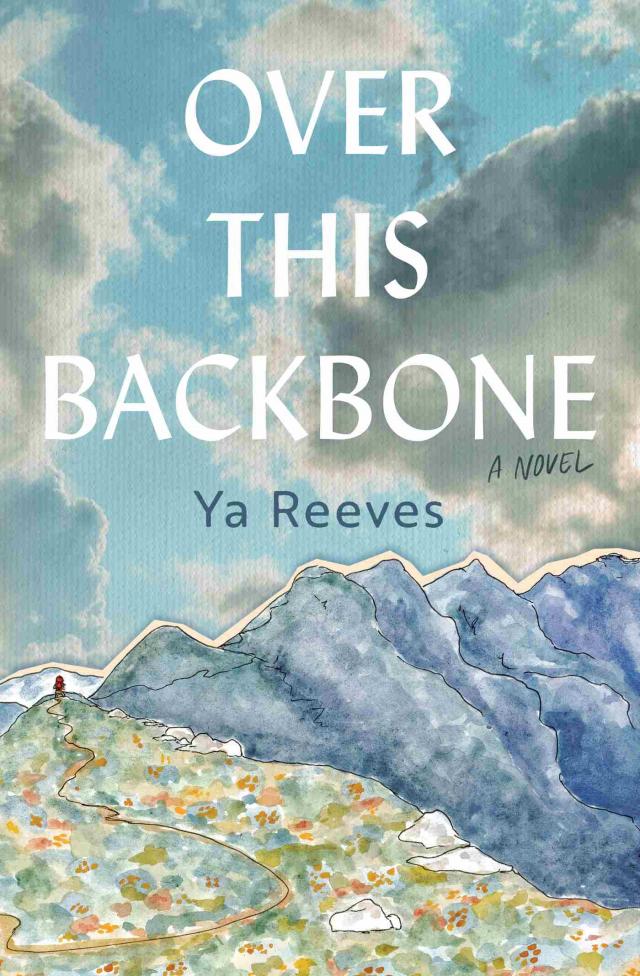
For Alice and Mark.
Contents
Title Page
Prologue: 549 km
Part One
18 km
23 km
39 km
45 km
61 km
63 km
80 km
Part Two
95 km
110 km
136 km
157 km
174 km
199 km
Part Three
208 km
224 km
241 km
262 km
278 km
302 km
335 km
355 km
Part Four
373 km
391 km
419 km
435 km
451 km
459 km
484 km
503 km
518 km
Part Five
544 km
590 km
603 km
Acknowledgements
Copyright Page
prologue
549 km
December 2016
What a way to end it. At least, end something. The it, the track, this butchered thing, isn’t whole enough to have a clean end.
I waddle slow in my underwear like I’m saddle-sore. Sodden clothes stuffed deep in the bag. No point. They’re saturated, and skin is at least water resistant and it’s all heat and fug down here in the valley.
Hot rain torrents down my bare stomach which folds around the waist belt of the pack because I’m walking bent as though I’m older than life itself. The fight has gone from me and I’m chafed and dehydrated and purged and dumb. Eviscerated. He stripped me bare and I stripped me raw.
Maybe this indifference is a symptom of drinking a dead animal. Or maybe I’ve just pitted out, smacked the rock-hard bottom of giving a fuck, dried the well of self-compassion. The latter feels more likely as I see them come towards me on the slick clay road.
Two small, two tall. A family. Happily rain-jacketed and exuding togetherness.
We near each other, and I know that my underpants are visibly stained with blood and mud and are knotted on one side to hold them to my hips. That the merino bra sags dramatically with the weight of absorbed rain and my socks are pulled half way up the calf and blood trickles down both thighs from leeches or blackberries or mosquitos or the raking of my own fingernails. That I still feel ill from the night before so the saliva pools into my chops and I spit it to the shoulder. Despite all that, my despicable state, I cannot rustle one iota of care from my exhausted body as we pass one another, this family and I.
There is a mild wisp of curiosity. What the hell are they doing here in these dank, rough depths?
They carry day bags, the parents. The kids carry nothing and they’re in front and stare with gaping fish gobs as I penguin past wearing a face of dripping sweat and disregard. The dad clears his throat, but the mum beats him to it.
Are you alright, love? she asks.
They all halt as we come abreast but somehow my legs don’t let me and before I can get a good look at her I’ve waddled onward like an unstoppable caboose—a diesel in first. I don’t turn my head, though answer loudly so that she might hear.
I came from Canberra, I say, but I realise this might not be enough of an explanation.
I drank a carcass and it’s so wet that I’ve given up, I say.
I know that their eyes are on my arse, and I feel that the loose underpants have crept up my crack, but I can’t figure out whether yanking them free is less offensive than leaving them chocked up in there.
Sorry, I yell, and wave a hand because this seems easier, not because I mean it.
Then I’m around the bend in the road. I’ll never know what they made of me.
There are three days to go; maybe I’ll just walk them into one. Ben won’t be waiting at the ‘end’. The whole thing is butchered—I took a knife to it.
I swing my legs wide to stop the chafe and carry on—a buckled and aged cowboy in perpetual swaying motion, some decrepit animal spitting nauseous sick, a nineteen-year-old girl with a one-sided wedgie and muscled thighs and a mordant grin and a chip on the shoulder and nothing but skin left to lose.
18 km
November 2016
It’s the pig that reminds me.
Dead on the track, half-decomposed, guts ripped to buggery, one eye still glassed in. Only a baby but still very much a pig.
I’ve heard that they’re rampant further across the border, though not in this dry, clattering, sclerophyll bush. They’re cloven like the devil only fatter, and commit a pawing, snuffling kind of environmental genocide. Like the horses, like the deer. This land is too old and dog-eared and crumbling for hooves that don’t give.
All this I know. Still, I’m caught off guard by the piglet carcass and rattled by the confidence I’d oozed when I told Ollie that there would be none.
I swing the heavy canvas pack off with a grunt and prop on its sweaty base, sip some water, stare. Mull it over while the yellow box rattles in the breeze. Stretch my brown legs into a patch of sunlight and rack up some cancerous cells in exchange for the warmth.
I don’t remember where I put the knife. It’s not in my possession now. It could be back in the desert or shoved beneath a car seat or packed into the pile of clothes in Ben’s room. Maybe I never accepted it. Maybe I’ve gone mad.
I shake my head—it’s only day one.
That wind is hot. I can feel the salt drying and gluing my eyebrows and lashes and gripping to the fine hairs on my cheeks. Shoulders, already knotted, ache. Blisters bubble their way to the surface, and I know I should have stopped for them but I’m single-minded to the point of recklessness. I want to keep moving. Feet are too broad for the boots, anyway. Pack is too heavy, but I’d never breathe a word of it because that’d prove them right and I’m too young to be wrong.
It doesn’t matter where the knife went because, as I’ve said, I won’t need it.
I stand and arch and crack and stretch and suck a breath and heave the pack and leave the pig where it rots—harmless.
October 2016
Ollie gave me the knife a few weeks before I was due to start walking. It was the day after the incident.
We were out cat-trapping on one of those blinding South Australian afternoons in spring with the desert range shimmering purple and salmon on the horizon and the fairweather cumulus lifting off the drying paddocks. There’d been a power outage the week before and no one had thought to reset the scrambled freezer in the old Woolshed, meaning the fourteen-day dead rabbits were now rife with maggots. We’d salvaged a few and slung them into the tray of the ute with a knife the length of my forearm.
So, Peta Rafe. You’re really going walking, Ollie said as we jolted along the rutted tracks.
Yessir.
How far is it again?
Six hundred and eighty kilometres. Nothing really, I chuckled.
He grunted, then said, from where to where?
Canberra to Walhalla, in Gippsland. It pretty much follows the Great Divide across the ACT, New South Wales and then Victoria.
Ollie didn’t comment until we pulled up to the final traps.
He said, You could just stay here in South Australia. We’ll need guides for the summer.
Nah, I laughed. Time for me to go home I’d reckon.
A wedgetail lifted on the thermal above the steep crumbling walls of Wilpena Pound, its shadow whipping across the yellowing grass of the old station. It’d probably see the rotting carcasses in the ute with those telescopic eyes—would take them if it wanted. The dead rabbits occasionally lured eagles into the cat traps by accident, their size magnified by the confines of the cage. It was always a gut-wrenching mission to free them without breaking a wing or losing a finger, and we’d all groan to see the tiger sheen of their feathers thrashing against the grated metal.
But the trapping was necessary. Sheep had been removed from the property ten years earlier and the semi-arid bush was only just breathing back into the damage. The dwindling native marsupials and birds struggled to gain any footing with the cats at their throats, so we did what we could.
I was the hiking guide at Boroolya Station and Ollie the chef, though we all did our bit. None of the wealthy, high-flying guests were staying at the homestead that day so our options were macheteing rabbits or ironing sheets. We’d flicked a glance at one another and headed for the ute.
The task was simple: whack the rabbits in two with the knife and then thread the top half by the ears and the bottom half by the skin of the back onto a pendulous hook deep in the cage. Could double the traps with the same amount of bunnies.
I slid from the ute, taking a fat rabbit, and walked to a log. One foot pierced and ached as I stepped, and though I tried not to show it Ollie knew I was in pain. Of course he knew. He wanted me to talk about it—the incident the night before, that dumb joke gone wrong. I’m here when you’re ready, he’d said. But I wouldn’t—couldn’t.
It was just another reason for me to walk off on my own.
That’s a long way, Peet. Ollie lit a durrie and sat back on the tray.
Not really. And you know I’ve planned it thoroughly. You’ve watched my preparation—it’s been manic.
I slung the rabbit over the log, lined the heavy knife up with its swollen belly.
It’s not you that I’m worried about. He sucked back on the smoke.
I whacked once, twice, made it through the gri
Agh, what the fuck?
I dropped the two halves. Ollie howled.
Better scoop them back in, he chuckled.
Are you kidding me?
Waste not want not.
Fuck this sideways.
My stomach heaved with the stench, the maggots cascading from the carcass, but I was determined to react no further. I’d already let a wobble into the facade and I needed Ollie—steady, quiet, wary—to believe in me and this beast I was undertaking. Needed the doubt to ease up.
Ollie watched, amused.
I poked the offspring into the mother’s guts while flies spiralled towards my eyes, clung mercilessly to my lips. With the rabbit legs restuffed, I pierced a pinch of skin with the hook and knelt in the dirt. Hands sticky and putrid. Trap set.
So if you’re not worried about me, what are you worried about? I plucked the rabbit’s head by the ears and carried it towards the final cage.
I dunno, mate. You’re going to be by yourself out there. You’re young. I’ve seen the world as it really is. People aren’t always good. I just wonder how safe it’ll be with you alone, he said.
I laughed.
I can handle myself! Didn’t you just see me massacre a rabbit and its entire family? I’m tough. Stop your stressing.
The hook threaded easily through the soft ear cartilage.
That rabbit was dead already, dingbat, Ollie said. But that’s not the point. What if you get eaten by a wild dog?
I snorted.
Or gored by a pig, he continued.
We met at the tray of the ute where he dribbled water from a jerry over my hands while the filter hung limp and curling smoke from his bottom lip. Rust flecks spattered his pants. He stubbed out the ciggie.
I mean, the jumping jacks might get me, I said.
I thought about the EpiPens, wondered where they were, untouched since the move out here because the desert didn’t have the kind of ants that would kill me. Not like the mountains.
But those mountains are home, Ollie. I grew up in them, I smiled. We don’t even have pigs!
We climbed into the ute, but he didn’t touch the key.
You right?
I want you to take that knife, he replied finally, and pointed to the tray. He turned to face me with his blue eyes glinting and a half smile on his lips.
We’d only known each other for a few months, but this place wasn’t exactly rich for company. We’d bonded over vegetable gardens and beer and black coffee and staring into the Elder Range from the deck of the staff house while his wife, Annisa, sung loudly in Indonesian or chided him for his silence. We both knew that she appreciated me and the way I drew him out of himself.
Easy companionships were the kind you gripped white-knuckled around here.
I punched his arm, gentle, playful.
Why would I need a knife, Ollie? I smiled, shook my head, tossed away the intensity of his concern.
But I knew why. We both did.
He stared me down, and I held it until I felt the blood charge for my ears and the hills blur out of focus, until his face was central and isolated, until a glacial twist of resignation turned his mouth and crinkled his eyes. Finally, he sighed, faced the wheel, and put a hand on the key.
For the pigs. He started the car. And for the people.
23 km
I half run, half limp down to the Orroral River late in the afternoon and dump my pack, my walking pole and my bag of bones onto the flattest patch of earth I see. Heavy, body and mind.
It’s a wide valley with spongey, soft green grass—the kind that usually irritates me for seeming so out of place amid the muted olive and earthen tan of the Australian bush. The grass rims the reedy bank of a narrow creek where frogs grind elusively, unseen. I tip my head back and listen to the percussive racket of the cicadas. Screw up my nose, suck a breath, whack my legs.
Righto, enough sitting and feeling.
I dump the contents of my pack onto the grass and notice again how extravagant my equipment appears. Why have I carried so many strips of waxed cardboard? So many socks? I unfurl my one-man tent and chuck my possessions inside, except for the rat-eaten brown woollen jumper and my oversized Crocs. Leave the tent doors open and waving innocently in the shifting evening air.
At the river, I scan the valley for signs of life. Big Eastern greys wallop across the plains and cockies carry on. Otherwise I seem to be alone.
I tenderly slip my feet out of the boots and chuck a face at the blisters that have rubbed their way to the surface. I should know better.
Peel my already drying shorts and underwear down my legs, pull the shirt and bra over my head. There are discoloured patches on my hips. I give them a tap for good measure and wade into the river. I go under.
My muscles are slapped with pain and numb. I count to ten and resurface for a breath and a whoop, dizzy with the cold clamping down on my skull. I stand waist-deep and the creek tugs around me.
Perhaps my tactic had not been wise—to let walking this track be the training for walking this track. I’d been working as a hiking guide, but the clients were old and slow, and I hadn’t exactly broken a heavy sweat on the three-day hikes. For the last few weeks I’d been back with my parents on the coast of East Gippsland—thousands of kilometres from Boroolya Station, hundreds from where I sit soaking in the Orroral River. On the coast I was planning and running and walking unweighted in these increasingly worrying boots, trying to break them in. Mostly I’d been surfing.
I glance down at my toned arms.
Helpful.
Scramble up the bank and shimmy off the water. Stand for a few moments letting the air suck the moisture, then slip back into my crusty clothes and wring out my long, scrappy hair. I pull on the jumper.
I’m halfway back to the tent, visualising dinner, when she calls out and I nearly shit myself.
Hi! Nice evening for a dip.
Jesus fuck. I jump, and she laughs.
She’s tucked up away from the river on a flat of grass where the road cuts a switchback. I must have passed her earlier with my focus locked on the water. I wonder whether she saw my arse, my tits, my overstuffed pack. Decide not to care.
G’day. Sorry, I didn’t see you. I make my way to her tent.
It’s a beautiful river, isn’t it?
I know. And a beautiful name—Orroral. Sounds like you’re rolling a gobstopper in your mouth.
She’s propped in a Crazy Creek hiking chair, stove bubbling beside her, book cracked in her lap. She might be in her mid-forties, but I’m coming to trust my assumptions about age less as the years pass. Her hair is brown, flecked with grey, pulled into a single plait. She’s dressed from a Kathmandu catalogue, all beige and that magenta that they use to label any item as ‘women’s’. Crow’s feet that I envy—a product of squinting and weathering and time to think.
I think that Orroral comes from the Namadgi word for tomorrow, she smiles. Which is fitting for me.
I like that, I say and pause at the periphery of her camp. Where’ve you come from?
Well, believe it or not, I came from Walhalla a few months ago. This is the last night in my little tent and tomorrow, I walk into Tharwa having officially finished the Australian Alps Walking Track. She grins and toots a triumphant tune with her mouth pursed into a trumpet.
Canberra baby—at last, she grins.
Ah, so you’ve walked it south to north?
I sure have, she says, and puts her book aside. A Tom Robbins. I’d always loved his books, the strangeness of them, so I like her immediately.
Well, congratulations. How long has it taken you?
I lean against a pale trunk, hover above her.
I started four months ago, she explains, twisting the knob on her gas stove. But I’ve had big breaks in between, weeks at a time. I started too early and there were blizzards. I caught the snow on the Main Range and had a bit of trouble there. It was a really wet spring, you know—had a few rivers rise on me and I couldn’t cross. Skipped some kilometres because I rolled an ankle. My husband has been rescuing me from this damn track on and off for the entire walk. Honestly, he must be sick of it.
So you cheated.
Fair enough, I say, and my stomach knots at the thought of things to come.









