Fighting retreat, p.1
Fighting Retreat, page 1


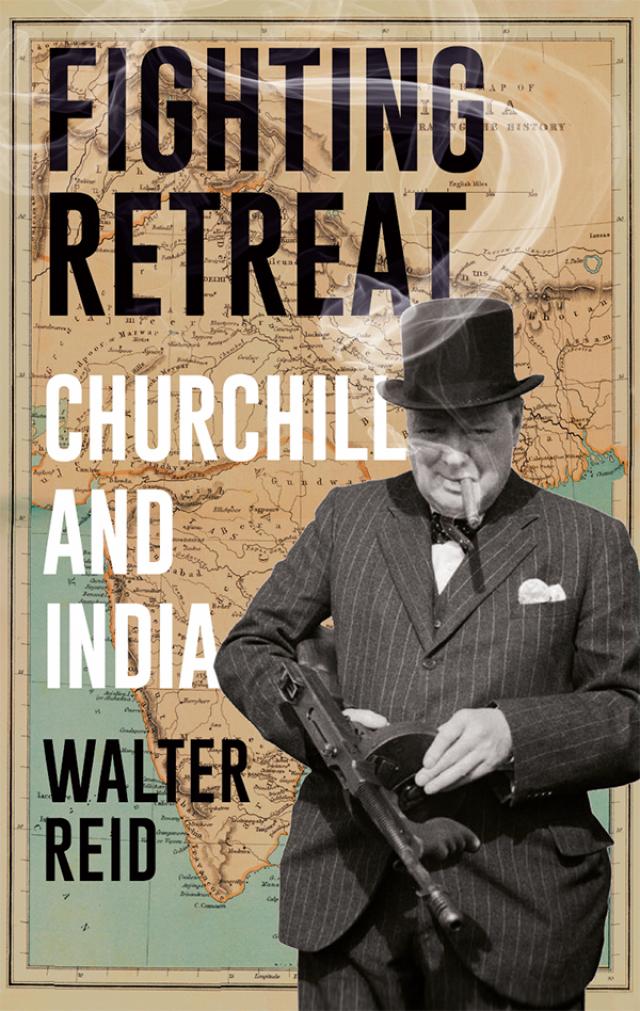
Fighting Retreat
ADVANCE PRAISE FOR THE BOOK
‘History writing at its best. A fascinating and important story, beautifully, clearly and fairly told. An excellent read’—Oliver Everett, CVO, Librarian Emeritus, Royal Library, Windsor Castle; and first secretary, UK High Commission, New Delhi, 1969–73
‘Judicious, elegantly argued and a joy to read, Fighting Retreat addresses the thorny questions of why Churchill took such a jaundiced view of India and whether his obduracy over Indian independence fed the rancour that led to Partition. As the author of seminal works on both India and Churchill, Walter Reid is well placed to supply the answers. He does so with elan and conviction. This is an important and immensely rewarding account of a hitherto puzzling conundrum’—John Keay, author of India: A History of India and The Honourable Company: A History of the English East India Company
‘In this day and age, Churchill remains a controversial figure: he is seen as a great patriot in Britain but nothing less than an archetypical imperialist villain in India. Reid has put his hands into a wasp’s nest to examine Churchill’s attitude towards India. To his credit, he has come up with a fair and warts-and-all account that explains Churchill’s attitude, even while it does not excuse it’—Manoj Joshi, distinguished fellow, Observer Research Foundation, New Delhi
‘Walter Reid pulls no punches in this troubling book, and the attentive reader will have much to reconsider’—John Hussey, OBE, winner of the Templer Medal Prize for Waterloo: The Campaign of 1815
‘Reid’s account and assessment are critical and impartial. The real Winston Churchill emerges with blemishes and strengths but not as a friend of India’—General T.S. Shergill, PVSM
‘This is a splendid book, clear-eyed and dispassionate, which perfectly captures the essence of Churchill’s misguided ire towards India. The presentation of him and his approach to India, the various peoples of India and to Indian nationalism, is compelling. I have really, really enjoyed this. Not only does Reid write beautifully but the issues are arrayed clinically, and dispatched calmly and authoritatively. I don’t think I have seen the whole subject dealt with so dispassionately. The chapter on the Bengal famine is exemplary. I agree that nuance is required in understanding Churchill’s use of language: there is a clear divide between his sometimes shocking verbal intemperance and his political actions. Reid draws a distinction between what he said and what he did. The final chapter is masterful. It certainly helped me to understand some things about Churchill for the first time’—Robert Lyman, author of A War of Empires and Slim, Master of War
Fighting
Retreat
Churchill and India
WALTER REID
HURST & COMPANY, LONDON
First published in the United Kingdom in 2024 by
C. Hurst & Co. (Publishers) Ltd.,
New Wing, Somerset House, Strand, London, WC2R 1LA
Copyright © Walter Reid 2024
First published by Penguin Random House India
All rights reserved.
Printed in the United Kingdom
The right of Walter Reid to be identified as the author of this publication is asserted by him in accordance with the Copyright, Designs and Patents Act, 1988.
Distributed in the United States, Canada and Latin America by Oxford University Press, 198 Madison Avenue, New York, NY 10016, United States of America.
A Cataloguing-in-Publication data record for this book is available from the British Library.
This book is printed using paper from registered sustainable and managed sources.
ISBN: 9781805260509
www.hurstpublishers.com
For Janet
Contents
Preface
Acknowledgements
1.Goodbye to India
2.A Passage to India
3.Soldiering on the Frontier
4.Colonial Adventures
5.Politics—‘A Fine Game to Play’
6.The Young Radical
7.‘Prizes of the Game’
8.Jallianwala Bagh
9.Creating Kingdoms at the Stroke of a Pen
10.Out of Office
11.A Future for India
12.The Irwin Declaration
13.India Grips the Commons
14.Churchill and the Bill
15.Trade, Lancashire and the Committee of Privileges
16.Inside Churchill’s Language
17.Boxwallahs and Martial People
18.The Imperial World
19.In Power Again
20.War: The August Offer
21.War: India at War
22.War: Two Cripps Missions
23.War: Quit India
24.War: The Bengal Famine
25.War: The Indian Army Triumphant
26.The Beginning of the End
27.Independence and Afterwards
28.The Heart of the Paradox
Notes
Index
Preface
In an earlier book on the role of the British in India, Keeping the Jewel in the Crown: The British Betrayal of India, I examined British policy towards the subcontinent from 1917, the year of the Montagu Declaration, to 1947 and Independence. I was not entirely surprised that my studies revealed a malign continuum of deceitful and hypocritical attempts to thwart India’s entirely reasonable political aspirations.
I was, however, taken aback by the scale, nature and significance of Winston Churchill’s role. I was aware of his determination not to preside over the liquidation of the British Empire, but I was not prepared for what I found: consistent, disingenuous and unprincipled opposition to any initiative which might edge India, however slightly, out of the clutches of Great Britain.
I have written in another book about Churchill’s strategy in the Second World War and I found little to criticize in his conduct of that war. Indeed, I have found much to admire in most aspects of his remarkable life. He was capable of a grandeur of spirit and of concern for the generality of mankind. But not for India. Similarly, though he was for the most part surprisingly liberal in relation to Britain’s colonial possessions, his hostility to India was uncompromising. The scope of my earlier book didn’t allow me to focus unduly on Churchill and India; that’s what this book is about.
Acknowledgements
In the course of writing and researching this book, I have been reminded yet again of how generous writers and historians are prepared to be with their time and assistance. I have made new friends and have received much valuable help and support. I have to thank Oliver Everett, John Hussey (yet again), Manoj Joshi, John Keay, Rob Lyman and General T.S. Shergill.
James Colvin very kindly allowed me access to the papers of his grandfather, Lieutenant Colonel James M.C. Colvin VC. Colonel Colvin was part of the Malakand Field Force, and awarded his Victoria Cross for his conduct in the Mohmand Valley action. His observations about Churchill, who served with him as part of the Field Force, are of interest.
Gwen McKerrell has been of enormous help in bringing my undisciplined draft into a coherent whole and assisting with research.
I particularly want to record my gratitude to Tarini Uppal, who was the senior commissioning editor at Penguin Random House India when the idea for this book was forming in my mind. She was wonderfully supportive of what was then a fairly inchoate notion, and it was great to work with her on this book as on an earlier one. Very real thanks too to her marvellous successor, Archana Nathan, and to Manali Das, the most sensitive of copy editors.
Finally, and as always, my heartfelt thanks to Janet and our wonderful family. I could say much more, but they know what they mean to me.
1
Goodbye to India
On 18 June 1898, Winston Churchill, a junior officer in the Fourth Hussars, set sail for Europe from Bombay. He cut an elegant figure in his cavalry uniform. He was good-looking: his eyes blue, his hair ginger and his countenance distinctly boyish. He had none of the jowly bulldog appearance of Karsh’s famous photograph of 1941, the image that came to symbolize his defiant leadership of the British people as they fought for survival. In Bombay, after months in the saddle, his figure was lithe.
He was very different, too, from the statue by Ivor Roberts–Jones, which now stands in Parliament Square. This huge bronze image of Churchill wearing a military greatcoat, one hand resting on a stick, his legs apart and his shoulders thrust forward, is based on a press photograph taken when the Prime Minister inspected the chamber of the House of Commons after it had been destroyed by bombing in 1941. This statue rests on a plinth standing twenty feet tall (over six metres), and the effect is to convey a sense of solidity and permanence.
In 2012, this iconic statue of the man whom Alan Taylor, an historian of the left, described in a celebrated footnote simply as ‘the saviour of his country’1 was vandalized. It was sprayed with red paint to look as if red blood were emerging from Churchill’s mouth, and a strip of grass, like a Mohican haircut, was placed on its head. Ten years later, in the course of Black Lives Matter protests, when Churchill was repeatedly accused of being responsible for the famine in Bengal of 1942–1943, in which millions had died, the statue was attacked again. Underneath the name, WINSTON CHURCHILL, the words ‘is a racist’ were daubed. The statue of the saviour of his country had to be crated up for its protection.
In 1945, Winston Churchill was the most famous man in the world. His fellow countrymen revered him. He had brought them to victory. He was seen as single-handedly having saved his nation from annihilation. By his for
And in 1945, he was applauded not only by his own countrymen. The free world recognized that it remained free, and the values that it shared continued to exist, only because of his leadership in the early years of the war. He was far from being a little Englander. He was a patriotic Briton; but his true commitment was to the world, as Lord Attlee, his lifelong colleague, opponent and friend, his deputy in the heroic years 1940–1945, averred in his tribute in the Lords after Churchill’s death. He had an incredibly wide sympathy for ordinary people, wherever they might be. He was committed to causes that overrode national boundaries—to a sense of unity amongst the English-speaking peoples, for instance. He favoured European integration and the Council of Europe. The scale of his humanity was demonstrated by the way he stretched out to succour his former enemies. He did so after the South African War; he did so after the First World War; and he would have done so again after the Second World War if he had been in office. No one would disagree with the first part of the peroration to Attlee’s tribute, and few would disagree with the second: ‘My Lords, we have lost the greatest Englishman of our time—I think the greatest citizen of the world of our time.’ In 2002, Churchill was voted the greatest Briton ever in a national poll. No one was greatly surprised. In September 2014, it was announced that Churchill’s portrait would be featured on the five-pound note.
When the announcement about the new five-pound note was made, Benjamin Whittingham, the Labour candidate for Wyre and Preston North, tweeted that Churchill was a ‘racist and white supremacist’. There had been straws in the wind. The ‘racist’ graffito had been scrawled on the statue’s plinth just ten years after the Greatest Briton vote and eight years before the Black Lives Matter scrawls, and the subsequent crating to protect the statue of the greatest Briton ever from the hands of crowds that had toppled statues of others regarded as racist exploiters. Empire, racism, the nature of Britain’s imperial history, the issue of whether a degree of involvement in slavery or imperial development meant that figures in history should not be commemorated in statues: all of those issues were suddenly very much in the air. Oxford University held a debate at the Union where the motion ‘That This House Believes the British Empire was a National Disgrace’ was passed easily. (It was a pretty one-sided sort of debate, with three formal speakers in favour of the motion and only one against). Meanwhile, in 2021, at the Cambridge College named after Churchill that constitutes the national and commonwealth memorial to him, there was a year-long series of discussions entitled ‘Churchill, Empire and Race’. The theme was not whether or not Churchill had been a racist. That was pretty much taken for granted. It was rather an examination of different facets of a type of racism that did not need to be proved. A college spokesperson said it was ‘not a debate [but] . . . specifically designed to be a more critical assessment of Churchill’s imperial policy’.
The second event in the Cambridge series was a discussion entitled ‘The Racial Consequences of Mr Churchill’. It was to consider ‘Churchill’s life and legacy in the light of his views on empire and race’. The discussion was not an open debate between two sides; on the contrary, four academics joined in a sustained attack on supposed ideas of white supremacy and eugenics.
The panellists were Dr Onyeka Nubia from Nottingham University, Professor Kehinde Andrews of Birmingham City University and Dr Madhusree Mukerjee. The chair was Professor Priyamvada Gopal from Churchill College itself. The purpose of this book is not to bolster Churchill’s reputation or to argue that he was benevolent to India, but it has to be said that the contributions at the event did little damage to him. The panellists were remarkably uninformed about some of the points on which their arguments pivoted. One of them did not appear to know the difference between Ernest Bevin, a member of Churchill’s cabinet and someone whom Churchill greatly admired, and Aneurin Bevan, an outspoken opponent, not to say enemy. Their contentions were that Hitler’s importance in the war had been greatly overstated, that the war would have ended in the same way without Churchill, and that the war was won by the Soviet Union. There is a large measure of truth in that last point, but it does ignore the fact that the war wouldn’t have begun if the Soviet Union had not allied itself with the Nazis in 1939; it also ignores the role of the United States in the defeat of Germany. It was narrated that the British Empire was the blueprint for Nazism; that the Holocaust was ‘not an outlier at all’; that ‘Churchill’s views on race were much the same as the Nazis’; ‘and that Churchill facilitated the Bengal Famine of 1943’. The ‘scholarship’ behind the conference has been fairly devastatingly destroyed by Andrew Roberts and Zewditu Gebreyohanes.2
Churchill’s grandson, Sir Nicholas Soames, told the Daily Mail that it seemed to him ‘extremely unlikely that young ladies and gentlemen will get a balanced view of Churchill’s life’ from the deliberations of the Cambridge programme, and he is probably right. Unless or until the revisionist wheel turns full circle, Churchill will be remembered not as the saviour of his country and of the free world but as a bigoted racist, as evil as if he had trafficked in slaves or run a plantation in the West Indies.
Why has his image changed so much? The ‘evidence’ against him in the Churchill College not-a-debate consisted mostly of criticism of racial stereotyping and of language used by Churchill and others of his time that is certainly to be deprecated but was all too common amongst men of his generation. But there is more substantive evidence to look at in relation to India; it is Churchill and India with which this book is concerned. Was the hero of 1940–1945, the saviour of his country, a racist enemy of India?
2
A Passage to India
In Bombay in 1898, standing at the stern of the ship, Churchill looked back at Wellington Pier with its tight network of wharves and narrow streets. As the troop ship moved out, its propeller disturbed the silt that was carried into the estuary by the Ulhas River and had settled around the mangrove swamps that lay on the shores of the harbour.
Just a few years later, the ramshackle buildings would be cleared to prepare for the visit of the Prince of Wales, soon to be King George V and Emperor of India. A monumental arch would be erected and called the Gateway of India. But Wellington Pier was already effectively that, and at the age of twenty-four, Churchill was departing through it, turning his back on India for the last time.
Several years later, when he was Prime Minister of Great Britain and in the middle of the struggle for his country’s survival, he seriously contemplated coming back to the subcontinent. He never did so; he never even came within 1000 miles. But from across the sea, he had more influence over a prolonged period, as backbencher, Cabinet Minister and Prime Minister, on the political development of India and its struggle for independence than any other British statesman.
The ship moved away from the Customs House building and Cotton Green into the harbour, down the estuary and finally into the Arabian Sea. Churchill bade farewell to India, the Jewel in the Crown, the most populous, and by far the most romantic part of the British Empire. It was the acquisition of this enormous peninsula and its potential treasures that prompted Victoria’s Prime Minister, Benjamin Disraeli, to promote his queen from a European throne to Empress of India.* Without India, Britain was an important power—possibly the most important power in the world—with huge possessions: Australia, Canada and New Zealand, as well as innumerable other territories scattered over the face of the globe. But with India, with its exoticism and riches, and its physical position, linking Victoria’s assets in the east and the west, Britain’s Empire became the greatest the world had known.