The alien jailers mate, p.1
The Alien Jailer's Mate, page 1
part #1 of Prisoners Of Karcerikus Series
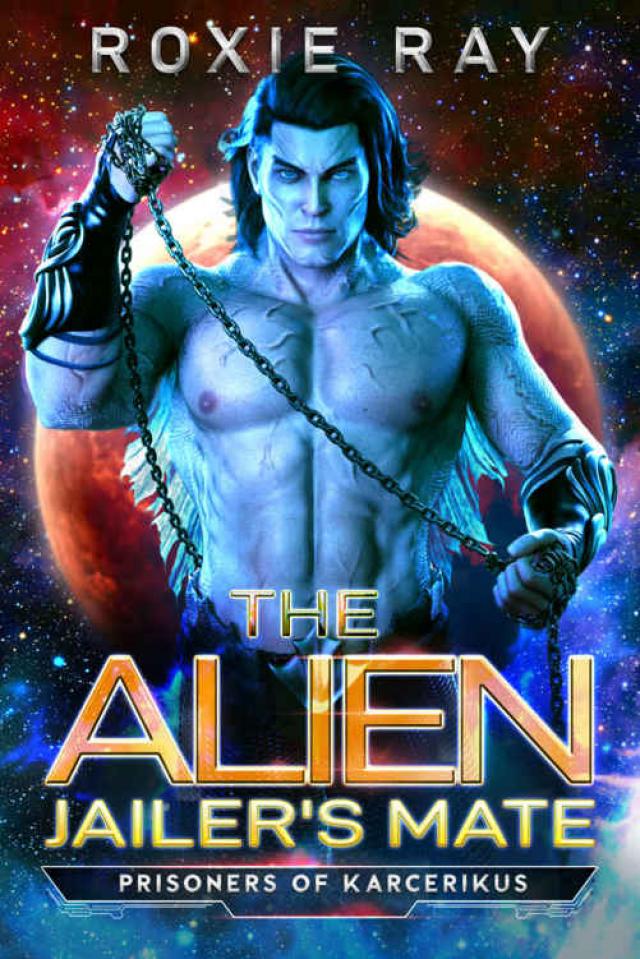


The Alien Jailer’s Mate
Prisoners Of Karcerikus
Roxie Ray
Contents
1. Tetro
2. Sharon
3. Tetro
4. Tetro
5. Sharon
6. Sharon
7. Tetro
8. Sharon
9. Tetro
10. Sharon
11. Sharon
12. Tetro
13. Sharon
14. Tetro
15. Sharon
16. Tetro
17. Sharon
18. Tetro
19. Sharon
20. Tetro
21. Sharon
22. Paige
Claimed By The Alien Warrior
Free Bonus Chapters!
Join my facebook page!
The Alien Jailer’s Mate
1
Tetro
I stared out the window of the transport shuttle, contemplating the vast emptiness of space. There were many among my race—the water-dwelling Manaeans—who believed that the endless, swirling darkness of the cosmic void mirrored the cool, deep, beautiful fathoms and trenches of our ocean home world.
But if so, there wasn’t nearly enough of a resemblance to bring me any comfort.
Oceans were oceans, and space was space, period. And I had recently been unfairly exiled from the former, and driven out into the cold, airless vacuum of the latter. No airy metaphors or philosophizing would make me feel any better about that.
I studied the dimensions of the Karcerikus Maximum-Security Terraforming Facility as my transport approached it. The floating penitentiary resembled an exploded view of an Earthling pocket watch—a burnished metal disc the size of a small moon, with exposed cogs and gears that constantly clicked and rotated, their ugly teeth grinding together steadily. From what I’d heard, it was the perfect metaphor, since the prison had a reputation for grinding up hundreds of prisoners per day with hard labor.
I wondered if it would be any kinder to its administrators. Somehow, I doubted it.
The prisoner transports soared toward the prison—long, windowless, rectangular slabs that looked like blocks of raw iron. In a way, I supposed, that was what they were. They were meant to give the impression of being utterly impenetrable, in order to dissuade those free outlaws who might attempt to liberate comrades who were chained up inside.
I sighed heavily, feeling no different from the inmates on those transports. We were both about to be trapped in this dreadful place for the foreseeable future.
For perhaps the millionth time since I was a small boy, I wished Danyos were with me. My older brother would have known just what to say—to comfort me, to make me feel strong enough to face anything the galaxy threw at me. I missed his wisdom, his compassion, the lessons he’d taught me about honor and decency.
But Danyos was long gone. I’d been alone for my entire adult life. And no matter how much older I got, no matter how much I excelled in my military career, the loneliness that came from being without him—without a family—never seemed to get any easier.
After Danyos’ death, I’d risen to the rank of lieutenant commander in the Manaean armada, with a promising career ahead of me. The upper echelons of the military were rife with corruption—but I had, miraculously, still managed to distinguish myself without using my status for personal gain and earning my ranks rather than sucking up to those who were ranked higher for favors. My less-scrupulous peers sneered at me early on when I refused to use bribery and ass-kissing to get ahead, and I accepted such treatment without complaint—after all, I knew that I would eventually be the one to come out on top.
And as time went on, the generals above me were unable to ignore or dismiss my intelligence, bravery, and resourcefulness in the service of the Mana Empire. My actions were the deciding factor in multiple victories against the Valkredians—our bitter enemies at the time—and I began to receive promotions and assurances that if I continued to perform at such a high level, I would one day be a member of the military’s ruling council.
Oh, how I had longed for that day.
I would lie in my bunk of glowing kelp each night, making fervent promises to myself: When I finally rose to power, I would rid the fleet of the shameful, immoral practices that were rotting it from the inside. With my newfound authority, I would restore order and honor to our ranks, and see all the criminals in uniforms driven out once and for all, so that what had happened to Danyos would never happen to another warrior of Mana. Under my command, courage and loyalty would replace nepotism and self-interest, and the entire galaxy would come to recognize and respect our steadfast code of conduct—as they had long ago, before the war with Valkred gave our soldiers an excuse to become a pack of greedy privateers.
Then came the skirmish in the Lak’haatha Sector.
Our ships had been tasked with hunting down a group of Manaeans who had rejected the recent treaty with Valkred. They were carrying out unauthorized raids on Valkredian outposts—and M’ruvev, our planet’s leader, had assured Valkred’s Blood Ruler Akzun that they would be dealt with swiftly and harshly before they could jeopardize the peace between our empires.
The battle had been going well. The renegade Manaeans put up quite a fight, but they were piloting civilian vessels that had been modified with whatever weaponry they could scrape together, so they were hopelessly outgunned.
We had blasted three of the four ships. As the shield generators of the last one were pummeled to scraps by our plasma cannons, Oshorr, my commanding officer, sent a transmission urging them to surrender.
Their response was simple and to the point: “Go to hell.”
“Well, you’ve got to admire their commitment to their cause,” I’d commented.
“You can admire them all you wish… after we’ve reduced them to space dust,” Oshorr had shot back irritably. “For now, target their engine core with a barrage of pulse mortars, and let’s end this.”
I’d complied, and the remaining ship shuddered, its hull buckling under our assault. Explosions began to bloom all across its surface. Just before it blew apart, a trio of escape pods detached from its undercarriage, powering up their thrusters and withdrawing.
“Target destroyed,” I’d announced. “Setting course for Mana.”
“Not so fast,” Oshorr had snapped. “We’re not done here yet. Pursue those pods, target them, and fire at will.”
I had turned in my seat, looking at him in disbelief. “Sir, those pods are unarmed. The people inside them are defenseless.”
“Then that should make the task at hand quite easy, shouldn’t it? We’re not leaving any survivors to fall back and plot their revenge. You have your orders, Lieutenant Commander. I expect you to carry them out without further insolence.”
I’d stood up, then, folding my arms. “They are unethical orders, sir. And by the codes of combat established under the Gaknaris Accords—codes agreed to by our own military—I am under no obligation to carry them out. And if you continue to insist that I do so, it will be my unfortunate duty to relieve you of command due to dishonorable conduct.”
As I kept my eyes locked on his and waited for his response, I had wondered: Was this it? Would this be the decision which set me apart from all the other officers—proving to my superiors that I was deserving of my own command?
How wrong I had been.
Oshorr had stalked over to me, his face inches from mine, his gills flaring. “Those codes are a joke. And since we’re not fighting against another galactic civilization, we are under no obligation to obey them. We’re dealing with our own people, and we are free to take whatever action we deem to be appropriate without being held to such antiquated standards of conduct. Now, for the last time: track those pods and open fire.”
I’d held my ground, raising my chin defiantly. “I will not.”
Oshorr had then turned to one of the young cadets. “Bo’hara, take over the tactical console and carry out my orders at once.”
Bo’hara had taken a step toward me without hesitation—and I delivered a swift punch to his nose. His golden eyes widened with surprise and he fell backward, blood trickling from the delicate membranes of his nostrils.
It had taken four other officers to drag me to the brig, and by then, the pods had ample time to escape.
Then came the trip back to Mana, and my court-martial. None of the admirals who presided over the proceedings cared about my adherence to the Gaknaris Accords. Half of them were friends of Oshorr’s family—who were quite influential in Mana’s political system—and the other half had been smugly waiting for a chance to punish me for my stubborn stance against corruption. I was convicted of rank insubordination, striking a fellow officer… and the most grievously unjust charge of them all: displaying cowardice on the field of battle.
Cowardice. For refusing to execute unarmed members of my own damn race.
My punishment was dishonorable discharge and exile. Since I’d dedicated my entire life to the military, I had no idea what to do next—until, surprisingly, I received an offer to work as an administrator at the Karcerikus Maximum-Security Terraforming Facility.
Some in my position might feel inclined to wallow in self-pity. Not me. I regretted none of my actions, and if the consequences had been unfair, so be it. I did what I felt was right, and I was willing to live with that.
Still. The thought of spending the rest of my days as a low-level prison administrator was far from thrilling. And my other options were limited. Pirates , mercenaries, and criminal syndicates were always looking for ex-military types to join their ranks—but I was a Manaean of honor, not a thief or a killer. If I was going to sustain myself, it would be by doing honest work for honest pay. Danyos would have accepted nothing less.
And I vowed that someday, somehow, I would find a way back into the Manaean armada. I would regain my former position, no matter how long it took, and clear out the rot that plagued the military on my home world. I didn’t know how—from where I was currently sitting, the prospect seemed hopeless, impossible—but I was determined to come up with a plan.
This was not the end for me.
My shuttle docked at an airlock on one of Karcerikus’ outer rings, and I disembarked. There was a Valkredian waiting for me, wearing a jailer’s uniform that matched the one I’d been issued—body armor colored a repulsive shade of brown, with built-in comm systems and compartments. The Valkredian was shorter than most members of his vampiric race. He had large pointed ears, thinning purple hair, a large wide nose, and close-set red eyes. Overall, his features made him resemble some kind of damnably large rodent.
“You’re Tetro, right?” he asked, slapping my shoulder chummily. “Nice to meet you! My name’s Korkos, and I’ll be showing you how we do things around here until you get settled.”
I’d known him for all of four seconds, and I already despised him. Strangers who affected such immediate and uninvited familiarity made my stomach turn. Still, I forced a smile and a nod. No sense starting things off on the wrong foot if I could help it.
“Funny that they’ve got us working together, huh?” he went on, leading me down a dark corridor that stank of machine grease and body odor. “A Valkredian and a Mana, I mean. After we were just fighting a war against each other and all.”
“Actually,” I replied, “it’s a common misconception that my people are called ‘Mana.’ Our planet is Mana. Our race are Manaeans.”
“Is that so?” He chortled. “Wow. Fascinating! See what we can learn from interacting with other cultures? And let me tell you, we got all kinds of cultures here on Karcerikus. Doesn’t matter where you’re from… Valkred, Mana, Xehrul—even Yuluna. Every planet’s got laws, just like every planet’s got folks who break ̓em and wind up here. Hey, listen, I hope you don’t mind, but I gotta ask: What’s your sign?”
I blinked, taken aback. Had there been a manual of some sort that I hadn’t been aware? “My… sign?”
“Sure, sure! Star sign, you know? Astrology? Constellations? It’s kind of a hobby of mine. Like, were you born under the sign of Klazmaz, the Cave Troll? A lot of you Mana… ̓scuse me, Manaean military types are, but from the way you speak and carry yourself, I’m getting a strong vibe that you were born under Oppol, the Sonic-Spear-Thrower. Or hey, maybe you were born under Klazmaz, but your ascending moon is in Corsunder, the Lasher. That’d explain why you’re not much of a conversationalist!”
I wasn’t sure how much more of his idiotic nonsense I could stand. “I do not know my sign. The date of my birth is in my personnel file. You may consult that, if you wish.”
“Yeah, but that won’t tell me what time you were born, which is a big part of it.” Korkos sighed, sounding disappointed. “Well, no matter. Follow me, I’ll show you around Unit Seven. That’s where you’ll be working.”
I allowed him to lead me into a vast, multi-leveled cell block. Sure enough, it was filled with species from every civilized world—hundreds of them, all wearing bright green jumpsuits stamped with identification codes, and all crammed together so tightly they were practically on top of each other. The cacophony of overlapping voices echoing from every direction was deafening.
“I thought they’d all be working,” I said, raising my voice to be heard over the noise.
“They do it in shifts, so just about everyone gets a turn. Most of ̓em will be called up soon enough. We don’t want to burn through ̓em all at once. It’s a neat set-up, huh? Real profitable!”
I raised an eyebrow quizzically. “What does profit have to do with it? I thought this was a prison.”
Korkos rolled his eyes. “Yeah, but it’s a private prison. See, most penitentiaries in the galaxy are run by planetary governments, to punish their own criminals. But Karaak—the Lunian who built this place—he saw that there was a huge market for terraforming. Let’s face it: Every race has uninhabitable moons and asteroids in their systems that they’d prefer to make use of as colonies or agricultural resources, right?”
Korkos waited for me to nod, which I did so grudgingly.
“Except converting them is nasty, expensive, dangerous work,” he continued. “The overhead’s so high, most of ̓em don’t bother. They don’t have the money, or the technology, or they don’t want to risk their own people. Karaak can get it done fast and cheap, since he doesn’t have to pay his workers… or care much about what happens to ̓em,” Korkos added with a sinister giggle. “So it’s pure profit! That’s how he can offer such high salaries to his administrators.”
“A Lunian runs this prison? And makes money from it?” I considered everything I’d ever learned about the Moon-Wizards of Yuluna… immortal ascetics, philosophers and magic-users who tapped into the central energies of the cosmos in order to gain knowledge. As far as I knew, none of them concerned themselves with material wealth.
Korkos must have sensed what I was thinking, because he winked. “Karaak ain’t your typical Lunian, friend. You’ll see.”
I noticed that there were identical androids stationed all around the unit, standing at attention. They were tall and reedy, with long limbs and cylindrical heads ringed with camera lenses that constantly swiveled in every direction.
“Guard bots,” Korkos explained. “Cost-cutting measure. They don’t feel pity for the inmates, they don’t need food or paychecks, and they can’t be bribed. Which is great, because it means more bribes for us!”
As Korkos patted my shoulder again in a show of comradery, I was getting the sinking feeling that life here wouldn’t be much different than it was in the corrupt Manaean military. What the hell had I gotten myself into?
Korkos pointed out a large group of heavily tattooed convicts gathered together. They seemed to include representatives from almost every race in the known universe. “Recognize the ink those guys are sporting?”
I peered at their markings and nodded. “They’re Sives. Members of the galactic crime syndicate.”
“Correct!” Korkos crowed. “We just got a massive influx of them, after the Valkredians and the Mana—sorry, the Manaeans—drove ̓em off Cexiea and cracked down on ̓em. They’ve still got lots of connections on the outside, though, so they run most of the contraband through here. You’re gonna want to show ̓em plenty of respect, and let ̓em go about their business. They basically run things in here.”
I bristled, the scales on my shoulders rippling underneath my uniform. “I thought we ran things.”
Korkos tittered nervously. “Well, yeah, I mean, up to a point. But they can still make life rough for you if you cross ̓em… or make you rich if you let ̓em have their way.”
“And what of them?” I pointed to a group of scarred, shaggy, rough looking aliens, most of them Kroteians and Xehrulians.
“Those are the Carnage Riders,” he replied. “Space bikers. Only gang big enough to rival the Sives. They’re a violent bunch, and most of ̓em are hopped up on rax. They start fights just about every day. Gives us some free entertainment to break up the monotony, you know?”
I couldn’t believe my ears. Fighting? Smuggling? Rax abuse? And these things were not only permitted by the staff, they seemed to be encouraged?
This wasn’t what I’d expected at all. When I’d been offered this job, I’d imagined it would provide a comforting similarity to military life—uniforms, strict rules and codes of conduct, the disciplined lifestyle I’d long since become accustomed to. The reality I was now confronted with was… disappointing, to say the least.