The best of new dimensio.., p.1
The Best of New Dimensions, page 1


21-09-2023
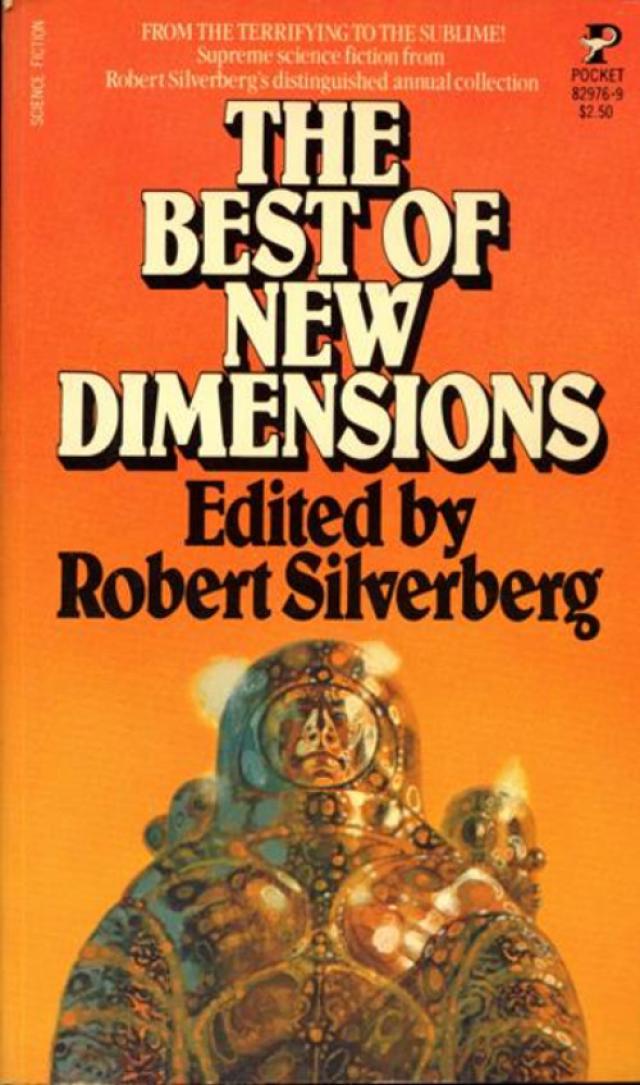
AT THE MOUSE CIRCUS
—Harlan Ellison
A mysterious, enigmatic, haunting story…I found it irresistible: beautifully written, marvelously controlled, wondrously hallucinatory. I’m proud to have published it.
NOBODY’S HOME
—Joanna Russ
I regard this story with awe, for it seems to me one of the most vivid and plausible depictions of the daily life of the future ever written.
THE PSYCHOLOGIST WHO WOULDN’T DO AWFUL THINGS TO RATS
—James Tip tree, Jr.
If I were allowed to claim as my work just one of the whole hundred-odd stories I’ve published in New Dimensions, this is the one I would take.
—Robert Silverberg
Edited by
Robert Silverberg
PUBLISHED BY POCKET BOOKS NEW YORK
Copyright © 1971, 1972, 1973, 1974, 1975, 1976, 1978, 1979 by Robert Silverberg. “At the Mouse Circus,” copyright © 1971 by Harlan Ellison. “A Scarab in the City of Time,” copyright © 1975 by Marta Randall. “The Ones Who Walk Away from Ornelas,” copyright © 1973, 1975 by Ursula K. Le Guin. All stories herein reprinted by permission of the authors and/or their agents.
Another Original publication of POCKET BOOKS
POCKET BOOKS, Simon & Schuster division of
GULF & WESTERN CORPORATION
1230 Avenue of the Americas, New York, N.Y. 10020
All rights reserved, Including the right to reproduce this book or portions thereof in any form whatsoever. For information address Pocket Books, 1230 Avenue of the Americas, New York, N.Y. 10020
ISBN: 0-671-82976-9
First Pocket Books printing November, 1979
10 9 8 7 6 5 4 3 2 1
Trademarks registered in the United States and other countries.
Contents:-
Introduction
A Special Kind of Morning
The Sliced-Crosswise Only-on-Tuesday World
At the Mouse Circus
Nobody’s Home
Eurema’s Dam
f(x) = (11/15/67) x = her, f(x) = o
The Ones Who Walk Away from Ornelas
They Live on Levels
Tell Me All About Yourself
The Examination
Find the Lady
A Scarab in the City of Time
The Psychologist Who Wouldn’t Do Awful Things to Rats
On the Air
A Quiet Revolution for Death
When the Morning Stars Sing Together
Calibrations and Exercises
Yes Sir, That’s My
Introduction
I remember telling myself, back when I was twenty-three or so, that it must be a whole lot easier to be an editor than a writer. A writer must conceive ideas, get them down on paper in properly publishable form, convey them somehow to the attention of a sympathetic editor, and, once having found a purchaser for his material, endure the harrowing process of collecting his check. Whereas an editor, as I imagined it, placidly sorts through his mail, selecting enough stories to fill his current issue, and sends the rest back —a filter, nothing much more. And a filter who gets a paycheck every Friday, too.
Of course, this was nonsense, and I knew it even then. Editors don’t have to bear the creative and financial risks that writers do, but otherwise their jobs are no sinecures. Aside from the little matter of commuting to some Manhattan office every day—a bother from which writers are spared—there’s the burden of ‘maintaining standards, the need to catch flak from high-strung writers, the risk of losing the job around which one’s security is built, etc., etc. And though some editors are content to be mere filters, the best of them—John W. Campbell, Horace Gold, Anthony Boucher, at that time—are involved in a constant exhausting enterprise of exhorting writers, cajoling them, instructing them, browbeating them, whatever is necessary in order to extract copy from them worthy of the gifts they have. Editors, in their way, work just as hard as writers, with rather less in the way of financial reward. (At least, as a twenty-three-year-old writer I was earning rather more than even the most important of the editors I dealt with…I was knocking myself silly to do it, though, which is probably why I found myself envying them their roles in the publishing world.)
My own brushes with editing had been occasional and casual. In summer camp I had edited the camp newspaper; in high school I had edited the school newspaper; from 1949 to 1955 I had edited an amateur science-fiction magazine, which at first was a strikingly incompetent publication but which eventually came to command considerable respect in its field. And at the age of eighteen or nineteen, after attempting with only spotty success to launch a career as a writer of science fiction, I had indicated to friends that I hoped some day to edit a professional science-fiction magazine. It seemed, just then, my only chance of earning a living doing something I enjoyed—for the writing wasn’t going particularly well. I remember telling a friend, after a spate of particularly discouraging rejection slips, that I thought my talents were primarily critical rather than creative, so that editing was really the most sensible path.
By the time I was twenty I was a successful professional author, producing stories as fast as I could type and selling them even faster, and that was the end of the notion of going into editing. I might have, in moments of fatigue, envied the life of an editor, but when I was rational I knew full well that I was in the right end of the business. And sa*it went for a decade or so. Eventually I did drift into a sort of editing— compiling anthologies of my favorite science-fiction stories—but that was pleasant part-time work, virtually a hobby, done at home in spare moments, a means of drawing on my expertise in the genre and, incidentally, of getting paid for it. The real center of my career was still writing, and as the years went along it became altogether inconceivable that I would ever exchange the perquisites and delights of the freelance writer’s life for the constraints of an editor’s. Editors, after all, are employees. They report to an office; they wear shoes when they work; they must pay heed to sales figures and the whims of popular taste.
Even so, in the late 1960’s I felt vague fugitive twitches of the desire to work with other writers on original material. I had strong notions about the nature of science fiction and an equally strong technical grounding in the craft of writing. I felt that most of the editors of the science-fiction magazines of the day were on the wrong track. (Gold had retired, Boucher was dead, Campbell had lost interest in his work. Among active editors, Fred Pohl and Ed Ferman were capable enough, surely, but ‘were forced by monthly deadlines to cut too many corners, and Damon Knight, with whose tastes I had been most nearly in sympathy, had lately veered much too far, I felt, in the direction of avant-garde experimentalism.) And finally I decided to enter the editorial ring myself.
Not as an employee, though, and not with a monthly magazine. The concept of the anthology of original fiction, pioneered by Frederik Pohl with his Star series in 1952, had lately been revived by Damon Knight with Orbit. Pohl’s Star had been an extraordinary publication. (Imagine a first-issue contents page with such names as Asimov, Bradbury, Clarke, del Rey, Gold, Kombluth, Kuttner and Moore, Leiber, Leinster, Merril, Sheckley, Simak, Tenn, Wyndham!) Pohl had done it by making use of his extensive contacts with other authors, by outbidding the existing magazines, and by being unwilling to settle for anything less than the best. I saw no reason why I couldn’t do the same. With some book publisher to back me, I would edit in unhurried fashion an annual volume of new short stories. I would pay the highest rate in the field (three cents a word was tops then—this was 1968) and work carefully and thoughtfully with my writers.
At the 1968 science-fiction convention in Oakland, California, I took the matter up with George Emsberger, the sensitive and perceptive science-fiction editor of Avon Books. He had recently purchased my novels Nightwings and The Man in the Maze; we trusted and respected one another; and we had markedly similar tastes in science fiction. He was immediately enthusiastic about the New Dimensions proposal, with only one reservation: the cost of the project.
I wanted to publish a fine fat book, 80,000 words, and pay five cents a word for my material. That was $4000 right there—to which I meant to add an editorial fee for myself of $1000. But a $5000 advance was a bit outlandish for 1968, when 95% of all science-fiction books were bought for guarantees of $3000 or less. Months passed while we endeavored to find a way around this problem. Since I refused to reduce the editorial budget (there was no point in doing the book unless I could offer higher word-rates than the conventional s-f magazines, and thus demanding more careful writing and rewriting) it became necessary to call in a co-publisher, and in time one was procured: Walker & Company, which then had a program of reprinting in hard cover outstanding paperback science-fiction novels. A complex arrangement was worked out by which Avon agreed to pay me $5000, then would collect $1500 from Walker, who would do a hardbound edition in advance of the Avon publication. I signed the contract on September 15, 1969.
By that time I had already been editing New Dimensions in an unofficial way for many months. Well in advance of the contract, on Emsberger’s verbal commitment alone, I had quietly sent out requests for material to a select group of writer and agents. I did not notify Writers’ Digest or any of the other traditional disseminators of market news, for T dreaded being inundated by amateur manuscripts. (I had my own main career to handle, after all; this was supposed to be part-time work.) A typical letter was this on
“My inclinations are slightly to left of center in the Old Wave/New Wave thing, and I intend to be pretty tough about what I buy…I mean to be fussy, even if I look conservative; I’m not going to make loud noises about ‘storytelling,’ by which the Old Wavers mean lots of chase sequences and laser duels, but I’m going to hold out for a high level of literacy. What I want, I suppose, is the sort of tight, cerebrum-in-gear writing that is characteristic of Bester, Blish, Kuttner, Kombluth, Budrys, Pohl. I’m willing to buy flamboyance of the Zelazny type or wild soaring Lafferty stuff—but I’ve got to have the feeling that the author is in charge of his material, that he understands what a short story is, what the elements of his material are…I’m trying to define a position here, and in a way it’s a classicist’s position: I will buy any kind of story that touches my imagination, even if it violates the Hal Clement rules [of hard science]; I’m open to surrealism, to grotesquerie, to black humor, but I want professionalism too, and will not happily buy an amateurish story that shows flashes of brilliance.”
What I wanted, actually, were stories worthy of Fred Pohl’s early issues of Star—early 1950’s craftsmanship, late 1960’s sensibility.
The grapevine was efficient and soon stories started coming in—too soon, for the Avon-Walker contractual waltz was going on and on, nothing was signed, and I had no way of paying for material. The first acceptable story reached me on February 7, 1969—from two beginners, Alex and Phyllis Eisenstein. I bought it instantly, but warned them I might not be able to pay for it for a few months; then, while the negotiations with the publishers continued interminably, I had to keep those poor people waiting almost all year for their first professional writing check! (I finally paid them in October.)
There were more embarrassments ahead. In a leisurely way I went on buying stories all during 1969 and early 1970. Some of the writers I had most hoped to see material from sent nothing—no Blish, no Zelazny, no Dick, no Vance, no Budrys, no Bester —but I did get stories of the level I was seeking from such professionals as Ursula Le Guin and Philip Jos6 Farmer and such newcomers as Gardner Dozois and Ed Bryant. From Thomas Disch came a brilliant segment of his novel-in-progress 334. From Barry Malzberg, Harry Harrison, Harlan Ellison—well, the issue came together swiftly and pleasingly. But I did get into one bad row with Le Guin that almost cost me her story after I had accepted it, because my acceptance was only moderately enthusiastic and a garbled report of my opinion got back to her. We patched that up. I got into difficulties with another well-known writer about revisions; we didn’t patch that one up, and the story went elsewhere. And then, somehow, Walker backed out of the co-publishing deal.
I don’t know how that happened. Apparently someone failed to draw up a binding contract between Avon and Walker, and, when Avon finally noticed it, Walker had changed editors and no longer cared to do the book. This left Avon stuck with the whole $5000 advance, an impossible economic burden at the time. I had already bought the stories, so the first issue would appear; but it appeared as though the first would also be the last. Since no other co-publishing scheme seemed feasible, I sent out word in the autumn of 1970 that I had ceased to solicit manuscripts.
Help arrived from a most unexpected source. On October 29, 1970, Diane Cleaver of Doubleday wrote me, “All the fanzines are informing us that New Dimensions has folded. Would you be interested in bringing it to Doubleday on an annual basis? If you are, let’s talk.”
That was a surprise. Doubleday and I were on friendly terms and they had published many of my novels; but still, here was an offer out of the blue for an unpublished anthology, sight unseen. I found that flattering. Could anything be worked out, though? I doubted that. Avon already owned the book; Doubleday would have to buy it in a subsidiary position; and Doubleday never ever did things like that. This time they did. The intricacies of the deal would numb the mind if I were to recount them here; it need only be said that all went well, and New Dimensions 1 appeared as a Doubleday book on October 1, 1971, just three years and a month after I had first broached the idea to George Emsberger of Avon.
The subsequent publishing history of the book proved to be as wondrously complex as its origins. Doubleday and Avon co-published the second issue, but were unable to agree among themselves on terms for the third, and neither would go it alone; ultimately I had to take the book to another house entirely, New American Library, which published numbers three and four as paperback originals. Then ‘my relationship with NAL grew bumpy, and when Harper & Row offered to undertake publication of New Dimensions I happily shifted it there as of number five. Harper intended to do its own paperback edition, but did so only for one year; issues six through ten, though handsomely published in hard covers by Harper, had no paperbacks at all. (There was a stillborn deal for reprints of issues six, seven, and eight by Pinnacle Books of Los Angeles.) The lack of a paperback edition eventually made it unfeasible for Harper to go on, and with the forthcoming eleventh issue New Dimensions shifts again, to Pocket Books. With the same issue I begin to share editorial duties with Marta Randall, and I use “sharing” euphemistically, for her responsibilities as coeditor will be increasingly heavy ones. After eleven years, I think the time has come to began easing myself out of* the editorial chair: all editors go stale in time, even the immortal John Campbell, and what was a driving passion for me in 1969 now has become a routine chore. That is unfair to readers, writers, and me—and, having found a coeditor whose ideas about science fiction are harmonious with those I held at the founding of New Dimensions, I have started to withdraw from active control.
But I found my decade as editor an exciting one, and not merely because seven publishers had to be dealt with in the course of getting out eleven issues. There was the delightful experience, many times repeated, of helping an author make his first sale. There was the pleasure of having some altogether magnificent manuscript arrived unsolicited in the mailbox from an unknown contributor. There was the joy of seeing two out of three Hugo awards for short fiction at the 1974 World Science Fiction Convention go to stories from New Dimensions. There was the reward of hearing writers express particular satisfaction at having sold something to New Dimensions, because I was so demanding an editor.
I wouldn’t do it again. But I’m glad to have done it when I did; and I regret only that this collection of the best stories from New Dimensions is not five times as long as it is. Arbitrarily I have limited each writer to one selection, which rules out some choice pieces by regular contributors; I have had to eliminate most of the longer stories I published; and I have left out others because of arcane copyright restrictions. Nevertheless, I think this collection fairly represents my intentions with New Dimensions, and I think I did accomplish, to a reasonable degree, what I had hoped to do when I first suggested the idea of the book in 1968.
—Robert Silverberg
Oakland. California
April, 1979
A Special Kind of Morning
GARDNER R. DOZOIS
In the summer of 1969, during that curious interregnum after the existence of New Dimensions had been announced but before any publishers’ contracts had been signed, a manuscript came to me from a writer whose name was not only unfamiliar to me at the time but also unpronounceable: Gardner Dozois. (“Do-zwah,” I quickly found out.) His eloquent and amusing covering letter began, “Several people have suggested that I submit something to an anthology you’re editing for Avon called New Dimensions. I thought that this was a fine idea; the state of perpetual starvation in which I exist renders me highly susceptible to suggestions of this sort.” The story was called “The Sound of Muzak.” I didn’t buy it, but I sent the most enthusiastic rejection letter I could: “I wish I could buy this,” I said, “because the prose is sensitive and intelligent, and I want to encourage that. You write very well, and I don’t mean that, as the standard rejection-slip crap.” But the story, I insisted, wasn’t true science fiction. “What’s going for it, really, other than its excellent writing? Style isn’t enough. The reader should be enlightened, enlarged, transformed. Shown things he’s never seen before and can’t think up for himself. I admire style, which is rarer than it ought to be in s-f, but I want an honest s-f theme underneath it, since that’s the commodity I’m offering the public. Note that I don’t mean I want Buck Rogers writing: just s-f thinking. I don’t find much of it in ‘Sound of Muzak*. But please do let me see something else. The book is wide open, new names are welcome, and there’s a nickel a word waiting for you.”