Hello world, p.1
Hello World, page 1
part #12 of First Contact Series
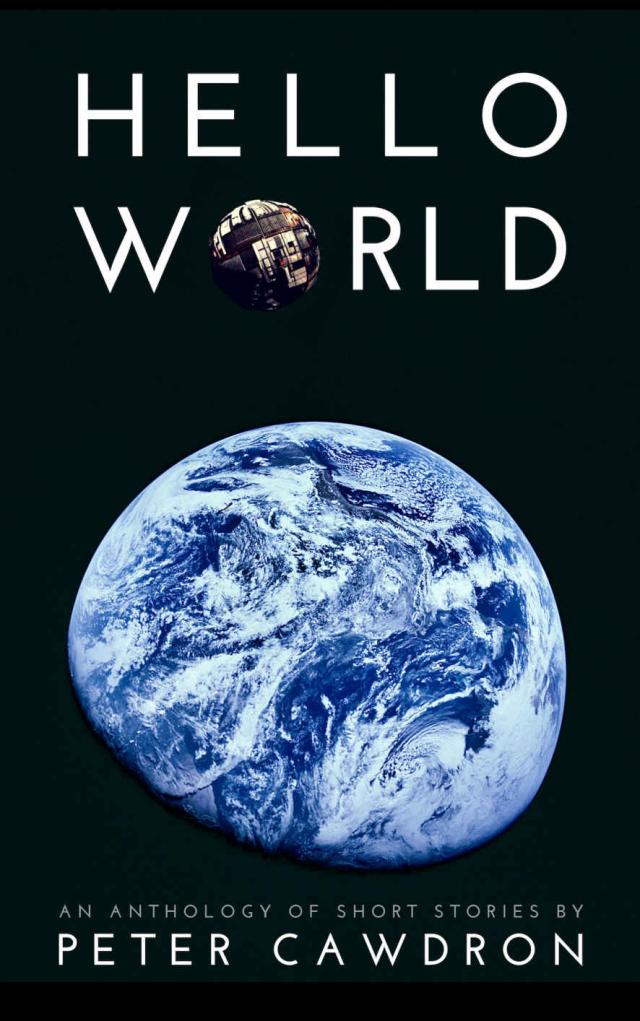


HELLO WORLD
Peter Cawdron
Copyright © Peter Cawdron 2019. All rights reserved. The right of Peter Cawdron to be identified as the author of this work has been asserted by him in accordance with the Copyright, Designs and Patents Act 1988. All the characters in this book are fictitious, and any resemblance to actual persons living or dead is purely coincidental
People are lost without science,
and yet science is nothing without people.
Introduction
I love short stories. They’re quirky, explosive, thought-provoking and fun. Whereas novels are a marathon, shorts are a bit of a lark, a brief run around the lake in Central Park.
Few realize that some of the great science fiction stories such as Richard Matheson’s I Am Legend, Orson Scott Card’s Ender’s Game, John W. Campbell’s Who Goes There (immortalized as The Thing) and Philip K. Dick’s Do Androids Dream of Electric Sheep (Blade Runner) all began life as either short stories or novellas. Personally, I think Philip’s best work was in his short stories. I still refer back to them. I hope you enjoy this collection as much as I have.
Peter Cawdron
Brisbane, Australia.
HELLO WORLD
Professor Franco Corelli has noticed something unusual. The twitter account @QuestionsLots is harvesting hundreds of millions of tweets each day, but never posting anything. Outwardly, this account only follows one other twitter account—@RealScientists, but in reality it is trawling through every post ever made by anyone on the planet. Could it be that @QuestionsLots is not from Earth?
Hello
Professor Franco Corelli walks on stage and the audience erupts. I rush to my feet, joining the clapping and cheering. Over the thundering noise echoing within the vast hall, I can hear calls of dissent. Although they’re in the minority, they’re vocal.
“Fake!”
“Fraud!”
“Liar!”
The guy beside me stands, but he neither claps nor cheers. He looks me up and down, checking out my dress, which is more than a little creepy. He’s young like me, being no more than twenty years old. There’s stubble on his cheeks, but his hair is freshly cut and neatly combed so he looks like a bit of a hipster. We both stood in line for hours to get these seats two rows from the front, but he never spoke to me. He just stared at his cellphone, constantly checking Twitter and Facebook and Insta-something—I lose track of all the different social media apps. Funny, though, how someone so social in a virtual sense can be so closed off physically.
“Can I have some quiet?” the emcee yells into the microphone as more dissent breaks out from the crowd. “If anyone persists in disrupting this conference, I will have security escort them from the auditorium.”
The audience settles, but there are still grumblings of anger coming from some sections of the hall.
Professor Corelli stands behind the emcee. He looks anything but controversial. Spectacles rest low on the bridge of his nose as he peers out across the sea of heads. He must be farsighted, I guess, using glasses only for reading. Tufts of grey hair sit on either side of his ears. He’s slightly rotund and could use a regular workout at the gym or a light run on the weekends, but it’s his cheeks that grab my attention. They’re cherry red, as is his nose. It’s as though he’s a sherry drinker or perhaps likes a bit too much gin. I can’t imagine the professor has had anything to drink before coming on stage, but the smile on his face is irrepressible even with the unrest. Maybe he has.
The emcee steps to one side and Professor Corelli steps up to the microphone. He’s short and has to adjust the mic so he can see over the crowd. He couldn’t hurt a fly. I find myself annoyed by the animosity directed toward him.
“As you know, it is my contention that First Contact with an intelligent extraterrestrial species occurred on December 21, last year, at 6:03pm Eastern Standard Time, but that’s not the real surprise. What’s surprising is that First Contact occurred on Twitter.”
Heckles erupt from the crowd, but Professor Corelli is oblivious.
On cue, a slide appears on the screen behind him, highlighting a single, unassuming tweet on the social media network.
“Hello world.”
Professor Corelli clears his throat.
“That extraterrestrials would use social media to reach out to us really shouldn’t be a surprise. Celebrities such as Lady Gaga, Justin Bieber and Katy Perry have more followers than there are citizens in sovereign nations such as Australia, Germany, Canada, and Egypt. Twitter is a virtual country spanning international boundaries.”
“You have to wonder what an alien species tens of thousands of years more advanced than Homo sapiens could hope to learn from eavesdropping on us. The answer is—they’re not interested in our technology. They want to understand our social structures. They want to learn about our approach to the arts, culture, religion, and sciences like biology and physics.
“Just like anthropologists, they’re interested in our complexity, in the nuances of how we live. In the same way we look back at the Greeks, Romans and Egyptians with curiosity, wanting to understand their approach to gender, race, social standing and family life, ET is using Twitter to examine the human record.”
Someone near the back of the hall yells, “Bullshit!”
The emcee, still standing to one side, points, signaling for security to act. I glance over my shoulder and see ushers rushing back. Professor Corelli isn’t fazed. He’s heard it all before. He keeps speaking.
“Twitter has allowed ET to sample human intelligence from a distance. And this gives them a unique advantage in that they know everything about us while we know nothing about them.”
There’s some fake coughing from behind me.
“They don’t want to know about our guns or bombs. These would be useless against them anyway. They’re interested in us as a species.
“Far from listening to a static, golden record stuck on the side of a deep space probe, they’re able to sample billions of thoughts in the form of tweets.
“Humanity’s first message to another sentient species may have been limited to 280 characters, but tweets cover every subject imaginable. And they’re uncensored, unmoderated. This is us raw—in the nude—at our best and our worst.
“On Twitter, there’s an equality of humanity. Heads of State can be called to account by any citizen, regardless of how rich or poor. Men, women, children, wealthy westerners and poverty stricken Africans—we’re indistinguishable in the electronic medium. And there’s the bots—algorithms impersonating people to sway opinion, but they too are revealing, as they speak of our need for control—how we seek to manipulate each other.
“Retweets and hashtags capture the sentiment of the masses and the shifting tides of humanity in a way that has never before been possible, and this is what has captured the imagination of our extraterrestrial friends.
“Twitter is the heartbeat of the human race. Sentiment has been crowd-sourced.
“There are more mobile devices in the world than there are people alive on the planet. With over two billion Twitter searches conducted every day and close to a hundred million tweets, we’re conducting a global conversation on a scale never before possible. Even though there are billions still disconnected, they have representation in the passion of those fighting for change, and this is what ET is looking at, this is what he wants to understand.”
“You have no proof,” someone yells from further down my row.
The emcee points them out, but Professor Corelli says, “No, no. It is okay. This is a common misunderstanding.”
He leans on the lectern, turning to face the man.
“Science is not concerned with proof as there’s rarely any definitive, absolute proof for any theory. It wasn’t until the 1960s that we had proof the world was round when the first pictures of a small blue planet were beamed back to us from outer space, but we knew Earth was round for thousands of years. Plato and Aristotle refer to the spherical Earth as a fact because they understood the mathematics and the physics involved.
“In the same way, we have known about the double helix structure of DNA since the 1950s, but we were not able to directly image DNA until just a few years ago.
“The same is true for atoms, electrons, x-rays, solar fusion, black holes. Direct proof isn’t always needed, what’s important is that our theories make accurate predictions—that they’re consistent with reality. From there, we refine them further as more information comes to light.
“We make observations. Based on those, we form a hypothesis. Evidence is considered. Predictions are explored. And a theory lives or dies on that basis.
“Science allows us to see beyond the limitation of our senses, teaching us we should not trust our eyes.
“Common sense tells us the Earth is flat, that the sun rises, that we are sitting stationary here in this auditorium. But science tells us we’re moving at tens of thousands of miles an hour. What do you believe? Who do you trust?”
The man beside me calls out, “Where is your evidence?”
“Ah,” Professor Corelli says, raising a finger. “Very good question. We can infer the presence of aliens in our social media networks by means of meta-analysis.
“@QuestionsLots has all the attributes we would expect from a non-terrestrial entity. They have only made one tweet, directed to the world at large. They follow only one other Twitter account @RealScientists, which is highly revealing as to their intent.
“Search histories reveal they have trawled through Twitter, starting with the followers of @RealScientists and slowly spreading until they had searched and reviewed over a quarter of a billion accounts and billions upon billions of tweets.
“And we can see the timestamps related to these searches. You think your internet connection is slow, their latency is measured in hours. And the time lag is consistent across their searches. They conducted most of these searches from somewhere beyond the orbit of Neptune.”
“In essence, they have systematically sampled a significant portion of the people on planet Earth from the far side of the solar system by injecting TCP/IP packets into one of our own satellite uplinks.”
I raise my hand with a question.
“The young woman in the floral dress, yes?” he says, pointing at me.
I stand up, feeling self conscious as people around the auditorium stare at me.
“What do they want?”
“To learn,” Professor Corelli says. “There is nothing we have that is of any value to them other than our culture. They don’t need our water or gold. Material things are meaningless to them. They can find them in greater abundance elsewhere. They don’t seek to enslave us or to control us. They’re curious. Like us, they want to explore.”
I’m suddenly aware I’m still standing in the middle of a row of seats. Professor Corelli has answered my question. He smiles warmly, gesturing slightly with his hands to see if I want any further clarification.
“Thank you,” I mumble with my eyes cast down. I go to sweep my dress beneath me and sit down when the young man next to me stands up and points at the professor. He’s angry, yelling, “These are the lies that lead to Heaven’s Gate!”
Heaven’s Gate? The term is vaguely familiar, but I’m struggling to place it. In the back of my mind, I remember something about a cult that believed an alien spaceship hid behind a comet in the 90s. Most, if not all of them, committed suicide—supposedly to be united with their extraterrestrial saviors.
“Your words are as smooth as oil. You seek to deceive, but we will not be fooled by a false Messiah again!”
Again? This guy is confused. Professor Corelli didn’t have anything to do with Heaven’s Gate. I’ve followed his career with interest. He holds degrees in biology and astrophysics. As far as I know, it’s not religious.
It’s only as shots ring out that I realize the young man is holding a gun.
Screams erupt around me. In seconds, there’s a crowd rushing for the exits. People clamber over seat backs, jump into the aisle and run for the doors.
Professor Corelli has his hands out gesturing for calm. He’s saying something into the microphone, but I can’t hear him over the pandemonium.
More shots are fired, deafening me, and I see Professor Corelli crumple, clutching at his chest. Scarlet red blood seeps through his white shirt and he falls to his knees.
I’m in shock. Nothing registers. No flight. No fight. Just disbelief. I sit there wringing my hands in front of me, grimacing with each shot as the gunman stands beside me firing at a security guard coming down the row. The guard slumps over one of the seats and falls to the carpet.
“No, no, no,” I whisper, feeling numb.
“Get up,” the lunatic with the slick hair yells. He pushes his gun against my head. The barrel is hot, burning my scalp. I struggle to get away but he has a hold on my arm and drags me out into the aisle.
Already, the auditorium is mostly empty. Those that remain are injured, trampled in the crush.
“You,” he yells, pointing his gun at an elderly man. “On stage. Everyone on stage!”
The gunman pushes me roughly onto the stairs and I scramble up onto the polished wooden stage floor.
Another shot rings out and another body falls to the ground.
“There will be no more warning,” he yells. “Get on stage or die!”
As I crawl across the stage, I see movement in the rows further back. There are dozens of people still trying to escape.
“I see you,” the gunman yells, and a woman stands about six rows back, allowing others on the far side of the auditorium to escape as the gunman’s attention is focused on her. He waves with his gun and she walks reluctantly down the row toward the aisle. I can tell she’s stepping over people still hiding behind the chair backs. Whether they’re dead, alive, injured or biding their time waiting to escape, I’m not sure, but I have no doubt about her bravery. She’s buying time for others.
Professor Corelli is lying beside the lectern. I rush over to him. Blood soaks into my dress as I kneel beside him. I press my hands hard against his wounds, but it’s clear he’s dying. Dark red blood seeps from two gunshot wounds to his chest and abdomen.
“Ah,” he says with the fondness of someone meeting a long lost friend. “The curious young girl from the second row... Such a pretty dress.”
I nod, not sure what to say.
“Greet them.”
“I’m sorry,” I say, unsure what he means.
“Trust no one,” the professor says. He takes my hand, pulling it away from his chest. Our eyes meet. My heart breaks as I see the depth of compassion and intelligence in his eyes. He knows he’s dying, but to him, this is more important. “Don’t tell anyone. Not the FBI. Not the NSA. No one.”
I don’t know what he’s talking about, but I nod, trying to comfort him. The gunman storms on stage, yelling and swearing.
“5689,” the professor says. He’s holding my hand with both of his hands, but it’s only now I realize why. He’s slipped a cell phone into the palm of my hand, but he’s done it in such a way that only I know. He squeezes my fingers and smiles. “5689. Tell them, hello from an old friend.”
I start to say something when the gunman kicks me in the ribs, knocking me to one side.
“There will be no more lies,” the gunman yells, and another gunshot rings out, only this shot seems to thunder within my soul. Professor Corelli’s body convulses. His hand twitches and falls still.
Five of us huddle in the middle of the vast stage.
“You! Come out here,” the gunman yells, pointing his handgun at someone backstage. In the wings, curtains sway. I hear the distinct sound of someone pushing down on the crossbar of a fire exit. Seconds later the door slams.
The gunman marches across the stage with his gun outstretched before him. He disappears behind the curtain and I can hear him jamming something into the door to prevent it from being opened.
“We should run while we have the chance,” I say.
“We’d never make it,” an elderly man says and I hesitate, wondering if he’s right, wondering what the consequences of any rash act would be. I doubt I’d make it to the back of the theatre or the side doors, but I might make it to one of the rows. I could hide there.
I go to move when the gunman marches back on the stage. If I had run, I would be halfway down the aisle and little more than target practice.
“Nobody’s going anywhere,” he announces. “Everyone stay calm. No one’s going to get hurt.”
Liar.
How can he be so dumb? He must know he’ll never escape. He must know his only hope lies in surrendering to the police—anything else will end with his death from behind the telescopic sight of a SWAT sniper. But like most of these clowns with their delusions of grandeur, this guy’s blinded by his own hatred and hasn’t thought this through.
The stage is roughly fifty feet wide and probably almost the same in depth, with multiple backdrops and curtains hanging just inches above the polished wooden floor near the rear.
We huddle together because we feel exposed. It’s as though there’s safety in banding together, but I’m aware this plays to his advantage. He has us herded like cattle.
“You got what you want,” the elderly man says. “You’ve killed him. Let us go.”
“You’re my insurance,” he replies, hopping down off the stage. “You’re going to get me out of here.”
Although the gunman is irrational, he’s clearly worried about the sheer number of entry/exit points around the theater.
I can see three emergency exits on each side of the theater, plus the two main doors at the rear. There’s at least another four doors on the mezzanine level, but they’re not visible from here. That’s where the police are going to creep in, and I suspect he knows it. Although he blocked one of the fire doors backstage, there’s got to be at least another two or three of them as this place is designed to get a lot of people out in an emergency. Plus there’s the green room, props area, wardrobe and makeup. There must be sixteen to twenty exits spaced around this theater on various levels. He can’t hope to block or cover more than two or three of them. I’d love to say, “Way to go, dip shit. You might as well be standing in the middle of Union Station,” but I keep my mouth shut.