Dark queen wary, p.1
Dark Queen Wary, page 1


Contents
Cover
Also by Paul Doherty
Title Page
Copyright
Historical Note
Historical Characters
The Prologues
Part One
Part Two
Part Three
Part Four
Part Five
Part Six
Part Seven
Part Eight
Author’s Note
Also by Paul Doherty
The Margaret Beaufort mysteries
DARK QUEEN RISING *
DARK QUEEN WAITING *
DARK QUEEN WATCHING *
The Brother Athelstan mysteries
THE ANGER OF GOD
BY MURDER’S BRIGHT LIGHT
THE HOUSE OF CROWS
THE ASSASSIN’S RIDDLE
THE DEVIL’S DOMAIN
THE FIELD OF BLOOD
THE HOUSE OF SHADOWS
BLOODSTONE *
THE STRAW MEN *
CANDLE FLAME *
THE BOOK OF FIRES *
THE HERALD OF HELL *
THE GREAT REVOLT *
A PILGRIMAGE TO MURDER *
THE MANSIONS OF MURDER *
THE GODLESS *
THE STONE OF DESTINY *
THE HANGING TREE *
The Canterbury Tales mysteries
AN ANCIENT EVIL
A TAPESTRY OF MURDERS
A TOURNAMENT OF MURDERS
GHOSTLY MURDERS
THE HANGMAN’S HYMN
A HAUNT OF MURDER
THE MIDNIGHT MAN *
* available from Severn House
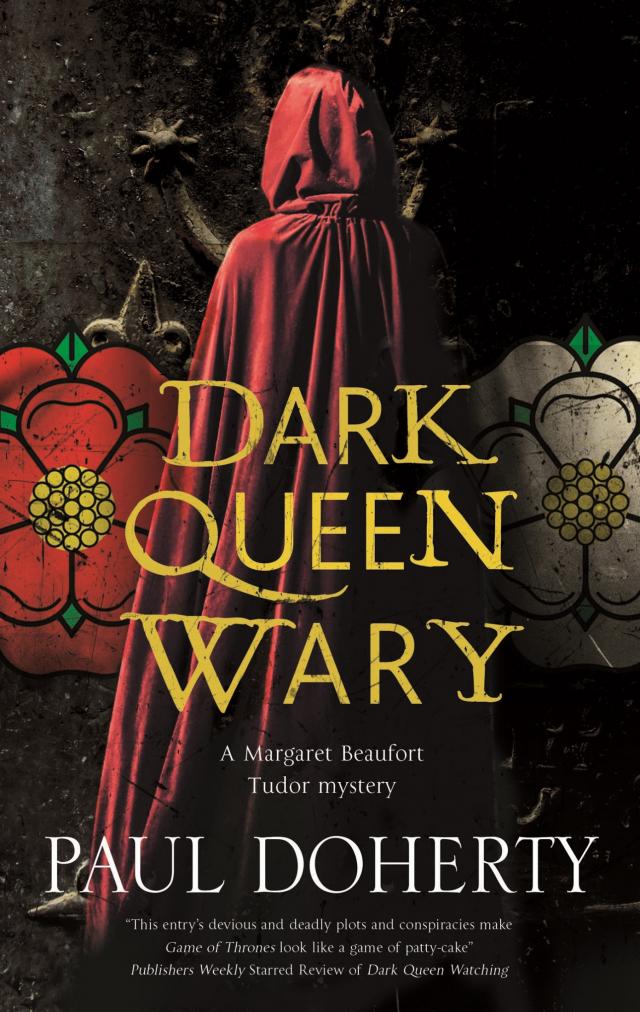
DARK QUEEN WARY
Paul Doherty
This ebook is copyright material and must not be copied, reproduced, transferred, distributed, leased, licensed or publicly performed or used in any way except as specifically permitted in writing by the publishers, as allowed under the terms and conditions under which it was purchased or as strictly permitted by applicable copyright law. Any unauthorised distribution or use of this text may be a direct infringement of the author’s and publisher’s rights and those responsible may be liable in law accordingly.
First world edition published in Great Britain and the USA in 2023
by Severn House, an imprint of Canongate Books Ltd,
14 High Street, Edinburgh EH1 1TE.
Trade paperback edition first published in Great Britain and the USA in 2023
by Severn House, an imprint of Canongate Books Ltd.
This eBook edition first published in 2023 by Severn House,
an imprint of Canongate Books Ltd.
severnhouse.com
Copyright © Paul Doherty, 2023
All rights reserved including the right of reproduction in whole or in part in any form. The right of Paul Doherty to be identified as the author of this work has been asserted in accordance with the Copyright, Designs & Patents Act 1988.
British Library Cataloguing-in-Publication Data
A CIP catalogue record for this title is available from the British Library.
ISBN-13: 978-1-4483-0864-4 (cased)
ISBN-13: 978-1-4483-1030-2 (trade paper)
ISBN-13: 978-1-4483-1021-0 (e-book)
This is a work of fiction. Names, characters, places and incidents are either the product of the author’s imagination or are used fictitiously. Except where actual historical events and characters are being described for the storyline of this novel, all situations in this publication are fictitious and any resemblance to actual persons, living or dead, business establishments, events or locales is purely coincidental.
This eBook produced by
Palimpsest Book Production Limited,
Falkirk, Stirlingshire, Scotland
HISTORICAL NOTE
By 1472 Edward IV, the ‘Glorious Son of York’, was triumphant. He and his entourage had annihilated their rivals the Lancastrians. Only one true claimant was left to challenge Edward’s supremacy: the young Henry Tudor, son of Margaret Beaufort, Countess of Richmond and Lord Edmund Tudor, a Welsh lord who could also claim descent from kings. Edward of York revelled in his triumph. The previous year he had brought to battle, and utterly destroyed, the armies of Lancaster at Barnet, north of London, and Tewkesbury in the West Country. The Battle of Barnet particularly was a gruesome, bitter conflict where both armies were hampered by the thickest mist which, one chronicle maintained, had never been seen before in England.
Once the battle was over, Edward marched back into London. He brought with him the corpses of two of Lancaster’s champions: Richard Neville, Earl of Warwick, and his brother John, Marquess of Montagu. Edward, surrounded by his henchmen, was committed to enjoying his victories, yet the Wars of the Roses were not truly over. The ghosts of the dead haunted the living. Memories were sharp and fresh about treachery, treason, and the hideous bloodshed these had caused. More importantly, Edward and his two brothers, George of Clarence and Richard of Gloucester, were still troubled by the continued existence of young Henry Tudor. Shakespeare wrote, ‘uneasy lies the head which wears the crown’: this certainly applied to Edward of York. If Tudor went into the dark then the ‘Game of Kings’ would finally be over. No one would be left to challenge York’s supremacy and monopoly of power.
The Wars of the Roses had been characterised by subterfuge, intrigue and betrayal: these poisonous weeds flourished vigorously in Edward’s court. The Yorkist lords dreamed of clearing the chessboard of all opposition and, especially, Henry Tudor. York’s minions worked hard to make this dream a reality, whatever the cost …
The Author’s Note at the end of the novel creates the context for the remarkable events this novel is based on. The quotations at the beginning of each section are from The Chronicles of the White Rose of York.
HISTORICAL CHARACTERS
House of York
Richard Duke of York and his wife Cecily, Duchess of York, ‘The Rose of Raby’.
Parents of:
Edward (later King Edward IV),
George of Clarence,
Richard Duke of Gloucester (later King Richard III).
House of Lancaster
John of Gaunt: son of Edward III, founder of the Lancastrian dynasty.
Henry VI, Henry’s wife Margaret of Anjou and their son Prince Edward.
House of Tudor
Edmund Tudor, first husband of Margaret Beaufort, Countess of Richmond, and half-brother to Henry VI of England.
Edmund’s father Owain had married Katherine of Valois, French princess and widow of King Henry V, father of Henry VI.
Jasper Tudor, Edmund’s brother, kinsman to Henry Tudor (later Henry VII).
House of Beaufort
Margaret Beaufort, Countess of Richmond, married first to Edmund Tudor, then Sir Henry Stafford and finally Lord Thomas Stanley.
John Beaufort, first Duke of Somerset and Margaret’s father.
Christopher Urswicke, Margaret Beaufort’s personal clerk and leading henchman.
Reginald Bray, Margaret’s principal steward and controller of her household.
House of Neville
Richard Neville, Earl of Warwick.
John Neville, Marquess of Montague, brother of Richard Neville.
George Neville, Archbishop of York, brother to Richard and John.
House of Oxford
John de Vere, 13th Earl of Oxford.
Others
Sir Thomas Urswicke, Recorder of London, father of the aforementioned Christopher Urswicke.
Sir Henry Stafford, Margaret Beaufort’s second husband.
Lord Thomas Stanley, Countess Margaret’s betrothed.
THE PROLOGUES
‘And there was such a great mist, neither side could even see each other’
His world was dying. The day of judgement, Easter Sunday, 14 April, the year of Our Lord 1471. Dawn had broken, yet heaven hid the rising sun under the thickest, cloying mist. Such a mist had never been seen before and, after the battle, when tales were told, the common consensus was that the mist had been boiled in hell. Richard Neville, Earl of Warwick – self-styled kingmaker, the shatterer of crowns, the arbiter of power – realized all of this was now lost. This day of judgement truly was his time of reckoning. He had taken off his helmet and cast it to one side and let the freezing mist catch his bruised, battered face. He tried to stagger forward, to be immersed in that violent, bloody surf of weapons as the last of Lancaster’s battle lines buckled under the ferocious assault of Edward of York and his minions. All was lost! Warwick’s banners, displaying the ragged staff and bear, and all the other insignia had long disappeared. John Neville, Marquess of Montagu, Richard’s brother, had been cut down, hacked to the ground by a Yorkist battle group. Warwick, wild eyed, gazed around. Men were fleeing for their lives, running to the left and right of him. Warwick’s sweaty body began to cool, his mailed shirt and armour clasping him with icy clamps, the freezing beckoning of the grave. The harsh, strident din of battle was drawing closer. Warwick’s own array was falling back in utter confusion, though a few of his captains strove to hold their battle groups against the enemy. In truth, what an enemy! Edward of York, golden-haired and blue-eyed, had moved like the magnificent leopard he was. Breaking out of London with his brothers, pale-faced, narrow-souled Richard of Gloucester, and that Judas incarnate George of Clarence. They had caught Warwick’s army by surprise. John de Vere, Earl of Oxford, had tried to hold the left wing of Warwick’s force, but his men had been lured away, good for nothing. Warwick peered into the gat hering mist. For a brief breath it parted and Warwick glimpsed the golden sun of York. Edward, surrounded by his household bodyguard, hand-picked knights, who were carving and hacking their way through their opponents. A constant clubbing and cutting to spray the mist with a deep, bloody tinge. Trumpets brayed. Horns howled. The war cries grew stronger. All was lost, it was time to flee. Desperate, Warwick turned, looking for his own battle group, The Five Wounds, a group of skilful swordsmen who had vowed loyalty to their master, body and soul, to the death. Warwick quietly cursed. He had taken the advice of Matthew Poppleton, the captain of The Five Wounds to dispense with his warhorse, to reassure the common foot that Warwick and his captains would not flee the field. They would not leave them to the not-so-tender mercies of York. Warwick thought he heard his name called. He glanced over his shoulder and thought he glimpsed the tabards of his battle group, The Five Wounds, close to a copse. The strident call of trumpets and the harsh song of the battle horns cut above the din, the agreed sign to retreat. Warwick glanced around: his own battle line was writhing about, falling apart; all was lost. Warwick turned, heavy-hearted, stumbling as he ripped off his heavy armour, desperate to reach that copse. Perhaps his battle group waited there. They had horses fresh to ride. They would escape. Warwick would fight again. He paused to breathe, sucking the icy air through his lips. He had failed because he had been betrayed. He sensed this. Something had gone terribly wrong. Was it the work of the damnable Achitophel, that dark spirit who moved between the warring factions of England, offering information, selling his service, which always meant disruption and betrayal? Had this happened here? After all, why had he been left like this, alone and forsaken? He was Richard Neville, Earl of Warwick, Europe’s premier warrior, once this kingdom’s ruler, yet now he was alone in this muddy, bloody, mist-hung field. For a brief moment the great earl thought of what he was leaving: his hapless brother George and the Lady Grace. How would they fare when confronted by the power of York? He just thanked God that he had not brought the Secretum with him but hidden it away at The Moor for others to use. So many wanted that document, but it had always been his and his only. Now, if he was going to die, he could rejoice in that one thought. The truth could still spill out to trap and shatter his enemies. For they were all there: false, conniving George of Clarence, treacherous Thomas Urswicke, and all the other canting crew. But time was passing. Warwick hastened on but then he slipped, his armoured foot catching a gore-soaked clump of harsh grass. Warwick crashed to the ground. He rolled, staring up into the blankness of heaven. He struggled to rise but he was abruptly pushed back by a hooded figure whose tabard displayed the suns of York. Warwick gargled in fear. He fought to speak. He wanted to explain who he was, what he could do. He tried to plead but his gorget was ripped off and the dagger blade sank deep into his exposed throat.
A courier, carrying one of King Edward’s bloody, battered gauntlets, thundered through Bishopsgate into the city. He presented the gauntlet to Edward’s beautiful queen, Elizabeth, as a token of her husband’s resounding victory at Barnet a few hours earlier. He brought news, startling news. Warwick was dead. Gone to judgement. Montagu, Richard’s brother, also slain, together with a long array of Lancastrian captains.
News of Edward’s outstanding, blood-soaked victory soon swept the city. George Neville, Archbishop of York and Warwick’s beloved brother, made an immediate submission to York, personally prostrating himself before the King. He also handed to Edward the keys of the city, as well as the hapless Lancastrian King Henry, for whom Warwick had so vainly fought. Archbishop Neville was now in comfortable confinement in the Tower, where Henry, the King whom George Neville had sworn to protect, soon joined him. In the meantime, the Brothers York revelled in their great triumph.
Late that same afternoon, Edward entered London with standards displayed, banners billowing, horns and trumpets braying, as every bell in the city rang out their joyous welcome. Edward led his army straight from the battlefield and the good citizens shivered as they looked at the wounded soldiers, their faces and noses hacked, squashed, bloodied and sliced, a gruesome testimony to the ferocious hand-to-hand fighting at Barnet, where helmets were discarded and visors raised, as man became wolf to man. Edward led his bloodied host in formal procession into St Paul’s, through the sprawling graveyard, past its famous wooden pulpit and soaring cross. He entered the church through its main door, riding up the nave to be formally greeted and congratulated by the mayor, leading citizens and masters of the guilds. Once he had reached the sanctuary, Edward, accompanied only by his henchmen, set up his battle standards and war pennants, shredded and tattered by cannon, culverin and fire arrows. They were displayed in the sanctuary as the choir chanted the Easter hymn, ‘How joyfully is this day celebrated’. The choir celebrated God’s victory over hell, which in this case was the House of Lancaster.
Early next morning, shortly after the dawn mass, a more sombre and macabre procession arrived at St Paul’s. An open coffin, escorted by six Friars of the Sack, their black pointed hoods pulled forward to conceal both head and face. The good brothers, three on either side, each held a lighted taper. They walked slowly, preceded by a ragged boy beating a tambour. They reached the trestles specially erected just outside the entrance to the rood screen where they deposited the coffin, little more than a battered weapons chest. Once they had done so, they intoned psalms of mourning for the two corpses crammed in the coffin like slabs of meat. The two cadavers lay face to face, naked as they were born except for a dirty cloth covering their genitals. This was the final humiliation for Richard Neville, Earl of Warwick, self-styled kingmaker, and his brother John, Marquess of Montagu. Nailed to each side of the coffin was a proclamation which declared that these were ‘the mortal remains of two traitors, Richard Neville and his brother John, displayed openly so as to counter any subtle and malicious rumour that Warwick might have survived the hellish, brutal slaughter at Barnet, to cause fresh mischief, new murmurs, insurrection and rebellion’. The corpses, the proclamation continued, would lie until the following Friday evening, when they would be removed before compline to the Neville mausoleum at Bisham Priory.
On that same day, after thousands had filed past the coffin, a dark garbed figure, dressed in heavy widow weeds, slipped in through the corpse door of St Pauls. The church lay deserted. The good citizens of London had slaked their morbid curiosity. More important, a vicious, violent windstorm had racked the city. According to the warlocks and wizards who plied their trade in St Paul’s gloomy graveyard, this storm was really a veritable host of demons sweeping into the west in preparation for another great bloodletting. A fresh Lancastrian army had landed in the West Country. Old King Henry’s warlike queen, Margaret of Anjou, had secured safe harbour at Weymouth and was now eager to entice York to fresh battle.
Such news had dampened rejoicings in London. People were no longer interested in the remains of the Barnet struggle, which had really resolved nothing. People also realized they should be careful. Lancastrian corpses, naked and bloodied, might soon be replaced by those of York. However, the dark, shrouded figure who’d come to pay its respects was not concerned with such news. Moving as soft and swift as a ghost, the mysterious pilgrim was not interested in the living but the dead. More specifically, the two corpses who lay like ghastly twins in their makeshift coffin casket. The figure bent over the corpses and stared at the bruised, battered remains. Richard Neville’s death wound was to the throat; John’s was a deep thrust through the right eye and to the left side. The figure pressed a delicately gloved hand against each of the dead men’s heads and silently swore bloody retribution.
Almost a year later Achitophel, that professional Judas man, that wraith of the night who’d gleefully assumed the name ascribed to him, sat in the darkest corner of The Mercy Pew, a sombre, ill-lit tavern not far from the precincts of Westminster. He had journeyed into London on some fictitious reason, but in truth he wanted to think, reflect, and to plot for the future. He favoured The Mercy Pew: it was an ideal place to meet strangers who wanted to do business with Achitophel. The tavern’s taproom had its own original sinister arrangement. The opposite walls of the long dining hall boasted self-contained closets sealed by a door with a trellised screen running down the middle of each of these narrow chambers, a sure way to protect oneself. On occasions such as this, Achitophel would sit, like a priest at the mercy pew, and listen to what his client had to say but, of course, there was no shriving, no forgiveness, nothing of the mercy of God or man. Indeed, the opposite. Achitophel dabbled in the deepest treachery, but now he realized his time was passing. He had to accept that. The deadly struggle between York and Lancaster had drawn to an end. Almost a year had lapsed since the Yorkist victories at Tewkesbury and, above all, Barnet. The Brothers York were, and would be, triumphant. Old Henry, Lancaster’s King, witless as a pigeon, had been lodged in the Tower where, of course, he suddenly died, and his corpse had been dressed and carted off to Chertsey. His warlike queen, Margaret of Anjou, had also grievously suffered: captured after Tewkesbury, she had to witness her only son, Prince Edward, being stabbed to death by Yorkist warlords in a tavern overlooking Tewkesbury marketplace. Afterwards, Margaret had been thrown into some prison where she would linger until the Brothers York decided to send her home to Anjou. The war was truly ended. The fighting had faded away and the armies dispersed. Time would pass. Times would change. There would be fewer opportunities for Achitophel to dabble in, though one attractive possibility remained which might still yield a rich harvest.