Unhinged, p.1
Unhinged, page 1


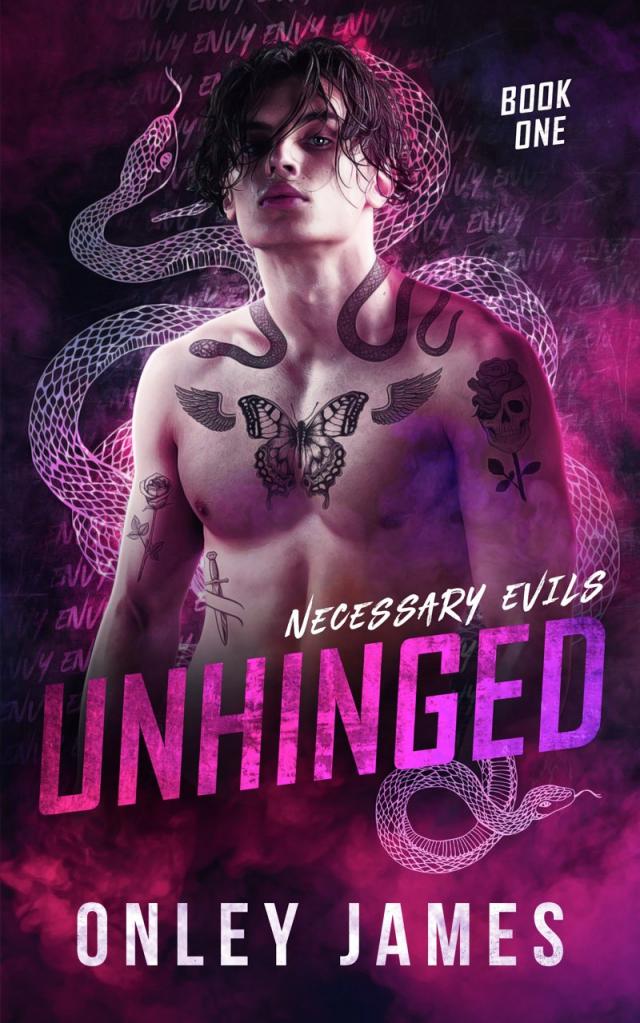
Necessary Evils
Unhinged
Psycho
Moonstruck
Damaged
Headcase
Mad Man
Lunatic
Maniac
Click HERE for a complete list of Onley’s books and their respective links.
CONTENTS
Prologue
1. Adam
2. Noah
3. Adam
4. Noah
5. Adam
6. Noah
7. Adam
8. Noah
9. Adam
10. Noah
11. Adam
12. Noah
13. Adam
14. Noah
15. Adam
16. Noah
17. Adam
18. Noah
19. Adam
20. Noah
21. Adam
22. Noah
23. Adam
24. Noah
25. Adam
26. Noah
Epilogue
Psycho Preview
Afterword
About the Author
UNHINGED
necessary evils book one
Copyright © 2021 Onley James
www.onleyjames.com
All rights reserved. No part of this publication may be reproduced, stored in a retrieval system, or transmitted, in any form or by any means (electronic, mechanical, photocopying, recording, or otherwise), without the prior written permission of the publisher.
This book is a work of fiction and does not represent any individual living or dead. Names, characters, places, and incidents either are products of the author’s imagination or are used fictitiously.
Cover and Interior Formatting by We Got You Covered Book Design
Trigger warning: This book contains graphic violence, very dark humor, and mentions of past child sexual abuse.
SUBJECT: ADAM
This was the hardest part. Finding the boys. But this boy…he would be the last. Then his set would be complete. Dr. Thomas Mulvaney had a small network of like-minded scientists who understood that what he was attempting was worth the risks. The woman beside him, Dr. Arbor, was new to the process. She was a second year resident who worked directly under Thomas's good friend, David.
“Age?” Thomas asked.
The young girl shook her head, hesitant. “Near as we can tell, around six.”
He was used to the trepidation. What they were doing was illegal. Some might even say it was unconscionable. Thomas saw it as a necessary evil. “I promise, this is in the boy’s best interest,” he assured her. “He should be around people like him, people who understand how to meet his specific needs.”
They both looked past the glass to the boy who sat at the table. He was calm in a way no child should be. He had a stillness Thomas had only ever seen in predatory animals and military trained snipers.
“Medicated?”
Once more, she shook her head. “No. When he’s alone, it's like he simply…powers off. Goes into his own head. It’s common in children who’ve endured the type of trauma he’s been through.”
Thomas had seen it before. Too often. The child’s chart said he was found when police responded to a murder-suicide. He’d been tied to the radiator for such a prolonged amount of time that the rope marks on his ankle were now a permanent ring of scars.
He wasn’t the only child found in the home, each filthy, neglected, and in distress. But the other two were young enough that they might still have a chance at a normal life. But this boy? At this age? Attachment disorder had already set in. He knew from experience it was impossible to reverse.
Thomas studied the boy’s unnaturally pale skin, husky blue eyes, and inky black hair. If he was put up for adoption, there was a very good chance he’d be picked almost immediately. He was six but could easily pass for younger. Families always wanted the young, white children, especially boys. They’d have no idea what they were taking into their homes. Not until it was too late.
He sighed. “Diagnoses?”
Dr. Arbor folded her arms across her chest. “Officially? Oppositional defiant disorder, conduct disorder, attachment disorder, post traumatic stress disorder.”
“Unofficially?”
She cut her gaze to him before quickly returning it to the boy, like she was afraid to take her eyes off him for too long. It was probably a good instinct to have.
“He shows increasing signs of psychopathy. He lies seamlessly, he’s charming when he wants something, funny, calculating. His inappropriate touching of adults indicates prolonged abuse. He doesn’t actively attempt to harm himself or others, but he shows no compassion for others’ suffering. Unsurprising given his living conditions.”
“Any bed-wetting, arson, cruelty to animals?”
“It might be too early to tell but, so far, no. In fact, he’s quite taken with the smaller children. He treats them almost like…pets. We suspect he was often tasked with trying to keep the younger ones alive. No easy task considering their limited range of motion.”
He was perfect. "Interesting. Does he have a name?”
“If he does, he’s not saying. We just call him Adam,” she said, sounding tired in her bones.
Thomas understood. Working as a pediatric psychiatrist showed a person just how inhuman humans could be, the level of pain and trauma they could inflict on the population’s most vulnerable people. It showed that most mental health disorders in children were a direct result of the people who were supposed to love them. It ate away at the soul until, over time, it just became too much for most people to bear.
That was where Thomas came in. There was no fixing these children, no healing their psyche. At best, they would become a burden to whoever agreed to take them in. At worst, they would become a plague on their household, maybe even their neighborhood. Pets would go missing, parents would start putting multiple locks on doors, entire families sleeping together in one room until they just couldn’t take it anymore and begged the courts to step in. They wouldn’t.
But Thomas would. He’d take them before they became a blight on society. “There’s no birth certificate?” he asked.
The doctor flicked her gaze towards him once more. “No. His parents didn’t seem like the paperwork type. None of the children in the home had birth certificates. DNA proved they were all biologically related to the mother, so it wasn’t a kidnapping situation. The man who killed her was only the father of the youngest, and we have no way of determining who the boy’s biological father is. There was no match in the DNA database. Not even familial. As far as the government is concerned, he doesn’t exist.”
“And his files?”
“It would be easy enough to make them disappear.”
These children always fell through the cracks. They were the forgotten, the nobodies. Ghosts in a system that just hadn’t killed them yet. Foster families took them in and gave them back, social workers vowed to check on them, but eventually became overwhelmed by their never-ending case loads. It wasn’t any one person’s fault. The system was a broken wheel, inefficient by design.
That always worked in Thomas’s favor. “Excellent. I’d like to meet him now, please.”
She swallowed audibly before reaching for her water bottle and taking a few swigs. “What do you do with them?” she finally asked.
It was only fair she’d be curious. A doctor essentially stealing children in the dead of night was the stuff of nightmares. He was a fairy tale villain. Given the type of people these doctors were forced to endure, it was only fair they were suspicious of him. They should be. But he wasn’t the problem, he was the solution. “I mold them.”
Her brows knitted together, her gaze sharp behind her large glasses. “Into what?”
Into killers. Thomas smiled. “Into exactly what God intended.”
She recoiled, her hand flailing at her side. “I can’t imagine God had much to do with what happened to Adam.”
Thomas shook his head. “Have you ever heard the idiom, ‘psychopaths are born, but sociopaths are made’? Research shows it's true, but what if they aren’t a design flaw? What if they’re here to do what others cannot?”
“What does that even mean?”
“All you need to know is that I run a home for boys just like Adam. He will be well cared for, far better than anything anybody here could offer. He will have access to the best medical care, the finest education, and I will show him exactly what he’s capable of.”
“Which is what?” Dr. Arbor said, looking at him like he was the sociopath.
Thomas made a sweeping gesture. “Using his gifts for good instead of evil.”
Dr. Arbor snorted. “Gifts? I’d hardly call this level of disease a gift.”
He was already shaking his head. “But that’s where you’re wrong, Dr. Arbor. You can’t fix a psychopath. You can’t fix a sociopath. But you can guide them, hone their focus. Teach them how to direct their rage towards those who deserve it.”
“Deserve it?” she echoed. “You’re teaching them to be monsters?”
“Of course not. They’re already monsters. I’m teaching them to kill the ones who made them that way.”
She was silent for a long while before finally asking, “Does it work?”
“That’s what I aim to find out. These boys are my first test subjects. Over the course of their lives I’ll document their progress, teach them how to identify and vet their targets. Teach them to be invisible.”
Once more, her gaze dragged to Adam, still blinking at the blank wall. “H ow many boys do you have?”
“Including Adam? Seven.”
It was truly a small sample size, but any more than seven and he wouldn’t be able to give them his individual time and attention. It was important that they learned to rely on him and each other. While there was no capacity for love, that didn’t mean they couldn’t grow to trust each other. They would need that trust. They would need to blend in with society on some level.
“How do you raise a house full of psychopaths, Dr. Mulvaney?” she asked, looking back through the glass at the small boy.
“Very carefully, Dr. Arbor. Very carefully.”
After a moment, she walked to the door and opened it, gesturing for Thomas to enter first. Once inside, Adam’s shrewd blue eyes tracked him, though the rest of him remained perfectly still. It was clear he unnerved Dr. Arbor, but Thomas thought he was perfect. A perfect specimen. His final boy.
He crouched down beside the boy and held out his hand. “Hello, Adam, my name is Thomas Mulvaney and I’m here to take you to your new home.”
The mask of indifference shattered, replaced by a slow, almost sinister smile. The boy took Thomas’s hand and shook it. He could see why he unnerved the other physician. Adam had no baseline for normal. He could only watch and mimic what he saw. He wasn’t a six-year-old boy. He was a six-year-old robot currently downloading the software that made a six-year-old boy.
Adam was a gift, Thomas could already tell. “Shall we go?”
Adam tucked his head deeper into his red hoodie, his hand curling around the hilt of the knife buried within the sweatshirt’s through and through pocket. It was easy to blend in the middle of the night, swirling from shadow to shadow, avoiding the anemic yellow street lights of the dark, dingy street, but that didn’t mean this was a safe neighborhood. Not by any means.
This was the forgotten part of town. Every building had bars on the windows, the roads were pockmarked with potholes, which became oil-slicked pools each time it rained. The prevalence of gun stores, bail bondsmen, and lawyers sat in stark contrast to Adam’s neighborhood on the other side of the tracks. But he wasn’t trying to ‘slum it’ with the poor. These were Adam’s people. He’d spent the first six years of his life in a dilapidated trailer behind the mini-mart.
Police cars prowled the streets, sometimes shining their flashlights out the window to harass a cluster of people until they dispersed. But they never noticed Adam. Nobody ever noticed him, really. That was why he was still free to roam, to hunt, to kill. But, tonight, the only thing on his to-do list was an early bedtime.
It was strange how seamlessly one could blend if they just pretended they belonged. Even somebody who spent much of his time in the public eye. Somebody famous in certain circles. He supposed it was almost easier to blend in when the alternative seemed preposterous. And the youngest son of billionaire Thomas Mulvaney walking around alone in the worst part of town in the wee hours of the morning seemed pretty preposterous.
But that wasn’t who Adam was either. In truth, Adam was nobody. A carefully crafted lie, raised specifically to right the wrongs of others. A lie he had executed so well that, sometimes, even he believed it. But it wasn’t real. Any of it. Maybe that was what truly made his walks the best thing about his nights. Nobody gave a shit about him on this side of town. They didn’t know the Mulvaney name or who the world thought he was. They didn’t care.
He cut through a dark alley to the entrance of the hollowed out shell of a building where he kept his…supplies. He didn’t need light to see his way around. He’d been using this particular shelter since he was fifteen. He just needed to drop the knife in his kit and then he’d be on his way. He might even make it home by midnight.
Adam didn’t hear the scuffing of sneakers over concrete until it was too late. The sound of a gun’s hammer cocking quickly followed, echoing through the empty space. Still, he didn’t slow his pace until a wobbly voice shouted, “Stop.”
Adam was tempted to ignore the request. The owner of the voice sounded young, uncertain. Terrified, really. It wasn’t uncommon for homeless kids to try to find shelter when it grew cold outside. He was probably a junkie. A tweaker looking for quick cash or drugs. But the likelihood of getting shot wasn’t zero, and even twitchy junkies sometimes got lucky and hit an artery. His father would resurrect him just to kill him again if he got himself merced in this part of town.
He slowed to a halt with a sigh, turning to face his assailant. He was definitely an amateur. He’d stopped directly in the only pool of light in the darkened space, illuminating his features in great enough detail that Adam could have drawn the boy’s sketch from memory.
He was the antithesis of Adam, fair and freckled where he was tan, messy light brown hair where Adam’s was jet black, small and delicate boned in direct opposition to Adam’s swimmer’s body. He most likely wasn’t much younger than Adam. He looked to be in his early twenties.
The kid, whoever he was, had never held a gun before. That much was clear by his stance and the way his hand trembled, but his finger hovering directly over the trigger meant Adam gave him the same care he’d give any other predator.
“Okay, you got me. Now what?” Adam asked.
“Put your hood down,” the boy demanded, gun twitching in his hand as he spoke.
Adam frowned at the odd request. “Why?”
The kid seemed to hesitate, like he hadn’t expected Adam to argue with him. He thought the gun gave him an advantage. It probably did for most. But not to Adam.
He shook the gun. “Don’t ask questions. Just do it.”
Adam took a single step forward, watching with interest as the boy took a step back. “No.”
His eyes bulged. He looked near tears. “No? I’ll fucking shoot you in the face.”
Lie. “Then do it.”
Adam watched as the boy’s finger twitched on the trigger. Oh, he wanted to do it. He wanted Adam dead. Interesting. Maybe this was all a misunderstanding. There was no shortage of criminals in this area. Plenty of people to hold a grudge.
“I know who you are,” the boy said, confidence edging into his voice.
Adam couldn’t help but chuckle. “Oh, yeah? Who do you think I am?”
The boy’s eyes narrowed, a pained smile forming on his face. He was sweating despite the cold, but Adam no longer thought he was a drug addict. The boy was terrified, but his eyes were clear, his skin flawless. This boy wasn’t a junkie.
“Adam. Mulvaney.” He enunciated each syllable, like saying it out loud might invoke some sort of supernatural wrath.
His name on the boy’s lips wiped the smirk off his face. If he didn’t need to hide his identity, then he might as well show his face. Might as well give the boy the appearance of control. He pushed the hood off his face. “And who are you?”
There was no hesitation. “Noah.”
Adam mouthed the boy’s name. He hadn’t expected him to answer him. People who intended to let their victims live didn’t give their names. That didn’t bode well for poor Noah, who looked like life had already run him over more than once.
“Okay. What is it you want, Noah? Cash? Drugs? I have a hundred bucks on me, but if you take my debit card, you can access a lot more. I’ll even give you my pin.”
The boy’s face twisted with a fury that almost looked comical on his innocent freckled little face. Almost. “It’s just that easy for you, huh? Just throw money at it. How do you do it?”
“Do what? I’m just trying to make sure we all go home tonight. I have money. You look like you could use some help. Nobody blames you for doing what you have to do to survive.”
That only made him more angry, if that was even possible. “People really don’t see who you are, do they? You lie so easily.”