Beyond the crushing wave.., p.1
Beyond the Crushing Waves, page 1
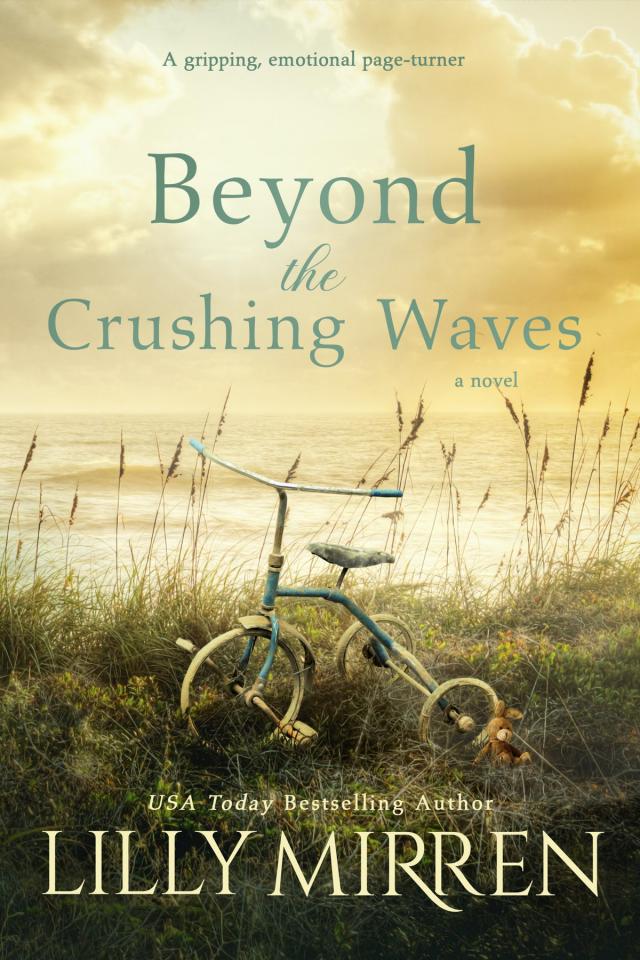


Beyond the Crushing Waves
Lilly Mirren
Contents
About the book
Part I
Prologue
Chapter 1
Chapter 2
Chapter 3
Chapter 4
Chapter 5
Chapter 6
Chapter 7
Chapter 8
Chapter 9
Chapter 10
Chapter 11
Chapter 12
Chapter 13
Chapter 14
Chapter 15
Part II
Chapter 16
Chapter 17
Chapter 18
Chapter 19
Chapter 20
Chapter 21
Chapter 22
Chapter 23
Chapter 24
Chapter 25
Chapter 26
Chapter 27
Chapter 28
Chapter 29
Chapter 30
Part III
Chapter 31
Chapter 32
Chapter 33
Chapter 34
Chapter 35
Chapter 36
Chapter 37
Chapter 38
Chapter 39
Chapter 40
Chapter 41
Chapter 42
Chapter 43
Chapter 44
Epilogue
Author’s Note
Also by Lilly Mirren
Glossary of Terms
Discussion Guide
About the Author
About the book
Two generations face heartbreak and injustice in this poignant and emotional novel inspired by true events.
Mary Roberts is a poor gutter child living in a council flat in 1950’s London. When she and her sister are left at an orphanage by their mother, they don't think their lives can get any worse.
Harry Evans is an orphan who finds himself, with Mary and her sister, on board a ship bound for Australia. They're sent to a farm school for children, where abuse and neglect are rife. A journey that will change their lives forever, and from which they’ll never return.
Married to her dream man, and with a baby on the way, Dr Mia Sato’s life is in perfect order. When her beloved grandmother has a fall, the photograph clutched in her hand prompts Mia to ask questions her grandmother isn’t willing to answer. When she cries out a confession that rocks Mia to her core, it leads to a shocking discovery of a past filled with lies, broken families and forced child migration.
Based on one of Britain's most secret and shameful real-life scandals in which over 100,000 British children were forcibly deported to Canada, South Africa, and Australia over several decades. Lilly Mirren’s heartbreaking, captivating and ultimately uplifting tale reminds us that no matter where the journey leads us, our heart will always find its way home to those we love.
* * *
Please note: this book is written using Australian English. Some words, spelling and phrases may be unfamiliar to you. There is a handy glossary located at the end of the book to assist you.
For my children, who carry my heart with them wherever they go.
I
Dreams forge brimming hope,
Beyond the crushing waves;
Coastal fiery sunsets,
And rain-drenched, sweeping plains
Australia, by Bronwen Whitley 2021
Prologue
1909 Oxford, England
Kingsley Fairbridge
The folded sheet of paper floated to the ground, caught on the breeze, resisted its descent a moment, then fluttered to the left and veered off the footpath, landing in a mud puddle. The shiver that rippled the water’s surface indicated the presence of a dozen or more tadpoles and Kingsley Fairbridge grimaced as he bent to retrieve the sodden paper. He shook the water from the pamphlet, regarded it with a sigh of despair, then continued on his way. His footsteps echoed down the narrow street as he rounded the corner and climbed a steady slope.
It wasn’t far now. Soon he’d be standing in front of the Oxford Colonial Club, addressing them on an issue he regarded as one of the most pressing to face the modern world. His stomach tightened and nausea gripped him, but he shook it off and scurried forward, sweat beading on his pale brow. What should happen if he forgot his purpose — if the words he’d rehearsed so many times slipped from his conscious mind? He’d pulled more than a few strings to gain this audience. If he mishandled the situation or flubbed his speech, there was no way he’d be invited to stand before such company again — certainly not based on his own credentials.
His father and grandfather were well respected enough to get him access to England’s elite for an afternoon, but what happened next would be entirely dependent upon him and his ability to communicate the vision he’d had several years earlier for how to expand the empire while at the same time improving the lives of countless English subjects. As he saw it, there were two problems facing the modern empire, and one single solution that might very well address them both.
If only he could inspire the men he was about to face, his entire life would change. Not to mention the countless others who would benefit from the insight he’d spent years honing in preparation for this moment.
Fairbridge dodged around a woman scolding a child in a perambulator. The feather on her hat fluttered in the frigid wind over a scarf that wrapped around her chin. Her ample rear blocked the entire footpath. With a stern glance in her direction, he stepped off the path and around her, nostrils flaring as his newly polished black boots squelched in the sucking mud. Just what he needed. He’d spent the morning shining the boots, brushing off his best suit and running over his notes so that he would make the best possible impression. Now his shoes would be soiled, and he’d sweated through his suit.
He turned onto High Street, his heart rate accelerating at the sight of the crowd: men and women navigating their way between shops and restaurants; ladies peering beneath fanciful hats into windows; and horses with heads bowed and necks bent smartly, drawing carriages at a clipped pace down the centre of the street. His top hat shifted as he climbed the few stairs that led to the Japanese restaurant. With a collection of folders and several dozen pamphlets in a briefcase clutched to his chest, he used his free gloved hand to adjust his hat. The sweat had seeped through his shirt now and was well on its way to dampening his entire torso. He could only hope it wouldn’t be obvious to the members of the club how nervous he was.
“Good afternoon, sir,” greeted the doorman before nodding and opening the timber door.
He muttered a response, swallowed hard and headed inside. The sombre lighting gave him pause for a moment, but his eyes soon adjusted, and he took in the sight of the restaurant with a sweeping, if somewhat impatient, glance. This couldn’t be the place. Surely he hadn’t misunderstood the address written to him by the club’s secretary. A wave of panic gripped his chest. He startled when a man in a dinner suit, with a high collar in place of a tie, addressed him.
“Can I help you at all, sir?”
“Ah yes, thank you. I’m looking for the Colonial Club, if you please.”
“Right this way, sir. Follow me.”
Fairbridge swallowed again, then dutifully followed the man in the suit. They bypassed the restaurant, skirting down one side of it, then stepped through a set of doors and into a large, enclosed room. It was decorated in shades of red and black. There were rows of seats placed one before the other throughout the entirety of the room, and all facing in the same direction — pointed at a solid lectern.
The man stepped to one side, linking his hands behind his back. “Here you are, sir.”
Fairbridge gave him a nod, then walked further into the room. Men in black suits lingered around a bar at the back of the room while waiters slipped elegantly between them with white-gloved hands offering silver platters of canapés.
Dark timber panelling lent the room a sturdy tone; a chandelier overhead sparkled and glimmered, sending dappled light across black-clothed shoulders, broad and narrow alike.
“You must be Fairbridge,” suggested a voice at his shoulder.
Fairbridge faced the voice with a forced smile. “Yes, indeed I am.”
“I’m Handley Smythe, the club secretary. It’s a pleasure to meet you.” Handley held out a paw, his round, freckled face shining with a grin.
Fairbridge shook his hand, returning the smile as a feeling of relief washed over him. “The pleasure’s all mine, I assure you. I was beginning to think I was in the wrong place.”
“No, you’re most definitely in the right place. We’re really looking forward to hearing what you have to say. The entire place is buzzing with it, let me tell you. Your reputation, or at least your father’s and great-grandfather’s, precedes you. We’re most anxious to hear your perspective.”
Fairbridge dabbed at the beading sweat on his forehead with a handkerchief and followed the fellow through the club to the other end of the room, where a chair awaited him.
Smythe clapped his hands together and shouted to the group. “Listen up, gentlemen. We have a guest with us today. I’d like to introduce to you Kingsley Fairbridge. He comes to us from Rhodesia by way of Oxford University, where he studies as a Rhodes scholar. Please join me in welcoming him to our humble club.”
The group ceased their conversations and turned to face Fairbridge, applauding lightly. Cigar smoke drifted towards the ceiling and gave the room a cloistered feel.
&nbs p; With some degree of murmuring and a scraping of chair legs on the timber floor, each man in the room took a seat except Fairbridge, who rummaged in his briefcase for a moment, then pulled out a small stack of pamphlets. He scanned them a moment, reading the title over in his mind for the hundredth time: “Two Problems and a Solution”. Then, he handed the pamphlets to the nearest fellow, who took one and passed on the rest of the stack.
A glass of water stood on the lectern by his right hand. He took a sip and cleared his throat, then blotted his forehead again. No need to review his notes — he’d done it so many times, he knew them by heart. With fifty pairs of eyes aimed his way, he began to speak.
“I propose to establish a society in England for the furtherance of emigration from the ranks of young children, of the orphan and waif class, to the colonies.
“I propose, therefore, to take out children at the age of eight to ten, before they have acquired the vices of professional pauperism, and before their physiques have become lowered by the adverse conditions of poverty, and give them ten to twelve years of thorough agricultural education at a school of agriculture.”
There was a smattering of applause throughout the room. Men removed cigars from their mouths and leaned together to exchange remarks amongst themselves. Fairbridge straightened his back and continued, growing in confidence.
“Imperial unity is not a phrase or an artificial thing. Great Britain and Greater Britain are and must be one. The Empire has two problems that require a solution. The colonies are in need of good English stock to help realise the potential of the mammoth unused farmlands, while England itself struggles to find purpose for the growing number of destitute children within its borders.”
There were murmurs of agreement, along with several distinct head nods. Fairbridge had found his audience. He smiled to himself, his voice rising a little higher. “Now there are in England over sixty thousand dependent children – orphans or homeless — who are being brought up in institutions, who will be put into small jobs at the age of twelve or fourteen, jobs for which they become too old at eighteen. They have no parents, and no one standing in any such relation to them. What have they before them that can be called a future?”
He paused as a silence descended on the room. The men from the Colonial Club considered his words through their puffs of smoke and over the rim of squat crystal glasses. He revelled in the seriousness of the moment. This was his chance to make a mark on the world that would allow him to be introduced in future by his own name and not his great-grandfather’s or his father’s. His voice trembled as he continued.
“Here and now, let us found a society to take as many as we can of these children overseas, to train them in our own colonies for colonial farm life. We want schools of agriculture in every part of the Empire where good land is lying empty for lack of men. This will not be charity — it will be imperial investment. There will be no pauper strain attached to our farm-schools; every child will be worth far more than the price of his training to the colony he will eventually help to build.”
1
Current Day
Mia
I’m having one of those days where it feels as though my tummy might explode. Maybe explode isn’t the right word, and tummy certainly isn’t the technical term. Uterus would be more specific, although I don’t think of it that way, since to me a uterus is something dark and cozy, hidden deep inside my body and housing an adorable cherub who’s yawning and stretching before rolling back over to fall asleep. Instead, my entire abdomen feels as though something horrid is stretching it taut from the inside out — working its way slowly to the surface like a wombat on the hunt for carrots. The wombat kicks fiercely against my bladder, bringing a grimace to my face as I do my best to ignore his repeated taps.
I’m enormous, so even though the picture of a wombat rolling through the dusk, snuffling after its next meal, seems appropriate for the baby. I could better be described as a gigantic seal or walrus. I should be beached on top of a piece of floating ice way out in the middle of the vast ocean. In fact, I like that idea. Ice would be welcome right about now — I can see myself lazing around on top of a frozen white shelf. Though it’d have to be a big one to hold me.
The Brisbane summer heat is more than I can take. I’ve lived here for years, but I still can’t get past the humidity. There’s a cloying relentlessness in the sun as it bakes the top of my head during the few moments I’m traveling between the car and the house. I can’t escape it—it’s already left a trail of sweat down the centre of my spine, and my maternity jeans are soaked through.
Why am I wearing jeans in forty-degree weather? Because when I last went clothes shopping, my stomach only protruded slightly over the waistband of my pre-pregnancy jeans, and I couldn’t stand the look of the maternity shorts on my chubby little legs. They hadn’t been chubby before the strip turned pink, but the only way I’d managed to stave off constant nausea in my first trimester was to fill my stomach with a constant stream of snack foods.
Of course, it’d been a chilly spring day when I’d chosen the jeans, and I’d thought more about fashion than the weather. I’d had a plan to lose the weight from the first trimester by switching to a whole-foods diet. It’d be better for me and for the baby. I’d been determined, certain I could do it. I’d imagined myself in my third trimester as a cute, sprightly woman with nothing but a bump up front as I jogged my way through the final weeks of pregnancy. Just like the celebrities you see splashed across the fronts of magazines piled on wire stands in grocery shops at every checkout, with headings like: Didn’t gain a pound, Bounce back after pregnancy, and Show off your bump!
Instead, I’m waddling up the footpath to Gammy’s house with one hand pressed to my twinge-y lower back and the afterburn of my first daily bout of indigestion still haunting the back of my throat.
I knock at the door, then peer through the glass window beside it. The old Queenslander where Gammy lives is in dire need of a new coat of paint. One more thing to add to my list of to-dos before the baby comes. Although I’m running out of time as the list grows daily. Ben says I don’t have to do everything before the baby gets here—I’ll still be able to do some things after.
My entire life these days is divided into those two categories: before the baby and after the baby. It’s my own little version of anno domini, but it seems more final. Like I shouldn’t plan for anything after the baby comes. The date looms unknown on the horizon, as though enshrouded in a mist and there’s a burgeoning urgency to do everything now, before it’s too late. To clean my house, purchase everything the baby could possibly need for its first six months of life, to find those last few pieces of furniture I’ve been procrastinating over, to get my hair done, to paint Gammy’s house, to have coffee or lunch with every one of my friends, to go away with Ben for one last jaunt, and make sure everything is added to my list so I can check each item off one by one.
There’s no sign of Gammy, so I huff back down the half-dozen steps to the grassy yard and waddle around the side of the house, past the garage that Gramps added on in the nineteen seventies. It’s the same colour as the house, and you’d never know he added it later. He was always good with his hands, could build anything he wanted even if he wasn’t trained to do it.