Old ramon, p.1
Old Ramon, page 1


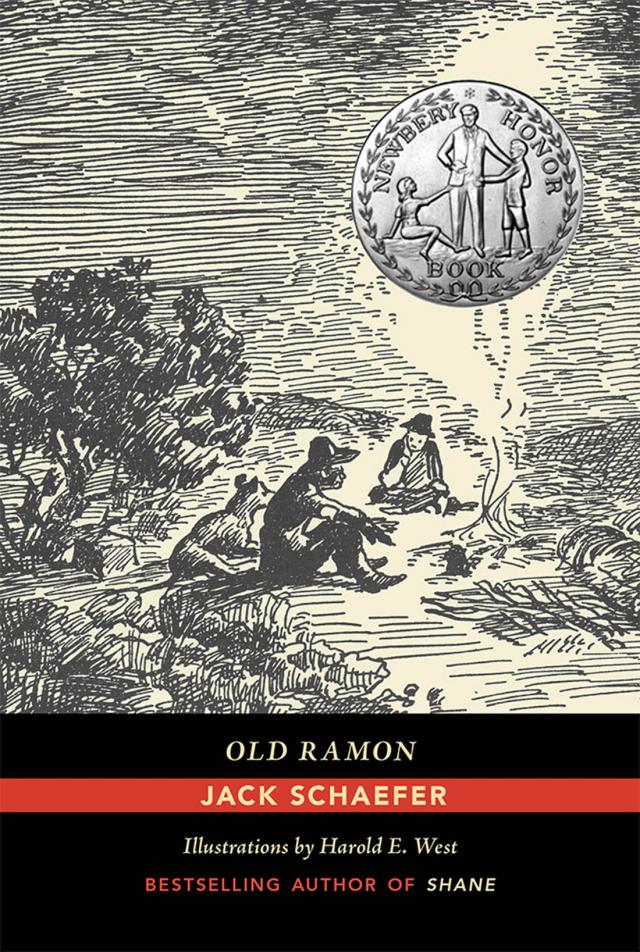
OLD RAMON
Also by Jack Schaefer
Shane
First Blood
The Big Range
The Canyon
Company of Cowards
The Kean Land and Other Stories
Monte Walsh
OLD RAMON
JACK SCHAEFER
Illustrations by Harold E. West
© 1960 by Jack Schaefer, renewed 1988 by Jack Schaefer
All rights reserved. University of New Mexico Press edition published 2016 by arrangement with the Jack Schaefer Trust
Illustrations reproduced by special arrangement with Jerry West (the estate of Harold West)
Printed in the United States of America
21 20 19 18 17 16 1 2 3 4 5 6
Library of Congress Cataloging-in-Publication Data
Names: Schaefer, Jack, 1907–1991, author. | West, Hal, 1902–1968, illustrator.
Title: Old Ramon / Jack Schaefer ; illustrated by Harold E. West.
Description: Albuquerque : University of New Mexico Press, 2016. | Originally published in Boston by Houghton Mifflin in 1960. | Summary: A wise old shepherd teaches a young boy lessons about survival, bravpery, wisdom, and friendship as he shows him how to care for a flock of sheep in the harsh Mojave Desert.
Identifiers: LCCN 2016019939 | ISBN 9780826357649 (pbk. : alk. paper) | ISBN 9780826357656 (electronic)
Subjects: | CYAC: Shepherds—Fiction. | California—Fiction.
Classification: LCC PZ7.S332 Ol 2016 | DDC [Fic]—dc23 LC record available at https://lccn.loc.gov/2016019939
Cover illustration: Harold E. West
Cover design by Catherine Leonardo
OLD RAMON
1
THERE IS no other animal so stupid as the sheep,” said Old Ramon. “No other. Not one.”
“There is the chicken,” said the boy.
“The chicken?” said Old Ramon. “Yes. The chicken is stupid also. But he is no animal. He is a bird.”
“The birds belong to the animal kingdom,” said the boy.
“And who put such foolishness in your young head?”
“It says that in a book at my school.”
“In a book.” Old Ramon hunched back farther into the thin shade of the stunted juniper behind him. He looked down at his work-knobbed hands. He examined the cracked nails of his blunt old fingers. “Then it must be so. But such book-talk means nothing to a man of my years. It is for you that you study the books. And when you are a man, and a grandfather, you will not speak words that a boy can make wrong.”
From high overhead in the clean blue of the sky the sun of early summer sent its golden light over the big land, searching out the shadows everywhere, filtering through the meager branches of the junipers. Old Ramon sat still, head low, and studied his work-knobbed hands, and the boy looked at him, at the big old head under its ancient cone-crowned wide-brimmed hat tied with a string beneath the chin, at the broad flat face with deep-sunk eyes looking downwards now and cheekbones strong under shrunken old skin and big nose bent sideways by some blow of the far-gone past and wide flat mouth notched askew at one corner by the scar of a long-ago knife cut.
“You are my book about the sheep,” said the boy.
Old Ramon picked slowly at grains of sand under a cracked nail. “And how is that? I am only an old man who cannot even read in a book.”
“You are a man who takes care of the sheep for my father as not one of the others can do. You lose no lambs. You bring in your flock fat and well fleeced. My father says it has been so since he was a boy and you took care of his father’s sheep.”
Old Ramon’s head rose. “My patrón says that?”
“He says it. He said to me: ‘You will go with Ramon for this season. You have had too much of the printed books. You will watch Ramon and learn. If he will talk to you, you will learn more.’”
Old Ramon looked off into sun-shimmered distance, toward the far greening foothills of the mountains. Silent, seeming motionless, the flock rested nearby in small bunches crowded into the thin shade of other junipers. Silent, motionless except for panting tongues, the two dogs lay in another patch of shade. Silent, motionless except for occasional switchings of its tail, the burro drowsed under its lashed packs close by another juniper.
“I am listening,” said the boy. “My ears are open.”
Old Ramon looked at the boy. The hard lines of his old face of a pirate, of a bandit, softened a little. “There is no other animal except, it must be, for the chicken that is so stupid as the sheep.” He leaned back, against the low branches, and his eyes closed as if he searched inward for the words. “As the sheep. Not the flock. The flock is stupid also but not in the same way. The sheep, one sheep, is like the finger of a man that has been cut off. The finger then is a nothing. But as a part of the man it is a something. It is a part of the something that is the man. And so with the sheep. One sheep is a nothing except as a part of the something that is the flock. . . . Always it is that you must hold the flock in your mind. Not this one sheep and that one sheep but the flock. . . . I cannot explain this to you as could a man who writes a book. But it is so. . . . One sheep does not think. He does this or he does that and there is no sense to it. But the flock thinks. And what the flock thinks each and every one sheep in the flock knows at once and all together. It is strange but it is so. . . .”
Slow moments moved and Old Ramon sat quiet, against the branches, and the boy sat quiet, cross-legged, in neighboring thin shade, and Old Ramon pushed out from the stunted juniper and rose to his feet. “Do you see? The flock is stirring. Not this one sheep or that one sheep. The flock. At once and all together. The flock knows that the hottest hour of the day has passed. The flock thinks now of moving, of finding food. Do you not see how it is itself shaping itself? . . . That is Theresa in the front and others follow her. She was with me last season and she is with me now because she is one that others follow. . . . That is Juanita to the side and others follow her. That is Maria to the other side and she has those who follow. But all in the same direction. In the direction of the flock. . . . It is only the part of one day that we have been out with these sheep and already they have shaped the flock. Each one sheep knows now his place. And always now it will be like this. The same ones will be in the front. The same last ones will be the last ones. And that is good. It is that now, if they act otherwise, we will know there is a wrongness somewhere we must find and make right.”
Old Ramon picked up his worn stick and leaned on it to watch the slow drifting movement of the flock. The boy stood beside him. The soft muted blethering of the sheep came to them, the ewes calling to their three-month lambs, the lambs blatting gently in the seeming sheer joy of life and movement, all of it the social humming of the flock. In their patch of shade the two dogs lay still but their heads were raised. The young black dog watched the moving sheep. The old brown dog watched Old Ramon.
“I do not understand,” said the boy. “How is it that you know that is Juanita?”
Old Ramon straightened a little in surprise. “Because it is Juanita and no other.”
“But they are all the same. Each one is like the others. The young ones that are still lambs and just starting their wool, they are smaller and move about more. But the old ones, they are all the same.”
“The same?” said Old Ramon. “But they are as different as — as the people. No. The people have more differences but the sheep have their differences also. I have not thought of this before but it is so. It is that a good pastor knows each and every sheep in his flock when he has been with them for some days and his dog knows also. I am not certain because I have not thought about this before but I think it is not any one thing about the one sheep. It is the allness of that sheep. It is the shape of him, the way he is fleshed, the way he moves, the way the wool grows, the setting of the ears, the hang of the tail, the looking about, the cropping of the browse. Not any one of these things but the allness of them. Ramon will know each and every one of these sheep in a few days. It is new to you. But by the time that we reach the hills, you will know many of this flock.”
Old Ramon leaned on his stick and the boy stood beside him and together they watched the flock. The young black dog rose and trotted over by the boy and nuzzled against him. The old brown dog lay still in the patch of shade, head up, and watched Old Ramon.
“Do you see? The flock thinks that the graze will grow better to the south where the ground falls away to the Arroyo Hondo. And the flock thinks right. But that is private range. We are journeying to the hills where there is also good graze, and free graze, and for many weeks. We must go west. But not true west. Not even Ramon and his Pedro can make a flock journey into the eye of the sun. We will go southwest until the sun hides behind the mountains and then we will turn toward the Ojo Frio by the red rocks for water and the night.”
Old Ramon looked toward the brown dog and nodded his head. The brown dog rose and trotted after the flock and the black dog saw the other moving and leaped forward, eager and anxious, and followed and bounded ahead and came back and followed and bounded ahead and came back and followed. Close behind the flock the brown dog stopped and looked back. Old Ramon raised his left arm outstretched shoulder high and swung it forward in a wide sweep, a wide gesture southwestward. The brown dog trotted ahead and to the left of the flock and swung in by the leaders and nudged against shoulders and nipped at flanks and pressed them toward the right and the black dog followed and bounded and barked and nipped.
Old Ramon leaned on his stick. “Gently, ge
Old Ramon motioned to the boy to take the lead rope of the burro. “Now we follow. Now the flock thinks that the direction we want it to go is the direction it has wanted to go. But it goes slowly. That is right because it must feed on what there is along the way. But it goes too slowly. For four days, perhaps it will be five, we must follow behind and push. Gently. Always gently. A flock must not be driven, must not be made to go fast, except in time of need. It is not like a herd of the horses or of the cows. To go fast unsettles the sheep so that they do not feed well even when the graze is good and they lose flesh. But a flock can be gently pushed and made to think that it wants what we desire that it wants. We will follow behind and push until we have passed the Jornada Seca, the dry place that is the journeying of a long day and into the night and where there is little graze and no water. After that we will go in the front. The flock will know that we are coming near to good pasture and will begin to hurry. Perhaps it will smell the good grass up in the hills. Perhaps it will be that Theresa and Juanita and Maria will remember from last season and what they know the flock will know at once and all together. But too much hurrying and there is not enough feeding along the way. We will go in the front and hold them from the hurrying. . . .”
2
OLD RAMON sat on his blanket that lay flat on the ground near the embers of the little fire. He leaned against the red rock that loomed behind him big and black in the dim starlit darkness. The old brown dog lay by his feet, a dark shape on the ground, with its muzzle stretched out on its forepaws toward the flock that lay bedded in a wide clotted grayish patch on the bush-dotted level beyond. Thirty feet away the spring trickled from the rock outcropping of the slope behind to meander down to the small pool where the flock had watered. The boy squatted by the spring and scrubbed four tin plates and two tin cups with handfuls of sand and rinsed them in the trickling water. The young black dog crouched beside him and watched every move.
The boy took the plates and the cups over by the fire and laid them on the ground. The black dog followed, close by his heels.
“I think,” said the boy, “that perhaps I am almost as good a washer of the dishes as someone else here is a preparer of the food.”
“There is the pan,” said Old Ramon. “And the coffeepot.”
The boy looked at him and quickly looked away and hurried to take the pan and the coffeepot from the other side of the fire and go to the spring again and the black dog followed, close by his heels.
The boy came again by the fire and set the pan and the pot on the ground by the plates and the cups.
“The place for such things is in their bag,” said Old Ramon.
The boy straightened and looked at him. “And why is that? We will have need for them in the morning.”
“Always one must put all things in their places,” said Old Ramon. “Then if there comes a need to move quickly, all is ready.”
The boy looked down and scuffed at the ground with one foot. Slowly he bent and gathered the things and went over by the packs on the ground near the picketed burro and stowed them in a faded empty flour sack. He took his blanket and came back by the fire and spread this on the ground. He sat on the blanket, cross-legged, and the black dog lay beside him and pushed its head into his lap.
“Yes,” said Old Ramon. “Yes. That has shaped itself also.”
“The dishes?” said the boy.
“No,” said Old Ramon. “Nothing of the dishes. It is of the dog. Yesterday that Sancho was my dog. He is by my cousin Romero’s Hugo out of Fidel Hernante’s Nicole. He came to me from that Fidel who has owed me the price of three sheep since the winter of the big snow when life was hard and there was little meat. Fidel brought him to me. ‘I have forgotten the sheep,’ I said to him. ‘And I have my Pedro.’ ‘I have not forgotten,’ he said to me. ‘I have no sheep and no money. I have only many children. But my Nicole she also has the children and here is one of them.’ What is a man to do when another man wishes to pay a debt for the easing of his own mind? . . . Ai, yesterday that Sancho was my dog. Even this morning he was my dog. And now this night he is your dog.”
“My dog?” said the boy.
“Of a certainty. He has decided that.”
“Do you mean my dog to keep?”
Old Ramon thumped a hand down on the blanket beside him. “Of a certainty. Ramon does not speak just to make words. What a good dog decides, a wise man accepts. . . .”
The embers of the fire faded and winked out one by one and the boy scratched the black dog’s head in his lap and gently pulled one of its ears. Old Ramon stirred on his blanket. “Pedro.” The brown dog raised its head and turned it to look at him. “Pedro. It is time. Go to the flock.” The brown dog rose and trotted off into the darkness. Old Ramon looked at the boy.
“Can he not stay here with me?” said the boy.
“His place is with the flock.”
Slowly the boy stood up. “Go, Sancho. Go to the flock.” The black dog started away and turned back and licked the boy’s hand.
Old Ramon thumped a fist on the blanket beside him. “You must make him go!”
The boy stepped back from the black dog. He stamped one foot on the ground. “Sancho! Go to the flock!” The black dog started away and stopped and looked back and whined softly and trotted off into the darkness.
Old Ramon slid himself down until he was stretched full length along his blanket. He pulled one edge over him and then the other. The boy stared into the darkness after the black dog. Slowly he lay down on his blanket and pulled the edges over him.
The boy shifted on the ground and wriggled inside his blanket. The voice of Old Ramon was muffled as it came from within his wrapping. “Ai, the ground is hard. But it is that it becomes more soft each night. . . .”
The boy had scrouged small hollows for his hips in the loose sand beneath his blanket. He lay still. The voice of Old Ramon came again. “I do not yet know if he will be a good sheep dog. But I think it is that already he is a good boy-dog. . . .”
3
THE FLOCK drifted forward in the warmth of midmorning sun. It browsed in slow shifting seeming uncertain movement as small bunches lagged and then spurted to overtake the others. Out on the two sides trotted the two dogs and stopped to sit on haunches with tongues panting and trotted forward again. And behind walked Old Ramon swinging his stick in rhythm with his long slow strides and beside him walked the boy leading the burro.
“I think,” said the boy, “that the tending of the sheep means a muchness of walking in the sun.”
“It means that,” said Old Ramon. “Always it is so on a journeying. But when we are in the hills there will be the shade of the bigger trees and the days of sitting still. Of Ramon sitting still and watching the sheep put on good flesh and grow good wool and thinking of the many years of his living. And I think that he will be watching a boy play boy-games with a dog. . . .”
The flock drifted forward and the ground sloped away in far gradual descent to a vague curving line of reddish willow brush-clumps and a few big cottonwoods.
“And now we must cross that little river,” said Old Ramon. “And we must have care. There is nothing that shows the stupidness of the sheep and of the flock like the water. I have known a flock that went almost mad with the thirst because it would not drink from a pool, the one pool for many miles around, and good water, that a strange flock had visited and left there its smell. And yet at another pool that another strange flock had visited it might drink with no noticing. I have heard of flocks that lost many dead sheep because they broke away and could not be stopped and ran to water that everyone knows is bad. And when one must cross the water — ai, then there is no knowing. Perhaps the flock will cross as if it is a nothing, a little splashing in the water and that is all. Perhaps it will refuse and turn back and make the trouble. There is a good crossing here, not wide but good, where the water is not too fast and not too deep. But there is no knowing. . . .”