Scorpion, p.1
Scorpion, page 1


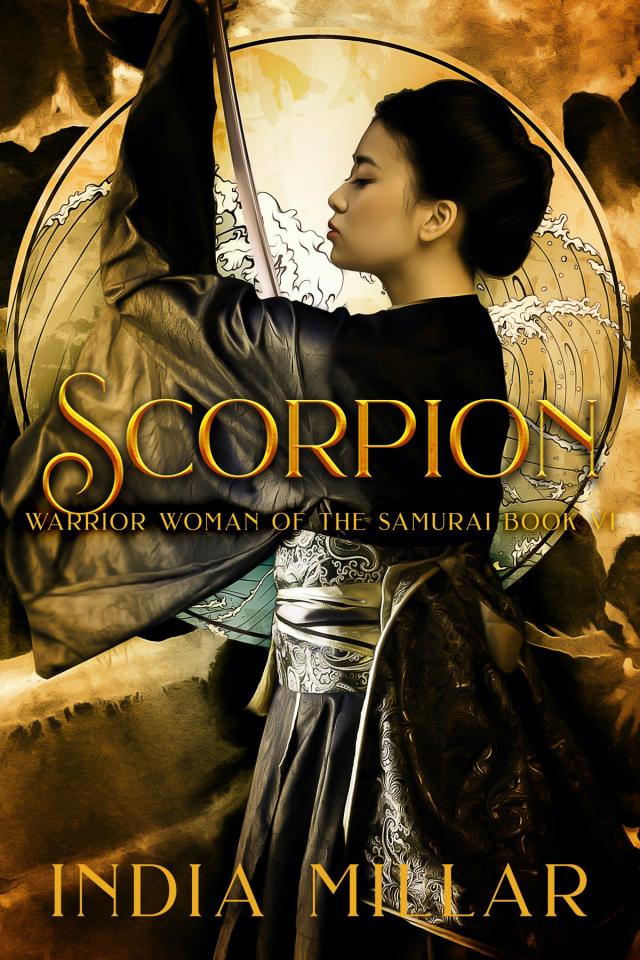
Scorpion
Warrior Woman of the Samurai Book Six
India Millar
Red Empress Publishing
www.RedEmpressPublishing.com
* * *
Copyright © India Millar
www.IndiaMillar.co.uk
* * *
Cover Design by Cherith Vaughan
www.CoversbyCherith.com
* * *
All rights reserved. No part of this publication may be reproduced, stored in a retrieval system, or transmitted in any form or by any means, electronic, mechanical, photocopying, recoding, or otherwise, without the prior written consent of the author.
Contents
Also by India Millar
Preface
Prologue
One
Two
Three
Four
Five
Six
Seven
Eight
Nine
Ten
Eleven
Twelve
Thirteen
Fourteen
Fifteen
Sixteen
Seventeen
Eighteen
Nineteen
Twenty
Twenty-One
Twenty-Two
Twenty-Three
Twenty-Four
Twenty-Five
Twenty-Six
Twenty-Seven
Twenty-Eight
Twenty-Nine
Thirty
Thirty-One
Thirty-Two
Thirty-Three
Thirty-Four
Cricket
About the Author
About the Publisher
Also by India Millar
Secrets from the Hidden House
The Geisha with the Green Eyes
The Geisha Who Could Feel No Pain
The Dragon Geisha
The Geisha Who Ran Away
The Song of the Wild Geese
The Red Thread of Fate
This World is Ours
Warrior Woman of the Samurai
Firefly
Mantis
Chameleon
Spider
Dragonfly
Scorpion
Cricket
Moth
Haiku Collections
Dreams from the Hidden House
Song of the Samurai
This book is humbly dedicated to Baizenten, the Japanese Goddess of Writers and Geisha. May both you and she enjoy the words written herein!
Preface
Though the sex to which I belong is considered weak you will nevertheless find me a rock that bends to no wind.
Queen Elizabeth I of England, 1558—1603
Prologue
When it comes to religion, Japan is a tolerant nation. Some worship Buddha, some prefer to follow Taoism, and many more are Shinto. Because of this, Japan is a land of many gods. In particular, if your choice of religion is Shinto, you may worship major gods alongside smaller, more intimate beings. In Shinto, all divine beings are all called kami, or holy powers.
Take Uzume, for instance. She is the goddess of the dawn and also revelry. Why this combination? Why not? For surely it is fitting to be delighted that one is alive to greet the new dawn.
And the opposite of Uzume? Perhaps this is Hachiman, the god of war, and also the guardian of Japan and her people. Oddly, Hachiman’s symbol is the dove, which elsewhere in the world the symbol of peace.
But there are also less important kami, those that concern themselves with the human condition at a lower level than daily renewal and strife. Take Okuninushi, the god of farming, business, and medicine. All good, sensible causes, to be sure. And how comforting to be able to seek the help of a god whose name you know when you swallow the nastiest of medicines.
But impressive as these deities are, they have little place in this story. In that case, you may be asking yourself why I have mentioned them at all. Well, it does nobody any good to turn their back on a kami. And who knows? The day may come when I have need of Uzume or Okuninushi or even Hachiman. In that case, I hope they will remember my grateful mention of them here.
If you have siblings, then you will understand when I explain that the gods who are important to this story are a sister and brother. And that it is the quarrel between them that causes so much sorrow in the lives of those who live and love on these pages. They are Amaterasu, who is the goddess of the sun, and her brother, Susanoo, who is god of the sea.
Like all siblings, Susanoo and Amaterasu had a falling out. The blame must attach to Susanoo, for he proposed a challenge to his sister. When she won, like the spoiled brat Susanoo surely was, he went on an angry rampage, destroying much of the earth in his fury. Because of his actions, Susanoo was banished from heaven by the elder gods.
To escape her brother’s anger, Amaterasu was forced to seek refuge in a remote rock cave, plunging the earth into darkness and chaos. After many long years, she was lured from her hiding place, and it is said that the sister and brother were eventually reconciled. I find it difficult to believe that Susanoo ever really forgave his sister, even though the fault was his in the first place. And would any woman really be able to forgive and forget a petty act of jealousy that resulted in her being banished from all she loved for so very long?
Like most sibling quarrels, others who are not directly involved also suffered. Surely, if resentment remains unresolved between sister and brother, then those who side with one or the other will find themselves in the middle of a deadly conflict without realizing their mistake…until it is far too late to do anything about it.
One
If it pleases you,
I will show the nape of my
Neck to you alone
I had blood on my hands.
Not a small amount, as if I had cut myself accidentally. Rather, my hands were so bloody it seemed as if they had been coated thoroughly in that particularly garish red color that is used to pick out details on the most important temples. All at once, my precious katana felt very heavy in my hands. I was grasping it firmly in the classic two-handed grip that ensures accuracy and makes it unlikely that the warrior who is wielding the sword will lose control of it in the heat of battle. I stared at in dismay. Not only were my hands bloody, the hilt and blade of my sword were stained an ugly, streaky red.
“Captain, you have taken no injury?”
My first mate, Reo, was hovering at my side. He was staring anxiously at me and I realized that it was not only my hands that were bloody, but the front of my robe was splashed from hem to neck.
“Not a scratch,” I replied lightly. I rolled my neck to ease the tension. Suddenly, I was inappropriately elated. The feeling was out of my control. It was the excitement that always follows battle and was made up of a number of things. Pleasure that we had triumphed. Relief that we were alive and would live to fight another day. “Reo, a bowl of water, if you please?”
Like a well-trained dog, Reo was unwilling to leave my side. He snapped an order to another sailor, and in moments I had my bowl of clean water. I could tell from the slight discoloration and the briny tang that it was seawater, but it didn’t matter. The sailor had been right to bring me seawater—why waste precious fresh water on washing? Reo took the bowl in his hands and held it out to me almost like an offering. Ignoring my bloody hands, I dipped my katana in it carefully, swilling water over the hilt and allowing it to trickle down the blade until I was satisfied the sword was clean. I held it up to the sun and rejoiced in the gleam of the jewel steel.
Unwilling to touch it with my stained hands, I grasped the katana carefully with my sleeves and turned to Reo, nodding at him to take it from me. He whitened, the color leaving his face so that his skin appeared the color of bone beneath his deep tan.
“Take it,” I commanded. “I have asked you to hold it. My katana will obey my instructions. It will not hurt you.”
Still, he trembled as the ancient weapon balanced carefully across his outstretched forearms. He frowned with concentration as he held the bowl of water in his hands at the same time, taking great care not to dislodge the katana from its precarious perch.
From time to time, he glanced at me as if to ask if he was holding it with sufficient care. I had no doubt that he was and concentrated on washing my hands and wrists. My robe was ruined. No matter how carefully it was washed, the stains would never come out. It would have to be discarded. No matter. I had other robes. And in truth, I would never have worn this one again. The memories it would have aroused would have made wearing it a penance rather than a pleasure.
“You are finished, captain?” Reo asked. I nodded and there was a moment of confusion as he tried to put the bowl down and hold on to my katana at the same time. I took pity on him and took the katana from his grip, sliding it into the saya lodged in my obi. I felt his relief that it had been taken from him.
My first battle as a wokou. And I—we—had won. I spared a heartbeat to thank Susanoo, the sea god, for taking our side. And then another, far longer and more heartfelt to pay tribute to the spirit of my dead lover, who had been captain of this pirate ship only hours before. But the time for contemplation and thanks was very brief. The need for action was upon me. I was fortunate. Although I was still a complete novice when it came to being in charge of a band of pirates, I had a thousand years of samurai tradition to guide me when it came to leading men.
Because of that tradition, my response to what needed to be done was instinctive. The samurai code of bushido had been instilled into me when I had become onna-bugeisha, a warrior woman of the samurai. The code orders the life of all samurai, and it leaves no room for argument. If a warrior follows the code of bushido, then he—or she—must always be aware that loyalty, courage, truth, compassion, mercy, and, above all, honor are paramount. So the welfare of my men was of the first importance to me, and my first care was for those who had fought with me and had been willing to give their lives unhesitatingly for me.
My question to my first mate was direct and simple. “Reo, do we have any dead?”
“Yes, Captain. Apart from Captain Fuma, Koji is dead, and one more. A few more have taken wounds, but all the gods be thanked, nothing that will not heal.”
“And the men from the militia ship?”
“They took heavy losses, but some of them are still alive. Do you want them to be finished off now? Mercifully, of course.” Reo made wringing motions with his hands, as if he was strangling a chicken. I stared at him stonily and shook my head.
“No. They are to be unharmed.”
“But they killed Captain Fuma!” he protested.
“I don’t need reminding of that, Reo,” I said icily. “We keep them as prisoners for the moment.”
Reo stared at me, his jaw dropping in horrified disbelief. “Prisoners? What do we want with prisoners? They’re nothing but trouble. They will eat our food and kill us in our sleep if they escape. Kill them off and feed them to the fish. That’s the wokou way. They would have done the same to us if we’d lost.”
He was wrong about that. Had we lost, the survivors would have been kept alive and made to stand trial with suitable ceremony. We would, of course, have been found guilty. The authorities would have delighted in giving us a public execution to remind everybody that they carried the power of the shogun behind them and were not to be disobeyed. If they discovered my true identity, they might have allowed me to commit seppuku, but I doubted it. For an infamous ronin such as me to die the death of a commoner would have been both deeply dishonorable for me and a real warning to others in my position.
“I hear you, Reo, but they are not to be harmed.”
“Captain, you don’t understand. They’re a terrible risk. I suppose we might get some return for them if we sell them as slaves, but even then, I don’t think it’s worth it.”
“We’re not selling them as slaves,” I said firmly. “And we’re not killing them. We’ll keep them on board and then dump them on land well away from any town. By the time they make contact with anybody, we’ll be long gone.”
Reo stared at me as if I was mad. “Leave them? Alive? But they’ll go straight to the authorities and tell them what happened. If we kill them, the authorities will think their ship foundered and there are no survivors. If we let them live, they’ll tell how we beat them, murdered their comrades, and then fired their ship. They’ll be able to identify us and our vessel. It’s far too dangerous.”
His eyes were bulging with the effort of trying to convince me. I sat quietly, waiting for him to stop. The problem was, I knew he was right. The militia’s captain had died in the battle—fortunately for both of us since if he had lived, I would have felt obligated to offer him the chance to commit seppuku. An honorable death, but tradition dictated that somebody known as a kaishakunin—a skilled swordsman—would hasten his death by decapitating him after he had made the ritual deep cut to his torso himself. I doubted any of his crew would have the necessary skill, so the role would have fallen to me. I would have done it, if I had had to, but I was happier to know there was no need.
Reo’s mouth was opening and closing silently as he sought for some way to convince me. I raised my hand to quell him before he could speak.
“I’m surprised at you, Reo. I never took you for a bloodthirsty sort of man.” Reo’s lower lip jutted. He looked exactly like a child who has been scolded unjustly. “When Fuma was your captain, did he instruct you to kill without need?”
“No,” Reo said. “But he never told us not to kill either. In any event, we’ve never had any prisoners to take. It was always us or them, and we made sure it wasn’t us. And I’m not being bloodthirsty about it,” he added sulkily. “These men are militia. They’re a terrible danger to us. When they report back to their masters, they’ll be sure to pass on details of our ship, and they’ll give the authorities descriptions of us as well. It’s not that I fancy the idea of killing in cold blood, but this lot are too dangerous to leave alive.”
This was getting us nowhere. I could command that Reo take the men prisoner, and he would pass the order on to the rest of the crew. But if I did, they would mutter amongst themselves and wonder if it was truly a good idea to have a woman as their captain, a woman who had already shown she was soft when it mattered. I understood that well enough. After all, it was their lives I was risking. I spoke slowly, praying the right words would come to me. Just as Reo was averse to killing in cold blood, I had my reasons for not wanting our prisoners dead.
I knew that Fuma had given instructions that men were not to be killed outside of the heat of battle. Fuma had been born a daimyo, the class of noble that ranks directly beneath the shogun. He would adhere to the code of bushido before anything else, and the code was clear on such matters. One honored fallen enemies. One did not kill them simply because it was inconvenient to keep them alive. In life, he had been not just my lover but also my superior, and I owed him obedience in everything. To my mind, that meant I must honor him in death as I had honored him in life.
Just as Fuma would have preferred death to living with dishonor, so would I. But I doubted I would ever be able to explain that to Reo. So I would lie to him, at least for as long as it took him to agree to what I wanted to do. I was not happy to lie to a comrade, but that was surely better than slaughtering my enemies needlessly. I could live with a lie for a good cause. I could not live with murdering men who had done no more than their duty in cold blood.
“I understand your concerns, Reo,” I said carefully. “But I assure you, I have my reasons for my actions. You know that shortly before he died, Fuma took me to visit Amaterasu’s shrine at Shima?”
Reo nodded. His expression was bewildered at this apparent change of tack. “I remember that, Captain. But I don’t see what it’s got to do with not getting rid of the prisoners,” he said stubbornly.
“I was interested in seeing the goddess’s greatest shrine. But my main object in visiting her was to ask the sun goddess to speak kindly to her brother, Susanoo, on our behalf.”
“The god of the sea.” Reo nodded approvingly. I smiled and made sure my body was relaxed and my tone even. Up until that point, I had told him nothing but the truth. From now on, everything I said would be a lie.
The visit to the shrine had taken place. My lover, Fuma, had been horrified when I told him I had spoken to the goddess woman-to-woman and had asked her for nothing but for her to intercede with Susanoo for us. I had been amused by Fuma’s superstitious fears at first, even when he had explained earnestly to me how—just like many human siblings—Susanoo and Amaterasu had quarreled fiercely. Even when they were reconciled, there was still jealousy and suspicion between them. He was certain that the sun goddess would be deeply offended by what she would see as my disrespect to her. I had soothed his fears, but it had come to pass that he was right to be afraid.