

Empire, p.1
Empire, page 1


Scanned by Highroller.
Proofed more or less by Highroller.
Made prettier by use of EBook Design Group Stylesheet.
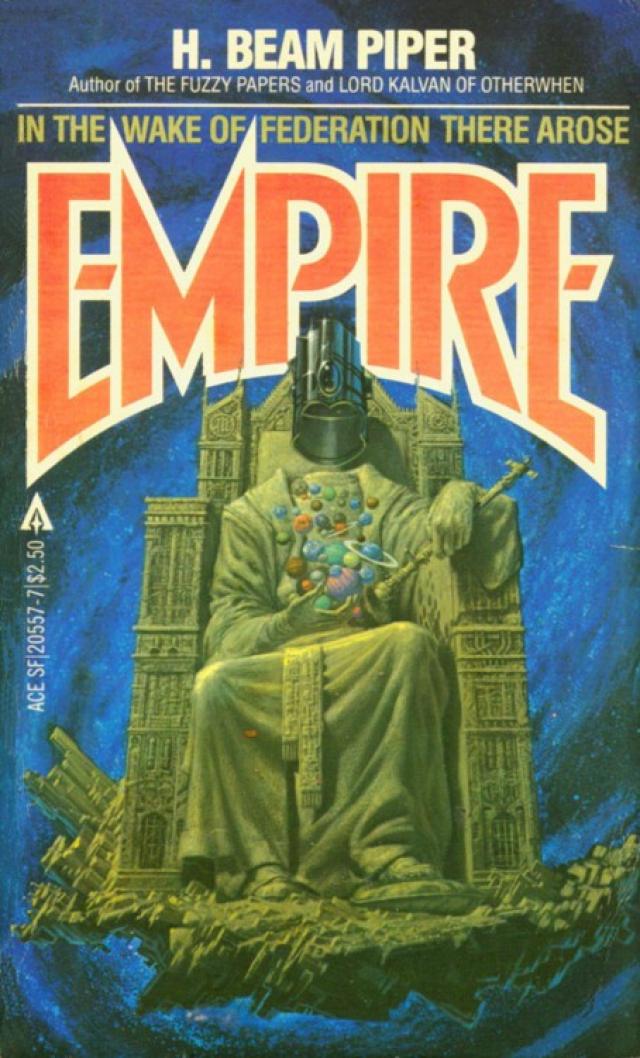
"Empire" a story collection written by H. Beam Piper.
TERRO-HUMAN FUTURE HISTORY CHRONOLOGY
* (The following dates are approximations suggested by data in H. Beam Piper's short stories and novels.)
(1942)1 A.E. Year One of the Atomic Era, which begins when the first atomic pile goes into operation under the direction of Enrico Fermi at the University of Chicago.
The first unmanned rocket, the Kilroy, is launched.
The first Lunar base is completed.
The Thirty Days War; the First Terran Federation is formed.
The First Mars Expedition.
Contragravity is developed.
The Mars Colony is established.
The first colony on Venus is started.
The first interstellar expedition.
Venus secedes from the Terran Federation.
The First Terran Federation is dissolved and the Second Terran Federation is established.
The Uller Uprising, a revolt against the Federation by the natives of Uller.
The Chartered Fenris Company goes bust.
The Gartner Trisystem is settled.
Zarathustra is found and colonized.
Foxx Travis is born.
Native revolt on Kwann.
Aditya is discovered.
—854 The System States War, starts when the System States Alliance tries to break away from Federation control.
Ten thousand refugees from Abigor flee with the remnants of the System States Navy to found a new civilization. They colonize Excalibur, the first Sword-World.
Merlin, the great Federation battle computer is located on Poictesme.
—1399 The Interstellar Wars, a series of revolts and wars that lead to the collapse of the Terran Federation.
Aditya is occupied by Morglay.
Skathi is deserted by the Space Vikings.
Six Space Viking ships from Haulteclere raid Aton; four of their ships are destroyed and two others limp home. After this failure the Space Vikings no longer raid civilized worlds.
During a war between Aton and Baldur, the Planetary Nationalist Party on Aton takes power and forms a dictatorship.
The Nemesis spaceship is built and Lucas Trask leaves Gram for Tanith in the Old Federation.
The Battle of Audhumla
Omfray of Glaspyth, with a fleet of eight Space Viking ships, lands on Gram.
The Battle of Marduk.
King Steven IV becomes the first Galactic Emperor.
The Sword-Worlds are added to the Empire.
Emperor Paul II begins building the Imperial palace on Odin.
Rodrik VI completes the consolidation of the First Galactic Empire.
Paul XXII tries to move the Empire out of its complacent rut.
INTRODUCTION John F. Carr
EX-BEATLE JOHN LENNON IS SHOT TO DEATH IN NEW YORK reads the headline of the Los Angeles Times as I write this article. Hundreds of distraught fans are already gathering at the famed Dakota Building where John Lennon lived and died. Thousands of flowers drape the fence. Tower Records of Hollywood announces they've sold over a thousand copies of Lennon's new, last, record, "Double Fantasy," in less than ten hours. Radio stations across the dial are playing Lennon's songs and Beatle retrospectives.
I think of James Dean, Jim Morrison, Dylan Thomas, Stanley G. Weinbaum, Marilyn Monroe, John F. Kennedy, Martin Luther King, Cordwainer Smith, Brian Jones—H. Beam Piper.
There's very little other than death that gives these people anything in common; a premature death that robbed them of future success and us of the special talents that might have enriched us all. What they all left us was a terrible sense of loss—within the science fiction community, the rock music community, the literary community, and occasionally the entire human family.
At the time of his death, H. Beam Piper was writing at the top of his form and certainly with the best of his contemporaries. "Omnilingual."
"Gunpowder God," Little Fuzzy, The Cosmic Computer, Space Viking: these were the products of Piper's last five years. When he died, Piper was working on a major historical novel, Only the Arquebus, had recently completed the third, and now lost, "Fuzzy" novel, and was finishing a new Empire novelet. We can only imagine what Piper, free of debts and worries, might have accomplished during the next ten or twenty years. Jerry Pournelle believes that had Beam lived, he would have been elevated to the top ranks of the science fiction pantheon.
But we will never know, and that is the greatest tragedy of all. Piper's death, by his own hand, because he wrongly believed his career was finished, brought everything to a premature end. Because of problems over the estate, it also kept much of his early work out of print for some time.
For over twenty years Piper's short stories have remained forgotten in past issues of musty old science fiction pulps. Other than an occasional anthology appearance, few of Piper's short stories have ever appeared in book form. But now, thanks to Ace Books, the best of them are being reissued in thematic collections like this one. Now together for the first time in Empire are the stories that describe and define the First Galactic Empire and the later times of the Terro-Human Future History.
* * *
H. Beam Piper is best known to sf readers for his Fuzzy books and to fans for his Paratime stories, but it is his Terro-Human Future History that is his greatest and most imaginative gift. Robert A. Heinlein may or may not have created the first future history series in science fiction, but he certainly gave it its modern definition and legitimacy. Isaac Asimov and Poul Anderson soon followed with their own unique contributions. Not far behind was H. Beam Piper. The Terro-Human Future History may not have the evolutionary synthesis of Gordon R. Dickson's Childe Cycle or the breadth of Anderson's Polesotechnic League and Terran Empire, but Piper's history of the future has a historian's attention to sociological and political detail that is unsurpassed.
As related by Jerry Pournelle, Piper's original plan had been to do a story per century throughout the first several thousand years of the Terro-Human Future History. Even had he lived another twenty years it is doubtful that he would have accomplished this goal. The demand for sequels to the Fuzzy books and Space Viking made it improbable. Yet, we are all the poorer for his not having had the time to try.
The Terran Federation itself is well mapped out by Four-Day Planet, Uller Uprising, Little Fuzzy, Fuzzy Sapiens, The Cosmic Computer, and half-a-dozen short stories; however, only one novel, Space Viking, and three short stories exist to describe the next four or five thousand years. Furthermore, since Space Viking takes place several hundred years before the First Galactic Empire, there are some large holes indeed.
"A Slave is a Slave" occurs during the consolidation of the First Empire and does illuminate some imperial policy; however, it leaves us with many questions about where the Empire began and how it rose to power. "Ministry of Disturbance" takes place some eight hundred years later when the Empire is at peace and suffering from stagnation. It sheds some light on a few of the previous Emperors, their reigns, and the state of the once mighty Sword-Worlds, but again provides us with nothing concerning the genesis of the Empire.
In order to learn more about the origins of the First Empire we have to look back at the Federation and its fall. In The Cosmic Computer, Piper's major late Federation story, we find the Federation in retrenchment. It is no longer expanding and the economy is deteriorating. Although Piper never makes this explicit, it appears that some sense of common purpose and unity was lost during the System States War, an economic war as brutal as the War Between the States. Part of the reason is that Merlin—the super battle-computer that directed the Federation's strategy during the war—had predicted the breakup of the Federation at the end of the war. "…the strain of that conflict [the System States War] had started an irreversible breakup. Two centuries for the Federation as such; at most, another century of irregular trade and occasional war between independent planets, in a Galaxy full of human-populated planets as poor as Poictesme at its worst."
The leaders of Poictesme, the world where Merlin has remained hidden since the war, learn of this prophecy when they locate Merlin. They ask Merlin's advice on how to stop the coming dark age; the computer gives them the Merlin Plan, a step by step blueprint on how to save Poictesme from the breakup of the Federation and then begin a revival of civilization. The mystery here is that there is no further mention of Poictesme or Merlin or the Merlin Plan in any of the novels or short stories that follow The Cosmic Computer.
In Space Viking we learn that the Interstellar Wars arrived just about the time Merlin predicted, as did the breakup of the Federation. Both books were written at about the same time; The Cosmic Computer was published in 1963, while Space Viking was serialized in Analog starting in Nov. 1962. Yet, there is nothing in Space Viking that gives any indication that Merlin or Poictesme had any effect at all in the rebirth of civilization. Unfortunately, Piper never wrote any stories that bridge these two novels, leaving a seven-hundred-year gap that includes the fall of the Federation and rise of Neobarbarism.
At the time of Space Viking, the fall of civilization is almost complete; only a few worlds such as Marduk, Aton, Baldur, and Odin have retained some degree of Federation culture and interstellar spaceflight. Most of the former Federation planets have regressed to a more primitive state, anywhere from nuclear-power-using civilizations all the way down to the Old Stone Age. Most of these worl ds have political and social structures resembling ones out of Terra's past (unsurprising, since one of Piper's major themes throughout the Terro-Human Future History is that the future repeats the past). Li "The Edge of the Knife" Piper has his history professor say: "There were so few things, in the history of the past, which did not have their counterparts in the future." In Space Viking, as the title indicates, this theme is played over and over again.
The Sword-Worlds do not suffer from the Federation's fall as they are separated from the Federation by culture as well as distance. The Sword-Worlds were settled by refugees from the System States. "Ten thousand men and women on Abigor, refusing to surrender, had taken the remnant of the System States Alliance navy to space, seeking a world the Federation had never heard of and wouldn't find for a long time. That had been the world they had called Excalibur. From it, their grandchildren had colonized Joyeuse and Durendal and Flamberge; Haulteclere had been colonized in the next generation from Joyeuse, and Gram from Haulteclere." Sword-World civilization continues to flourish until a ship from Morglay returns from the Old Federation to tell what has been going on there since the System States War.
The Space Vikings have a hybrid civilization, a mixture of high technology and feudalism. Sword-World men are expected to fight for their freedoms and keep careful rein on those who lead them. When talking to the Mardukan court, Lucas Trask—Prince of Tanith and former Space Viking—describes their political system: "Well, we don't use the word government very much… We talk a lot about authority and sovereignty, and I'm afraid we burn entirely too much powder over it, but government always seems to us like sovereignty interfering in matters that don't concern it. As long as sovereignty maintains a reasonable semblance of good public order and makes the more serious forms of crime fairly hazardous for the criminals, we're satisfied."
Sword-World civilization, by the time of Space Viking, is already on the decline; far too many trained and needed men are being drawn to the Federation for plunder and are then staying. When the Space Vikings do return home, their ships are loaded with stolen goods which can be sold at discounted prices unfairly competing with Sword-World-made products. The result is unemployment and runaway inflation which ruin the local economy. Historically, the same thing happened in Spain after the discovery of the New World; galleons brought load after load of Inca and Aztec gold and silver into the country, driving local artisans out of business and devaluing the currency. The final result was a rigid and unsympathetic aristocracy and a lower class locked into subjugation. "Nothing on Gram, nothing on any of the Sword-Worlds was done as efficiently as three centuries ago. The whole level of Sword-World life was sinking, like the east coastline of this continent, so slowly as to be evident only from the records and monuments of the past."
By the end of Space Viking, Lucas Trask has given up hope that civilization will be rekindled by the Space Vikings. "Sooner or later, civilization in the Old Federation would drive them [the Space Vikings] home to loot the planets that had sent them out." The dynastic wars that will bring an end to Sword-World pre-eminence have already begun, some generations ago. Another is about to begin on Gram, Trask's home world.
Trask, however, has a dream of his own—the League of Civilized Worlds. The League will start as a series of treaties and trade alliances with Tanith's neighbors, one that will grow until it pushes back the long night of ignorance and savagery. But, like Poictesme and Merlin, Trask and his League of Civilized Worlds slip into the murky waters of Piper's future history and are never mentioned again.
If the League of Civilized Worlds is not the seed from which the Empire springs, where does it come from? In a "Slave is a Slave" the planet Odin is identified as the Imperial capital. While Odin is briefly mentioned in Four-Day Planet and Space Viking, there is no indication that it will one day become the capital of the First Empire.
Later in "A Slave is a Slave" we read: "He showed them planet after planet—Marduk, where the Empire had begun…" Space Viking is the only novel in which Marduk figures predominantly; there it is described as one of the few
civilized worlds. Marduk, population two billion, never passes through a period of decline or barbarism after the fall of the Federation. At the time of Space Viking, Marduk has a British-style monarchy and prime minister with a fairly powerful aristocracy. Although Marduk has about a dozen colonies and client worlds, she shows no sign of becoming the start of the First Empire. Near the end of the book there is a Hitler-type take over of the government; most of the royal family is forced to flee or is murdered. A few escape to Tanith. There Lucas Trask recruits a large space navy and returns to Marduk to free her from the tyranny of Zaspar Mekann and Andray Dunnan.
Simon Bentrik, member of the royal family and friend of Lucas Trask, looks as though he will be the regent for Princess Myrna, who is still a child. Bentrik's son, Steven—a natural leader even as a boy—is her escort when Marduk is reoccupied. Trask advises his father: "You know, the girl will be Queen in a few years, if she isn't now. Queens need Prince Consorts. Your son's a good boy; I liked him the first moment I saw him, and I've liked him better ever since. He'd be a good man on the Throne beside Queen Myrna."
Simon Bentrik doesn't take to Trask's idea right away, but it's obvious that Lucas means to press it. It's in "Ministry of Disturbance" that we learn that it is Steven IV (almost certainly the great-grandson of Steven Bentrik) who is the Emperor who proclaimed Odin the Imperial Planet. The irony here, of course, is that Lucas Trask, by convincing Simon to help his son to the throne of Marduk, has undone his own dream of the League of Civilized Worlds before it even had a chance to begin.
But why did Steven IV move the capital from Marduk to Odin, when both are major worlds? The most likely answer is that Odin is much closer to Terra and the other major civilized worlds. We know Marduk is close to the frontier of the Old Federation; it is only five hundred light-years from Tanith, which was one of the last planets to be colonized by the Federation. In Four-Day Planet we learn about a Terra-Odin-Baldur interstellar milk run, which places Odin close to the center of human worlds. It certainly wouldn't be the first time in history that a capital was moved for political or economic reasons; Alexander the Great moved his capital from Macedonia to Persia for similar reasons.
We can only piece together the details of how the Empire began and the date when the Mardukan King became Emperor. Piper does give us a few clues; in "Ministry of Disturbance" we learn that a thousand years before, "the Empire was blazing into being out of the long night of hammering back the Neobarbarians from world to world." Some two hundred years later the Empire was consolidated by Rodrick VI. "A Slave is a Slave" takes place while the Empire was still expanding under the reign of Rodrick HI.
When the Imperial expeditionary force, a seven ship battle-line unit, reaches Aditya, it's obvious they mean to bring Aditya into the Empire either peacefully or feet first. The Empire may appear benevolent on the surface, but its policies are stamped with hobnailed boots: "The Galaxy is not big enough for any competition of sovereignty. There must be one and only one completely sovereign power. The Terran Federation was once such a power. It failed and vanished, you know what followed. Darkness and anarchy. We are clawing our way up out of that darkness. We will not fail. We will create a peaceful and unified Galaxy." The Empire has learned from the errors of the long gone Federation and is determined not to repeat its mistakes. "…I think your constitution (for Aditya)… will be nothing short of political disaster, but it will insure some political stability, which is all that matters from the Imperial point of view. An Empire statesman must always guard against sympathizing with local factions and interests…"
Yet, despite all its power and resolve, the First Galactic Empire comes crashing down just as the Terran Federation before it. In "The Edge of the Knife" the professor who "sees" into the future has this revelation about the First Empire: "He was struck by the parallel between the buccaneers of the West Indies and the space-pirates in the days of the dissolution of the First Galactic Empire…" Piper, like Arnold Toynbee—the great British historian who wrote A STUDY OF HISTORY—saw history as a cyclical process, civilizations growing Phoenix-like out of the ashes of previous ones. Later in "The Edge of the Knife" the professor says, "History follows certain patterns. I'm not a Toynbean, by any matter of means, but any historian can see that certain forces generally tend to produce similar effects." Piper also incorporated Toynbee's phases of history; Toynbee's universal state is found in Piper's Terran Federation; at the end of The Cosmic Computer the Federation is entering a time of troubles; and in Space Viking we see the interregnum before the emergence of the First Galactic Empire.






