Ruby falls, p.1
Ruby Falls, page 1


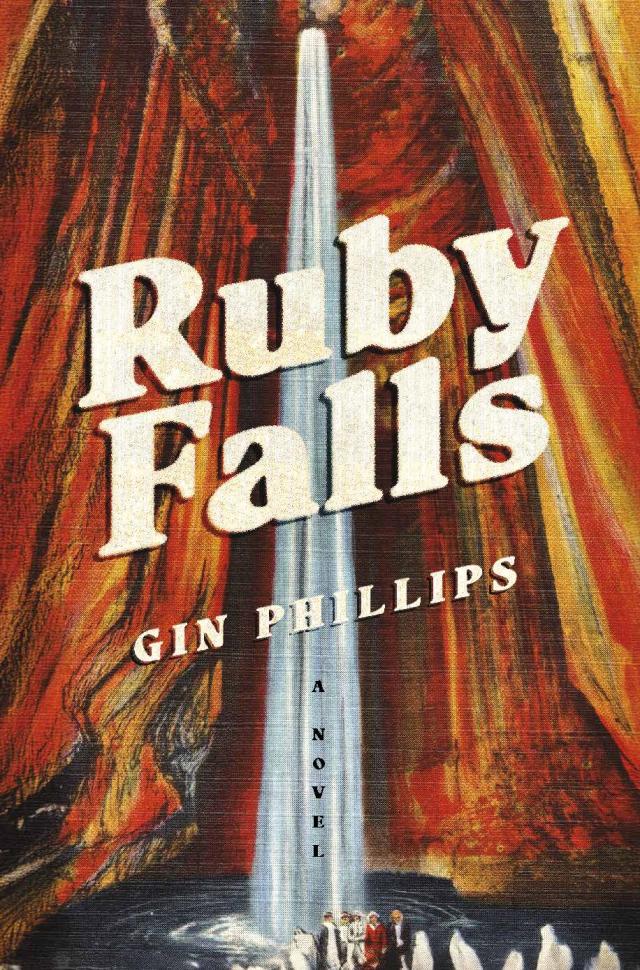
Ruby
Falls
Also by Gin Phillips
The Well and the Mine
Come In and Cover Me
Fierce Kingdom
Family Law
Ruby
Falls
GIN PHILLIPS
Atlantic Crime
New York
Copyright © 2026 by Gin Phillips
Jacket design by Eric Fuentecilla
Jacket artwork from Digital Commonwealth (Public Domain)
All rights reserved. No part of this book may be reproduced in any form or by any electronic or mechanical means, including information storage and retrieval systems, without permission in writing from the publisher, except by a reviewer, who may quote brief passages in a review. Scanning, uploading, and electronic distribution of this book or the facilitation of such without the permission of the publisher is prohibited. Please purchase only authorized electronic editions, and do not participate in or encourage electronic piracy of copyrighted materials. Your support of the author’s rights is appreciated. Any member of educational institutions wishing to photocopy part or all of the work for classroom use, or anthology, should send inquiries to Grove Atlantic, 154 West 14th Street, New York, NY 10011 or permissions@groveatlantic.com.
This novel is entirely a work of fiction. The names, characters and incidents portrayed in it are the work of the author’s imagination. Any resemblance to actual persons, living or dead, events or localities, is entirely coincidental.
Any use of this publication to train generative artificial intelligence (“AI”) technologies is expressly prohibited. The author and publisher reserve all rights to license uses of this work for generative AI training and development of machine learning language models.
FIRST EDITION
Printed in the United States of America
This book is set in 11.5-pt. Scala Pro by Alpha Design and Composition of Pittsfield, NH.
First Grove Atlantic hardcover edition: March 2026
Library of Congress Cataloging-in-Publication data is available for this title.
ISBN 978-0-8021-6692-0
eISBN 978-0-8021-6693-7
Atlantic Crime
an imprint of Grove Atlantic
154 West 14th Street
New York, NY 10011
Distributed by Publishers Group West
groveatlantic.com
To Mary Ella Marshall, who never stopped going full throttle on rope swings, hunting for snakes, and playing in the mud. She taught me that grown women can have as much fun as they want.
And to all the women throughout the centuries whose lives were one long series of gifts given—meals cooked, homes created, loved ones cared for—whose names weren’t recorded by waterfalls or billboards or history books.
The gray bat skims along the cave floor, missing the man’s forehead by millimeters. The way bats maneuver is sorcery, like much of what happens down here, and if he were alive, his heart would be racing.
The room is pitch-black. The floor is damp and wet, not that any of that matters now.
His clothes have gone stiff as his limbs. He is turning to mineral, maybe, a thought that would have struck him as funny once.
Continents collided to form this mountain. At some stage it was the floor of an ocean, and ancient sea animals are frozen in the rock, long-term residents. The walls around him are encyclopedias of eras and species and deaths, but he will not be joining the fossils. Someone is bound to come for him, eventually.
He is not alone. All the animals are welcoming him, bats and newts and a spider, near translucent. Ants have found the bare skin of his neck, drawn by the gaping hole. The millipedes, slower but bigger, are cutting in line. He is a banquet, and if he were alive, he would be equally disturbed and pleased. He dislikes—disliked—wastefulness, so it’s appropriate that at least the bugs are getting something out of his murder.
December 1928
He’s likely dead, although the children have no idea: Frances is shelling peas in her nightgown, aluminum pan wedged between her knees, and Justin keeps jabbing at logs and stirring up ash as if he’s accomplishing something. Eunice has miraculously kept track of the peel from her Christmas orange, and she’s arranging pieces of it along the floorboards.
Ruby, though, is wound so tight that she’s run into the doorjamb twice. Her face is smooth as a pond, but the rest of her is off-kilter. Her dark hair is falling from its bun as she takes the poker from Justin; she props it against the brick and bashes her shoulder into the mantel as she stands. She’ll be covered in bruises tomorrow.
“Time for bed,” she says to her children, cheerfully.
Ada watches them all from the armchair, her hands still pink from finishing up the supper dishes. She’s sat in this same spot many other nights, watching her closest friend’s family go through their nighttime routine. At eleven, Justin is past his mother’s shoulders. His body is sloughing off childhood, and he’s all sharp angles.
“Already?” he asks.
Ruby nods and presses her cheek against her son’s head. He leans against her briefly and disappears toward the back bedroom, but Frances doesn’t slow down with her peas. She shakes a shell loose from her finger, and it teeters on the edge of her pan.
“I don’t know where Cannonball is,” she says.
“In your bed as usual, I imagine,” Ruby says. She rubs at her shoulder and looks toward the front door. She’s been looking toward it all day.
“I might have left him on the porch,” Frances says, still shelling.
“You never take Cannonball on the porch,” Ruby says. “He’s by your pillow. Go on and check, and I’ll finish up the peas.”
“I’ll be done in a minute, Mama.”
Frances is being pigheaded enough that Ada wonders if she’s more aware than they’ve suspected. It was Frances who answered the phone yesterday afternoon, after all. A happening in the elevator shaft, one of Leo’s men had said. He needs to come as soon as possible. Why any fool would leave that message with an eight-year-old girl, Ada still doesn’t understand, but when Leo came home his daughter met him at the front door to tell him there’d been an accident, and he didn’t even take his hat off before he drove to the excavation site.
No tragedy, his men told him. The opposite. They’d been jackhammering and found an opening in the rock. The rush of air meant the passage might lead somewhere, which is the sort of thing Leo has never been able to pass up. The man can’t resist a leap in the dark. When Ruby’s family picked up and left Indiana, he followed her here to Chattanooga. She married him a year later. When he heard the old tales about sealed-off caves at the bottom of Lookout Mountain, he got the lunatic idea to stick an elevator in the middle of the mountain. And, lo and behold, he raised a couple hundred thousand dollars to do it. So when the workmen drilling the shaft for that elevator found a passage to some unknown world, of course, Leo had to crawl into the void. He’s always been so sure that good things will happen.
Ada could have told him that his luck wouldn’t hold. No one gets everything they want.
Seventeen hours ago, Leo and his men went into that crevice with nothing but flashlights, and they vanished completely. Ada’s been here since midafternoon, entertaining the children and helping with chores, but mostly making sure Ruby isn’t alone with her thoughts.
The clock on the mantel chimes, an off-key jangle that makes Ada think of loose springs.
“Bring her to bed while I herd the other two?” Ruby asks, nodding at Eunice.
The room still vibrates with the tinny echo of the clock. Ada realizes she’s missed part of the conversation. Frances has finally put down her pan of peas, and she’s tugging at the hem of her nightgown.
“Sure,” Ada says. “I’ll get her.”
For a moment, Ruby’s face ripples and the fear breaks through, but she puts her smile on again as she turns to Frances. The two of them slip away to the back of the house, and Ada turns her attention to little Eunice. The girl is completely absorbed in her orange, flipping pieces of peel and spinning them. She’s sitting on her knees, and the soles of her feet are black with dirt.
“What are you doing, baby?” Ada asks.
“Making a new orange,” Eunice says.
“You heard your mama say it’s time for bed?”
Standing, Eunice lets the orange bits in her hand fall to the floor, shaking her head. Ada holds out her arms. She’s afraid the girl will dart away—this would be a bad evening for a game of chase—but instead she comes closer, her wristless baby hands landing on Ada’s thigh, bunching up her skirt. Ada wants to jerk away, and she wants to never move. She freezes like when she sees a deer, as if even blinking might break the spell, and she tries to soak up the feeling of the small hand on her, even though she knows she can’t. She’s learned that well enough. She held her son after he was cold, tried to memorize the weight of his head against the hinge of her elbow and the look of his fingers and toes, as if they were words on a page and she’d be able to picture the letters later and compose the whole of him again.
She can’t.
It’s unbelievable, still, that she knew the feel of him against her ribs and lungs and bladder for all those months and she waited so long and then he was gone in a matter of days. It could be that way with Leo, too. It can be that way with anyone. The difference in here and gone is only a breath.
“Come on, sweet,” she says to Eunice.
She knows these children well, and sometimes she’s forced to sing “Home on the Range” a dozen times before Eunice goes still in her miniature bed, but tonight the girl’s breathing slows after the first verse. When Ada comes back to the sitting room, Ruby is sitting in the rocking chair, her hands hanging limp over its arms.
“Thank you,” Ruby says. “You didn’t have to throw out the water, too.”
So she noticed that Ada finished up the dishes. She’s always appreciative, Ruby. Quick to notice a kindness and quick to do a kindness herself. Competent, too, even though she’s pretty.
“What can I do?” Ada asks. “You need to tell me because I don’t know if I’ll guess right. You can go down to the site and wait, if you want, and I’ll stay with the children. We can try a hand of rummy. We can talk. Do you want to talk?”
“He’s always said some of those passages could be filled with water,” Ruby says. “He said there could be flooding.”
“If there was flooding, he’d turn around,” Ada answers, which is true.
She could say more, of course. She could promise that Leo will be fine. She could say that all manner of possibilities might have kept him in the caves for this long, but neither one of them would believe it. They are both women who get frustrated with stupidity, which is one reason they’re friends.
“He’s good at climbing,” Ruby says. “I trust that. He knows what he’s doing.”
“He does. Everyone knows he’s good at it. Smart and safe.”
She wishes she hadn’t said “safe.” The word is hanging in the air, and she struggles to think of something else to say that will knock it loose as Ruby kicks off her house slippers, tucking her bare feet under her.
The air has a hint of orange in it.
“I don’t want to talk,” Ruby says.
“You’re not doing a good job of convincing me.”
Ruby laughs, louder than the joke deserves, and Ada would like to believe it lets some pressure out. The bad kind of feelings swell up like blisters inside you. They need to be popped one way or the other, but Ruby’s not the sort to cry in front of an audience.
They’ve always made each other laugh. It’s another good reason for friendship, but it’s turned out that pain is a better one. The ties that bind start to unravel when your measure of joy is too different: Ada learned that with her neighbor Joyce Springer, happy as a clam with her four boys and her tall husband who still has all his teeth. She and Joyce used to make a point to hang out the wash together, but after the baby died, Joyce started going silent, always dipping her hand into her pocket for a clothespin and sticking it in her mouth, as if Ada didn’t know she was well able to talk around a clothespin. But Ada was glad enough for the silence. She didn’t want to hear about those four boys any more than Joyce wanted to tell her about them. It’s hard when one person has a full pitcher and another has an empty one. Joy is like money that way—Rockefeller could never be friends with a beggar.
She and Ruby were big-bellied together, and they had their babies the same month and they lost them within a month of each other, too. They never talk about it, but their pitchers are always next to them.
“You should head home,” Ruby says. “I’ll be fine. And Gerald will miss you.”
“He’ll make do,” Ada answers. “He’s likely out there on the porch, watching for that old fox.”
She has no idea if Gerald might be missing her. It’s not the way they talk with each other. But she suspects that if her husband had the choice of picking her or a fox to walk toward him through the glow of the streetlamp, he’d pick the fox.
Someone knocks at the door, and both she and Ruby jerk in their chairs.
“Thank God,” Ruby says, on her feet in one motion, running to the door and throwing it open even as Ada winces, knowing Leo would never knock on his own door.
She’s right. It’s Ruby’s mother and sister, both of them attractive and dark-eyed like Ruby, only shorter and finer-boned. Ada doubts either of these women could have hefted the basin of dirty dishwater into the backyard, and if sometime tonight a man comes to the door to announce that Leo is dead, surely neither of these women will be able to catch Ruby if she keels over.
The last time Gerald had one of his spells, Ada caught his full weight, all two hundred pounds of it, and she eased him down so he didn’t have so much as a bruise.
She should go home, though. There’s nothing to do here but keep Ruby company, and family has first rights to that. Ada will go on home and sit with Gerald on the porch and maybe they’ll see that fox or maybe they’ll listen to the owls, and if there’s any word about Leo, news will spread quickly enough.
She stands, going through the niceties with the women at the door—it’s so good to see them—oh, it’s an easy walk home—she only lives three doors down—yes, the house with the crepe myrtle—when the front door opens. No knock at all, only the turn of the knob, and a man is standing there.
She’s not sure, in that first second, whether he’s Black or white. Every inch of his skin is muddied, and his shirtsleeves are stiff on his arms. His face is like charcoal, and the whites of his eyes shine too bright.
Leo.
He’s back, and he doesn’t seem to be hurt, although she can smell him from here. He’s wide-eyed and vibrating like a dog spotting a squirrel.
Ruby pushes past them all, wrapping her arms around her husband’s shoulders, her forehead pressed against his filthy neck. He locks his arms around her as well, his helmet in his hand, dipping his head down in what is maybe a hello but possibly an apology.
“We found something,” he says. “We found something I can hardly even—”
“You couldn’t send a message?” Ruby says, pulling back. Her voice is wet, not angry. “We thought—”
He tosses his helmet through the still-open door, and it lands with a clatter on the porch. He nods a quick hello at all the women who are not his wife, running a hand over his face. It doesn’t make a dent in the dirt.
“They told me when we got back up top that everyone was worried,” he says. “I’m sorry. The time got away from me and I—listen to me, honey. You won’t believe it. That passage—no one had any idea it was there. Two hundred and sixty feet down on the west side of the shaft, maybe twenty inches high. We shimmy in and we go on like that for six hours before we can stand up. We come out into muck and a foot of water, but eventually we come to a room like an auditorium. Maybe a hundred feet high. And, listen, there’s a waterfall—a big one—underground.”
“People talk all the time about going in those caves before the railroad sealed them off,” Ruby says. “No one ever mentioned a waterfall.”
Leo shuffles toward her, even though she’s only inches away from him.
“Not in the old caves,” he says. “This is another level. A middle level that no one even knew about. Maybe no one ever. And we’ve found it. Ruby, it was like discovering God.”
When he smiles, his teeth are as white as his eyeballs. He takes another step and sways slightly. Ruby frowns.
“You’re limping,” she says.
He runs a hand down her shoulder, and somehow she doesn’t object, even though Ada’s breathing through her mouth to avoid the stench rising off him.
“I fell in a lake,” he says. “At the base of the falls. Are the children asleep?”
He’s peering toward the back of the house, and Ada can see eagerness and love even through the muck. This last one was the third baby they buried up at Forest Hills, him and Ruby. Aside from her baby boy, Ada has also lost two others who were only small shapes in a wash of blood. But Ruby still has three little ones and Ada has none, so their pitchers are not identical.
“You can wake them,” Ruby says. She still hasn’t let go of him.
Leo looks down at himself. “Nah. I want to lay eyes on them, is all. And, if you’re lucky, I might even go wash off.”
“You might burn these clothes,” Ruby says, starting to sound more like herself. “If I’m lucky.”