

The giant, p.1
The Giant, page 1


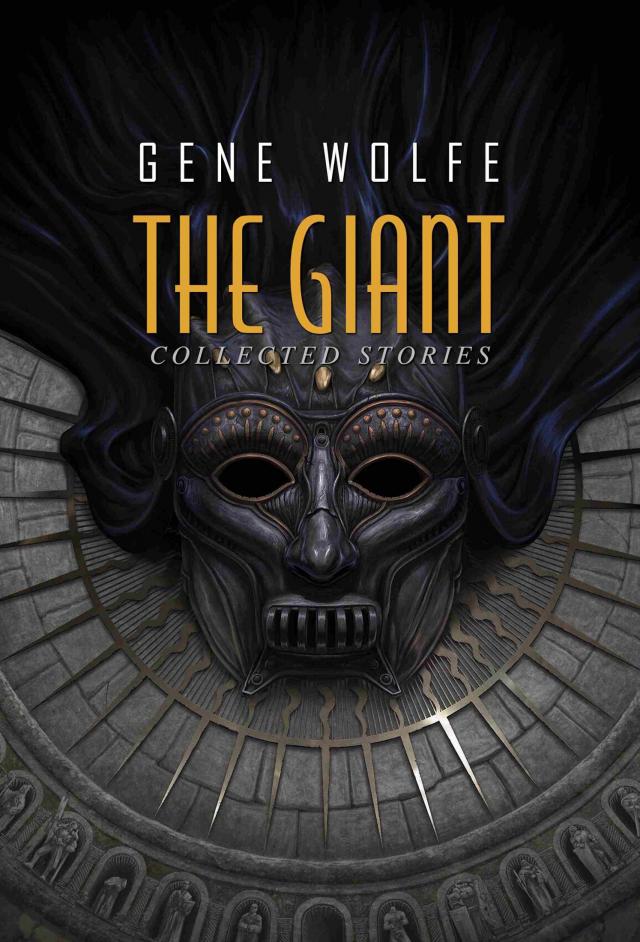
THE GIANT
Cover illustration by Aleksandar Saric
Copyright © Gene Wolfe
All rights reserved.
All characters and events in this publication are fictitious and any resemblance to real persons, living or dead, is purely coincidental.
No part of this publication may be reproduced, stored in a retrieval system or transmitted in any form or by any means, without the prior permission in writing of the publisher, nor to be otherwise circulated in any form of binding or cover other than that in which it is published without a similar condition, including this condition, being imposed on the subsequent purchaser.
wolfewiki.com
v3.0.1
Contents
Endangered Species
Introduction
A Cabin on the Coast
The Map
Kevin Malone
The Dark of the June
The Death of Hyle
From the Notebook of Dr. Stein
Thag
The Nebraskan and the Nereid
In the House of Gingerbread
The Headless Man
The Last Thrilling Wonder Story
House of Ancestors
Our Neighbour by David Copperfield
When I Was Ming the Merciless
The God and His Man
The Cat
War Beneath the Tree
Eyebem
The HORARS of War
The Detective of Dreams
Peritonitis
The Woman Who Loved the Centaur Pholus
The Woman the Unicorn Loved
The Peace Spy
All the Hues of Hell
Procreation
Lukora
Suzanne Delage
Sweet Forest Maid
My Book
The Dead Man
The Other Dead Man
The Most Beautiful Woman on the World
The Tale of the Rose and the Nightingale (And What Came of It)
Silhouette
Strange Travelers
How To Read Gene Wolfe
Bluesberry Jam
One-Two-Three for Me
Counting Cats in Zanzibar
The Death of Koshchei the Deathless
No Planets Strike
Bed and Breakfast
To the Seventh
Queen of the Night
And When They Appear
Flash Company
The Haunted Boardinghouse
Useful Phrases
The Man in the Pepper Mill
The Ziggurat
Ain’t You ’Most Done?
Innocents Aboard
Introduction
The Tree Is My Hat
The Old Woman Whose Rolling Pin Is the Sun
The Friendship Light
Slow Children at Play
Under Hill
The Monday Man
The Waif
The Legend of Xi Cygnus
The Sailor Who Sailed After the Sun
How the Bishop Sailed to Inniskeen
Houston, 1943
A Fish Story
Wolfer
The Eleventh City
The Night Chough
The Wrapper
A Traveler in Desert Lands
The Walking Sticks
Queen
Pocketsful of Diamonds
Copperhead
The Lost Pilgrim
Starwater Strains
Introduction
Viewpoint
Rattler
In Glory like Their Star
Calamity Warps
Graylord Man’s Last Words
Shields of Mars
From the Cradle
Black Shoes
Has Anybody Seen Junie Moon?
Pulp Cover
Of Soil and Climate
The Dog of the Drops
Mute
Petting Zoo
Castaway
The Fat Magician
Hunter Lake
The Boy Who Hooked the Sun
Try and Kill It
Game in the Pope’s Head
Empires of Foliage and Flower
The Arimaspian Legacy
The Seraph from Its Sepulcher
Lord of the Land
Golden City Far
Storeys from the Old Hotel
Introduction
The Green Rabbit from S’Rian
Beech Hill
Sightings at Twin Mounds
Continuing Westward
Slaves of Silver
The Rubber Bend
Westwind
Sonya, Crane Wessleman, and Kittee
The Packerhaus Method
Straw
The Marvelous Brass Chessplaying Automaton
To the Dark Tower Came
Parkroads—a Review
The Flag
Alphabet
A Criminal Proceeding
In Looking-Glass Castle
Cherry Jubilee
Redbeard
A Solar Labyrinth
Love, Among the Corridors
Checking Out
Morning-Glory
Trip, Trap
From the Desk of Gilmer C. Merton
Civis Laputus Sum
The Recording
Last Day
Redwood Coast Roamer
Choice of the Black Goddess
The Island of Doctor Death and Other Stories and Other Stories
Gene Wolfe: The Man and His Work
The Island of Doctor Death and Other Stories
Alien Stones
The Hero as Werwolf
Three Fingers
The Death of Dr. Island
Feather Tigers
Hour of Trust
Tracking Song
The Toy Theater
The Doctor of Death Island
“Cues
The Eyeflash Miracles
Seven American Nights
Death of the Island Doctor
The Fifth Head of Cerberus
“Human Because They’re All Dead”:
An introduction to The Fifth Head of Cerberus
The Fifth Head of Cerberus
“A Story,” by John V. Marsch
V. R. T.
Book of Days
Introduction
How the Whip Came Back
Of Relays and Roses
Paul’s Treehouse
St. Brandon
Beautyland
Car Sinister
The Blue Mouse
How I Lost the Second World War and Helped Turn Back the German Invasion
The Adopted Father
Forlesen
An Article About Hunting
The Changeling
Many Mansions
Against the Lafayette Escadrille
Three Million Square Miles
The War Beneath the Tree
La Befana
Melting
The Traveler
The Traveler
Innocent
The Tale of the Student and His Son
Easter Sunday
Donovan Sent Us
The Old Woman in the Young Woman
Mountains Like Mice
Tarzan of the Grapes
The Little Stranger
Build-A-Bear
The On-Deck Circle
Uncaged
The Vampire Kiss
The Tale of the Rose and the Nightingale
The Magic Animal
Prize Crew
At the Point of Capricorn
Last Drink Bird Head
King Under the Mountain
King Rat
Mathoms from the Time Closet
Dormanna
The Card
The Gunner’s Mate
Thou Spark of Blood
Bea and Her Bird Brother
How I Got Three Zip Codes
The River
Memorare
The Sea of Memory
Folia’s Story: The Armiger’s Daughter
The Hour of the Sheep
The Giant
The Tale of the Four Accused
Bloodsport
Josh
The Computer Iterates the Greater Trumps
Mary Beatrice Smoot Friarly, SPV
Remembrance to Come
Frostfree
La Befana
The Woman Who Went Out
Going to the Beach
Comber
How Beautiful with Spring
The Giant
The Case of the Vanishing Ghost
Six from Atlantis
The Lithosphere Whale
Unrequited Love
Christmas Inn
John K. (Kinder) Price
Incubator
Leif in the Wind
A Method Bit in “B”
On a Vacant Face a Bruise
Sob in the Silence
On the Train
Talk of Mandrakes
Green Glass
Why I Was Hanged
The Green Wall Said
Dumpster World
It’s Very Clean
To Melville
Riddle
British Soldier Near Rapier Antiaircraft Missile Battery Scans for the Enemy
Last Night in the Garden of Forking Tongues
Introduction
At this point it is traditional to state dogmatically that every short story must show a beginning, a middle, and an ending—the lash employed by editors and other critics to flog writers. And it is true enough that
It must have a voice that is not purposelessly changed (as that of the typical leader in “When I Was Ming the Merciless”), at least one character (the madman who composes “My Book,” for example), and at least one event to narrate, though in a few of these stories you may have to search carefully to find it. Most important, it must have a reader, which is the requirement most frequently overlooked. The same critics who spend hundreds of pages discussing various peculiarities of the author’s supposed nature often devote none to that much more significant person, the reader for whom he wrote. I do not say this in jest, merely to entertain you; it is a failure that disqualifies a great deal of head-scratching and hypothesizing. It amounts to saying that the letter is more important than its recipient, the signal more important than the changing image created from it, the bait more important than the fish. It is, of course, a totalitarian error, born of the classroom; it springs from the habitual professorial demand that the assigned material be read and his opinion of it be accepted without question.
But stories are far older than any classroom. They came to be at a time when the storyteller knew his (more correctly her, for the first were almost certainly women) audience thoroughly, and was not in the least averse to altering his narration to fit it. The hearer (every true reader hears the tale in his mind’s ear) is more central than the monstrous beast slain on the other side of the mountain, or the castle upon the hill of glass, or the mirror beyond which Gene’s sister glimpses an ocean in “The Sister’s Account.”
Therefore, let me describe the reader for whom I wrote all these stories. I wrote them for you. Not for some professor or for myself, and certainly not for the various editors who bought them, frequently very reluctantly, after they had been rejected by several others. You see, I am not an academic writing to be criticized. (Academics think the criticism the most important part of the whole process, in which they are wholly wrong.) Nor am I one of those self-indulgent people who write in order to admire their own cleverness at a later date; I do, occasionally, admire myself; but I am always made sorry for it afterward. (A few days ago I heard a young writer say, “I’ve had fun, and this isn’t it.” He expressed my feeling exactly.) Nor am I what is called a commercial writer, one who truckles to appease editors in the hope of making a great deal of money. There are easier ways to do that.
This is simple truth: Tonight you and I, with billions of others, are sitting around the fire we call “the sun,” telling stories; and from time to time it has been my turn to entertain. I have occasionally remembered that though you are not a child, there is a child alive in you still, for those in whom the child is dead will not hear stories. Thus I wrote “War Beneath the Tree,” and certain others. Knowing, as you do, what it is to love and to lose love, you may appreciate “A Cabin on the Coast.” Because you have sometimes pitied others, I have told you “Our Neighbour by David Copperfield,” and because others have sometimes pitied you, “The Headless Man.” We have sought and not found, you and I—thus, “The Map.” Sought and found, and thus “The Detective of Dreams.”
You are both a woman, amused by men, and a man, enthralled by women. You realize that it is only in our own time that life has become easy enough to permit a handful of us to abrogate our ancient alliance—nearly every story here will reflect that, I think. Others depend upon you, the steady one, and you depend upon others. Your lively imagination is governed by reason; you find it difficult to make friends, though you are a good friend to those you have made. At certain times you have feared that you are insane, at others that you are the only sane person in the world. You are patient, and yet eager.
Most important to me, you will be my willing partner in the making of all these stories—for no two readers have ever heard exactly the same story, and the real story is a thing that grows between the teller and the listener. If I have been wrong about you, you are welcome to tell me so the next time we meet.
The same authorities who insist upon beginnings, middles, and ends, declare that Great Literature (by which they mean the stories they have been taught to admire) is about love and death, while mere popular fiction like this is about sex and violence. One reader’s sex, alas, is another’s love; and one’s violence, another’s death. I cannot tell you whether you will find love or sex in “The Nebraskan and the Nereid,” death or violence in “Silhouette”; or as I hoped when I wrote it, new life (for there is more to life than sex), and a fresh beginning.
A Cabin on the Coast
It might have been a child’s drawing of a ship. He blinked, and blinked again. There were masts and sails, surely. One stack, perhaps another. If the ship were really there at all. He went back to his father’s beach cottage, climbed the five wooden steps, wiped his feet on the coco mat.
Lissy was still in bed, but awake, sitting up now. It must have been the squeaking of the steps, he thought. Aloud he said, “Sleep good?”
He crossed the room and kissed her. She caressed him and said, “You shouldn’t go swimming without a suit, dear wonderful swimmer. How was the Pacific?”
“Peaceful. Cold. It’s too early for people to be up, and there’s nobody within a mile of here anyway.”
“Get into bed then. How about the fish?”
“Salt water makes the sheets sticky. The fish have seen them before.” He went to the corner, where a showerhead poked from the wall. The beach cottage—Lissy called it a cabin—had running water of the sometimes and rusty variety.
“They might bite ’em off. Sharks, you know. Little ones.”
“Castrating woman.” The shower coughed, doused him with icy spray, coughed again.
“You look worried.”
“No.”
“Is it your dad?”
He shook his head, then thrust it under the spray, fingers combing his dark, curly hair.
“You think he’ll come out here? Today?”
He withdrew, considering. “If he’s back from Washington, and he knows we’re here.”
“But he couldn’t know, could he?”
He turned off the shower and grabbed a towel, already damp and a trifle sandy. “I don’t see how.”
“Only he might guess.” Lissy was no longer smiling. “Where else could we go? Hey, what did we do with my underwear?”
“Your place. Your folks’. Any motel.”
She swung long, golden legs out of bed, still holding the sheet across her lap. Her breasts were nearly perfect hemispheres, except for the tender protrusions of their pink nipples. He decided he had never seen breasts like that. He sat down on the bed beside her. “I love you very much,” he said. “You know that?”
It made her smile again. “Does that mean you’re coming back to bed?”
“If you want me to.”
“I want a swimming lesson. What will people say if I tell them I came here and didn’t go swimming?”
He grinned at her. “That it’s that time of the month.”
“You know what you are? You’re filthy!” She pushed him. “Absolutely filthy! I’m going to bite your ears off.” Tangled in the sheet, they fell off the bed together. “There they are!”
“There what are?”
“My bra and stuff. We must have kicked them under the bed. Where are our bags?”
“Still in the trunk. I never carried them in.”
“Would you get mine? My swimsuit’s in it.”
“Sure,” he said.
“And put on some pants!”
“My suit’s in my bag too.” He found his trousers and got the keys to the Triumph. Outside the sun was higher, the chill of the fall morning nearly gone. He looked for the ship and saw it. Then it winked out like a star.
· · · ·
That evening they made a fire of driftwood and roasted the big, greasy Italian sausages he had brought from town, making giant hot dogs by clamping them in French bread. He had brought red supermarket wine too; they chilled it in the Pacific. “I never ate this much in my life,” Lissy said.
“You haven’t eaten anything yet.”
“I know, but just looking at this sandwich would make me full if I wasn’t so hungry.” She bit off the end. “Cuff tough woof.”
“What?”
“Castrating woman. That’s what you called me this morning, Tim. Now this is a castrating woman.”
“Don’t talk with your mouth full.”
“You sound like my mother. Give me some wine. You’re hogging it.”
He handed the bottle over. “It isn’t bad, if you don’t object to a complete lack of character.”
“I sleep with you, don’t I?”
“I have character; it’s just all rotten.”
“You said you wanted to get married.”









