Black robe, p.1
Black Robe, page 1


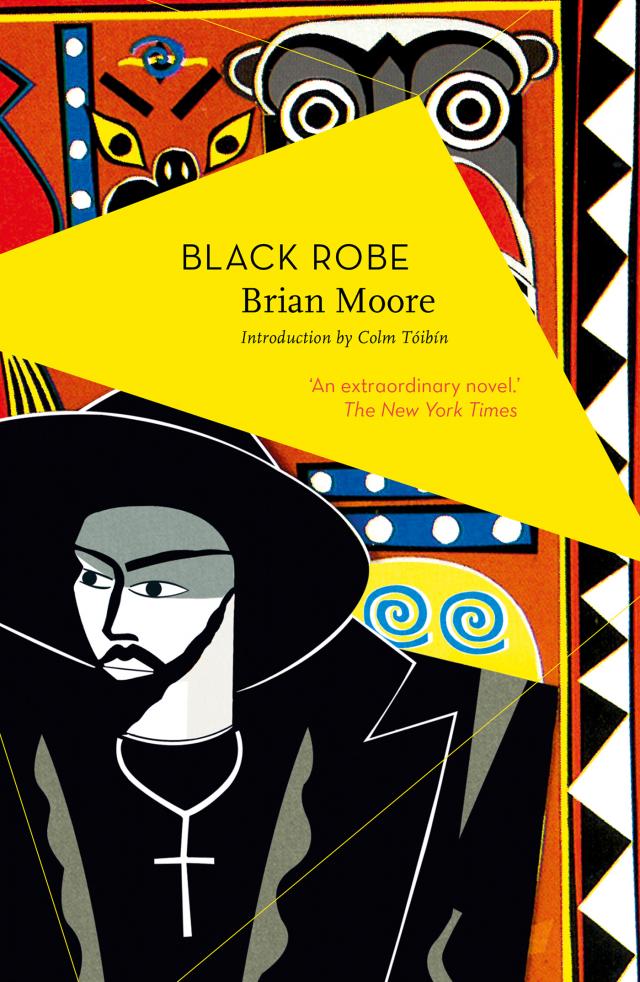
BLACK ROBE
Brian Moore
Start Reading
About this Book
About the Author
Table of Contents
www.apollo-classics.com
About Black Robe
Laforgue felt his body tremble.
What can be keeping them?
Has the Commandant refused?
Why has he not sent for me?
Is this God’s punishment for my lie about my hearing?
Father Laforgue, an idealistic Jesuit, embarks on a desperate mission to relieve an isolated priest in danger of his life in the wilds of seventeenth-century New France.
Black Robe is a tautly suspenseful tale of physical and spiritual adventure, and a meditation on good and evil in the human heart.
With an introduction by Colm Tóibín.
Contents
Welcome Page
About Black Robe
Dedication
Introduction
Author’s Note
Part 1
Chapter 1
Chapter 2
Chapter 3
Chapter 4
Chapter 5
Chapter 6
Chapter 7
Chapter 8
Chapter 9
Chapter 10
Part 2
Chapter 11
Chapter 12
About Brian Moore
About the Introducer
Endpapers
About the cover and endpapers
More from Apollo
About Apollo
Copyright
For Jean
Introduction
In the late 1970s and early 1980s, as the IRA campaign in Northern Ireland intensified and the British response came under greater scrutiny, Irish writers began to explore images of an earlier confrontation between outside forces and a native population. In the last lines of the title poem of his collection Meeting the British, for example, Paul Muldoon wrote:
They gave us six fishhooks
and two blankets embroidered with smallpox.
In 1979, the playwright Brian Friel began to keep a sporadic diary as he worked on a new play called Translations, which dealt with the changing of the names of the places in Ireland by the British in the nineteenth century. He knew he was working with two languages: the Irish spoken by the locals and the English by the map-makers. On 14 May he wrote:
‘The people from Urris/Ballybeg would have been Irish-speaking in 1833. So a theatrical conceit will have to be devised by which – even though the actors speak English – the audience assume or accept that they speak Irish. Could that work?’
He was aware that the Irish ‘cultural climate’ in 1833 was ‘a dying climate... the victims in this situation are the transitional generation. The old can retreat into and find immunity in the past. The young acquire some facility with the new cultural implements.’ What interested Friel in the creation of his drama was first of all a world in which two languages collided, but also in which figures from either language, especially the young, were left vulnerable, too ready to work for gain, or too ready to fall in love, to fit the pattern, to play the colonial game as though between settled sides.
Friel’s love scene between the Irish girl who can only speak Irish and the young English outsider who has come to change the names of the places is deeply affecting and powerful. It moved his play away from any possibility of propaganda or political parable, just as Daniel’s fierce attachment to Annuka in Brian Moore’s Black Robe makes the gap between the colonisers and the natives layered with irony and complex emotions. Brian Friel also understood that his drama could be easily played out in societies other than Ireland. He was asked by an interviewer: ‘Do you feel that the play has a relevance to places like Belgium or Quebec, where there is a problem of two cultures?’ Friel replied: ‘Yes, I think so. Those are two places I would love to go with this play.’
Although Brian Moore left Ireland definitively in 1948, he got to know a number of Irish writers in the 1960s, including Brian Friel whom he met for the first time in 1969. Later he wrote to him: ‘I know this sounds un-Ulster and extreme, but as it is much easier for me to say it in print than to your face, I am first among your many admirers.’
After the publication of Black Robe, when asked if it reflected his Belfast background, he said: ‘Originally, I’d have said that wasn’t true, but maybe subconsciously I was thinking of it. The only conscious thing I had in mind when writing it was the belief of one religion that the other religion was totally wrong. The only thing they have in common is the view that the other side must be the Devil. If you don’t believe in the Devil, then you can’t hate your enemy and that may be one of the most sinister things about Belfast today.’
In his author’s note to Black Robe, Brian Moore mentioned a piece in Graham Greene’s Collected Essays about Francis Parkman who published his work The Jesuits in North America in the Seventeenth Century in 1867. Moore, who, like Greene, was fascinated by unbelief, took a great interest in a French seventeenth century Jesuit mentioned by Greene who, although he detested native life in North America, vowed that he would live that life until he died.
Greene went on in his review to quote Parkman’s outline of the belief systems which the Jesuits sought to combat: ‘In the general belief, however, there was but one land of shades for all alike. The spirits, in form and feature, as they had been in life, wended their way through dark forests to the villages of the dead, subsisting on bark and rotten wood. On arriving they sat all day in the crouching position of the sick, and when night came, among the shades of trees and rocks; for all things, animate and inanimate, were alike immortal, and all passed together to the gloomy country of the dead.’
It is easy to imagine Moore’s concentration deepening for a second as he read this passage and then his lifting his eyes to offer the nearest horizon a forensic stare. This is how novels begin – stray reading or random experience hitting a vulnerable spot in the nervous system, or stirring the set of personal histories and obsessions which we all live with. Moore now had the bones of a book which would become, in my opinion, his best novel.
As he set to work, Moore was not only an Irish novelist, as James Joyce had remained despite his long exile, but a Canadian writer also. He had lived in Canada, mainly in Montreal, from 1948 to 1959 and had soaked up a great deal of the North American experience. In Belfast, as a Catholic, he was part of a minority in a place which had been heavily planted by Scots and English. In Canada, he was in the white majority. As in Ireland, the names of the Canadian places contained the gnarled history of the previous four hundred years – some native, some French, some British – reminding the white victors that this land, where Moore had sought and found some personal freedom, had once been a site of passionate and violent dispute.
Moore’s best two earlier books, The Lonely Passion of Judith Hearne (1955) and Catholics (1972) dramatised the idea of faith and loss of faith, as figures who seemed to belong to the very heart of the church received almost no comfort from its teachings and its power, but rather suffered for their unbelief. It was clear that Moore’s Jesuit in Black Robe, which he began to write in 1983, could not be a fanatic, but a man whose determination and doubt were in the balance.
As Moore settled down to work there was another set of opposites affecting his own style and methods of construction. He was moving towards the clipped tone of his last books, the story briskly told, led by plot, the emotion held in check, with no fine writing, or analysis of personality. ‘I’ve discovered that the narrative forms – the thriller and the journey form – are tremendously powerful,’ Moore said. ‘They’re the gut of fiction, but they’re being left to the second-rate writers because first-rate writers are bringing the author into the novel and all those nouveau roman things.’ Just as the Black Robe itself takes place at a pivotal moment in North American history, so, too, it was being written when Moore’s own interest in narrative drive was at its strongest, but before he had limited his style.
Francis Parkman’s The Jesuits in North America in the Seventeenth Century is a godsend to any novelist. The sweeping and confident descriptions of native society are vivid and deeply suggestive. In his introduction, for example, Parkman writes about the role of women: ‘Female life among the Hurons had no bright side. It was a youth of licence, an age of drudgery... Once a mother, and married with a reasonable permanency, the Huron woman from a wanton became a drudge.’ It is easy, once more, to imagine Moore lifting his eyes from the book, stopping for a second in reverie, knowing what sharp drama he could make from Parkman’s book. When Parkman describes the lack of privacy, houses lodging more than twenty families, I can imagine Moore thinking of what his Jesuit’s first discomforts will be as he travels with the savages. He can never be alone.
Moore moved from the reading of Parkman’s book to the original documents themselves, steeping himself in contemporary narratives. But this was a story of landscape as much as a spiritual story. Moore remembered the Montreal winters as he began to compose: ‘I would go into my room and my mind would go back to the Montreal winter I remember and the cold and the St Lawrence River. When I thought of the river I could see it, because I had gone up and down it so many times.’ He received a grant from the Canadian Arts Council to travel to the places where records were kept and where there were traces of Iroquois and Huron settlements, in particular where the Ontarian government had accurately reconstructed longhouses, a village and the original Jesuit mission. There is, in the description of landscape in the book, and the worsening weather, a forensic zeal. The sense of cold and hunger are evoked with real skill.
Parts of the novel were written on the wild southern shore of Nova Scotia. ‘I went into the wilderness of this book,’ Moore said, ‘because I had never written a book like this before. I didn’t want to write an historical novel because I don’t particularly like historical novels... I wanted to write this as a tale. I thought of it in terms of authors I admire, like Conrad. I thought of Heart of Darkness, a tale, a journey into an unknown destination, to an unknown ending.’
Perhaps because of Parkman’s detailed account of the native civilisation in his book and Moore’s own background as a Belfast Catholic, Moore managed in Black Robe, in a way that Conrad did not in Heart of Darkness, to make the natives, as he said himself, ‘among the strongest characters in the book.’ Their customs and beliefs, despite the astonishing cruelty they show, are rendered with dignity and mystery. The last illness of Chomina is a haunting and beautiful moment in the book, as is his last conversation with Laforgue: ‘Look around you. The sun, the forest, the animals. This is all we have. It is because you Normans are deaf and blind that you think this world is a world of darkness and the world of the dead is a world of light... If you have come here to change us, you are stupid. We know the truth. This world is a cruel place but it is the sunlight. And I grieve now, for I am leaving it.’
At the centre of Black Robe, however, is the Jesuit Laforgue himself, a towering and haunting presence in his mixture of will and weakness, faith and fear. He is our doubtful and determined hero. Moore is careful to make his responses constantly ambiguous and unpredictable. He is repelled by the love scenes between Daniel and Annuka and also excited by them. He wishes to embrace martyrdom, if necessary, but he also feels fear and pain and pity. He despises the savages and he is capable of feeling sympathy for them.
Because the book centres on matters of faith and the clash between cultures, the graphic and chilling descriptions of violence in Chapter 8 come as a great shock. This is Moore at the height of his considerable powers as a narrator, a manipulator of pace and tone and emotion. It is unsparing of the reader and utterly flawless. We feel such pity and fear for the characters involved that our sympathy for the two lovers and the priest at the end of the book is immense. Moore made sense when he spoke of the thriller in the hands of a first-rate novelist as a most powerful artistic tool. In Black Robe he wrote not only one of the best Irish and Canadian novels of the second half of the twentieth century, but one of the best books in the English language.
COLM TÓIBÍN, 2017
Author’s Note
A few years ago, in Graham Greene’s Collected Essays, I came upon his discussion of The Jesuits in North America, the celebrated work by the American historian Francis Parkman (1823–1893). Greene quotes this passage:
[Father] Noel Chabanel came later to the mission for he did not reach the Huron country until 1643. He detested the Indian life – the smoke, the vermin, the filthy food, the impossibility of privacy. He could not study by the smoky lodge fires, among the noisy crowd of men and squaws, with their dogs and their restless, screeching children. He had a natural inaptitude to learning the language, and labored at it for five years with scarcely a sign of progress. The Devil whispered a suggestion in his ear: Let him procure his release from these barren and revolting toils and return to France where congenial and useful employments awaited him. Chabanel refused to listen: and when the temptation still beset him he bound himself by a solemn vow to remain in Canada to the day of his death.
A solemn vow. A voice speaks to us directly from the seventeenth century, the voice of a conscience that, I fear, we no longer possess. I began to read Parkman’s great work and discovered that his main source was the Relations, the voluminous letters that the Jesuits sent back to their superiors in France. From Parkman I moved on to the Relations themselves, and in their deeply moving reports discovered an unknown and unpredictable world. For, unlike the English, French, and Dutch traders and explorers, the Jesuits came to North America not for furs or conquest, but to save the souls of those whom they called ‘the Savages’.*
To succeed, they had to learn the ‘Savages” often scatological tongues and study their religious and tribal customs. These letters, the only real record of the early Indians of North America, introduce us to a people who bear little relationship to the ‘Red Indians’ of fiction and folklore. The Huron, Iroquois, and Algonkin were a handsome, brave, incredibly cruel people who, at that early stage, were in no way dependent on the white man and, in fact, judged him to be their physical and mental inferior. They were warlike; they practised ritual cannibalism and, for reasons of religion, subjected their enemies to prolonged and unbearable tortures. Yet, as parents, they could not bear to strike or reprove their unruly children. They were pleasure-loving and polygamous, sharing sexual favours with strangers as freely as they shared their food and hearth. They despised the ‘Blackrobes’ for their habit of hoarding possessions. They also held the white man in contempt for his stupidity in not realizing that the land, the rivers, the animals, were all possessed of a living spirit and subject to laws that must be respected.
From the works of anthropologists and historians who have established many facts about Indian behaviour not known to the early Jesuits, I was made doubly aware of the strange and gripping tragedy that occurred when the Indian belief in a world of night and in the power of dreams clashed with the Jesuits’ preachments of Christianity and a paradise after death. This novel is an attempt to show that each of these beliefs inspired in the other fear, hostility, and despair, which later would result in the destruction and abandonment of the Jesuit missions, and the conquest of the Huron people by the Iroquois, their deadly enemy.
*
While much of the information contained in this novel on the mores, beliefs and language of both ‘Savages’ and Jesuits comes from the Relations, I am also indebted to other sources. I would like to thank James Hunter, Research Curator of Sainte Marie Among the Hurons, and also Bill Byrick, Professor Bruce Trigger of McGill University, and Professor W.J. Eccles of the College of William and Mary for assistance on various points.
I am indebted to Le Conseil des Arts du Canada for making it possible for me to visit places in Canada where records are kept of Iroquois, Algonkin, and Huron history and customs, and the sites of early Iroquois and Huron settlements, in particular, the village of Midland, Ontario, where the Ontario government has accurately reconstructed longhouses, a village, and the original Jesuit mission established there.
* In the early part of the seventeenth century the native people of Canada were not known to the French as ‘Indians’, but by the names of their tribal confederacies, and were referred to collectively as ‘Les Sauvages’ (the Savages). The natives, for their part, spoke of the French as ‘Normans’ and of the Jesuit fathers as ‘Blackrobes’. As for the obscene language used by the natives at that time, it was a form of rough banter and was not intended to give offence. I am aware that I have taken a novelist’s licence in the question of Algonkian understanding of Iroquoian speech.
Part One
1
Laforgue felt his body tremble. What can be keeping them? Has the Commandant refused? Why has he not sent for me? Is this God’s punishment for my lie about my hearing? But it wasn’t a lie; my intention was honourable. Or is that a sophistry? Am I now so mired in my ambition that I can no longer tell truth from falsehood?
For what seemed the hundredth time, the sentry on duty outside the Commandant’s quarters turned and marched along the ramparts of the fort. Laforgue heard voices. He looked down the steep path which led to the wooden buildings of the settlement. Two men were coming up. One was an officer, his slouch hat tilted over his forehead, his uniform whitened by dust. When Laforgue saw the face of the second man, he felt a sudden disquiet. A month ago, this man, a fur trader named Massé, had run from the stinking wineshop where the traders drank to yell obscene insults at Laforgue. The insults concerned a Savage girl Massé had been sleeping with, a girl Laforgue had lately tried to instruct in the faith.