

Bite me, p.1
Bite Me, page 1


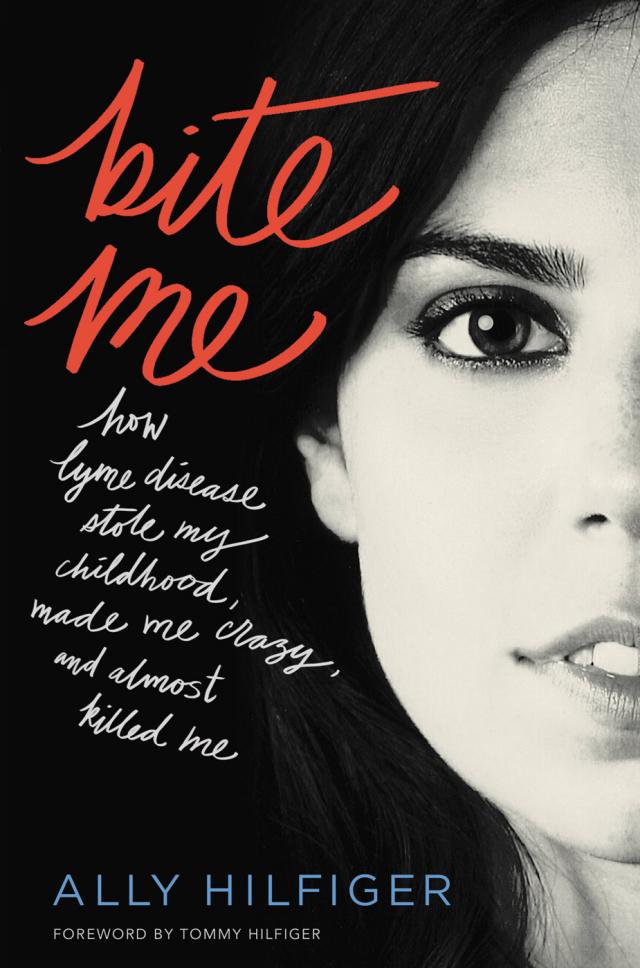
Begin Reading
Table of Contents
Newsletters
Copyright Page
Hachette Book Group supports the right to free expression and the value of copyright. The purpose of copyright is to encourage writers and artists to produce the creative works that enrich our culture.
The scanning, uploading, and distribution of this book without permission is a theft of the author’s intellectual property. If you would like permission to use material from the book (other than for review purposes), please contact permissions@hbgusa.com. Thank you for your support of the author’s rights.
For my daughter, Harley. The hope of you was the reason to keep fighting. You are the light of my life.
foreword
I remember it clearly: holding my baby girl Ally in the cab heading home from New York University Medical Center, where she was born, and freaking out every time the taxi hit a bump. I knew then that I would do anything to keep this child from harm.
As a young child, Ally was the most vivacious, outgoing, and fun little girl. We’d play outside in the leaves in the backyard or go hiking in the woods or collect seashells on the beach.
She was an incredibly social child, and would talk to anyone, especially those we would encounter on our travels, be it a cabdriver or a prince. I come from a big family, with eight brothers and sisters, and Ally fit right in. She carries the torch of the big love and big personalities of my clan.
She was also an old soul as a child. We would have long conversations about life, which she understood from a sophisticated angle from a very young age. I was pleasantly surprised every time I had a conversation with her. She’d ask the most intelligent questions and many times know the answer before she asked it—she would ask a question as a confirmation.
For a time, I was convinced she was going to be an actress on Broadway or in movies. She has a great singing voice, and is a gifted mimic. I think she got her social nature and talent for impersonations from me (I always wanted to be an actor), but she is incredibly creative, and has always had a great sense of style, which, along with her talent as an artist, she got from her mom, Susie.
There is an old saying that you are only as happy as your children, and when I began to see my daughter in pain I was in pain. From the time she was ten or so, we went to doctor after doctor and yet couldn’t find out what was wrong. It was difficult to endure. I wished it were happening to me instead of my sweet, little girl. I wanted to believe that at some point we would find a cure or a way to help her heal from the pain that seem to get worse, but instead the medical community continued to misdiagnose my daughter. I felt helpless and, to be honest, even hopeless at times.
For Ally things went from bad to worse. In her late teens, she experienced a psychotic episode that lasted for several days. Leading up to it, I knew she was not herself. I also knew her self-medicating had gotten out of control, but what I didn’t realize was that she had a disease that was spreading and that it had multiplied and crossed the blood-brain barrier, which caused a reaction in her that was similar to the way syphilis can cause psychosis. I tried to convince her to go to a rehabilitation hospital, but, as could be expected, she wouldn’t hear it. I thought she might have been on psychedelic drugs, but she insisted she wasn’t. So I decided that out of love for my daughter, I was going to have to use force. Two of my security guards helped me put her into a car to bring her to the emergency room and eventually Silver Hill Hospital, a psychiatric and addiction rehabilitation facility in Connecticut.
During that dark time, I knew Ally was very angry at me. I can still see the look on my daughter’s face when she thought I’d turned on her when she needed me most. One of the reasons I was so distraught and acted so dramatically is that I was quite aware of the teenage suicide rate and that thought haunted me; it was always in the back of my mind. If something like that were to happen I could never forgive myself.
So, I thought I had to save her life, and I was going to do whatever I had to do, and however I had to do it. Believe me, this was traumatic for all of us. I never gave up hope, however, that she would eventually see that love was my primary motivation.
As a father, there is nothing more devastating than seeing your child suffer and go through intense pain, except, perhaps, seeing her suffer and not knowing why. Silver Hill Hospital turned out to be a godsend. It was there that Ally would meet Dr. Ellyn Shander, who would properly diagnose her for the first time. Thank God for Dr. Shander.
Finding out what had been causing Ally’s physical and emotional pain was a relief, but it proved to be only the beginning of a journey that never seems to end. No matter how dormant her disease seemed, we lived in constant fear and worry that at any minute it would raise its ugly head. And it did, over and over again.
This disease is an uncontrolled, widespread epidemic, and what makes things even more difficult is that a lot of people don’t know they have it. They’re living with all sorts of ailments and don’t realize what’s causing them—and the longer it sits in your body, the worse it gets. With Lyme, there is no real, certain cure.
When I now see Ally holding my healthy, happy granddaughter, Harley, I know that she feels the same way I did when I held her for the first time in a cab. I’m incredibly proud of my daughter, for all she has withstood, all she has accomplished, and for the loving, giving person she is.
This book is testament of her giving nature, a gift of hope for those who suffer from Lyme disease and to anyone who has ever overcome a challenge, whatever it may be.
—Tommy Hilfiger
preface
I don’t remember when I was bit. It might have been in the summer of 1991 or ’92. My mother does, but she’s not sure where it happened. It could’ve been on Nantucket, or in Bridgehampton, New York, or even in our yard in Greenwich, Connecticut, she thinks. Though she doesn’t remember where it happened, she does remember finding the minuscule black creature with eight legs on my tummy, right next to my funny-shaped birthmark. Mom remembers too that she did exactly what the pediatricians were telling mothers to do: She pulled the tick off of me with sterile tweezers, put it in a test tube, and brought it to have it tested. The tests came back “inconclusive” but leaned more toward the negative side of the spectrum. My parents were dissatisfied with “inconclusive” results and decided to seek out a specialist. Unfortunately they were not given any hope or a list of symptoms to look out for. My mother is still very perplexed by the way the specialist handled the situation.
Studies now find that some 50 percent of commonly used Lyme testing misses positive Lyme cases.
Fifty percent!
It’s fitting somehow, though, that neither my mom nor I remember where the bite occurred and that doctors missed the correct diagnosis. Lyme disease is as sneaky as it is nasty: About half of the people infected by Lyme are like me: They can’t tell you when they were bitten. A very small percentage of people who have been bitten by a tick recall a bull’s-eye rash, which for years has been the medical community’s common indicator that a person has Lyme. In fact, before it even bites you, the tick releases a combination of chemicals that act like an anesthetic, so most times you don’t even know the little bloodsucker is burrowing into you. This is not a mosquito bite, people. Ticks can attach themselves to you for days because it takes that long for the spirochete bacteria to make its way into your bloodstream. Then it can take up to three weeks before you feel that anything’s wrong, and even then, most people think they just have the flu.
What happens next is where it gets really devious. Fact: After they have been bit, most people wait two and a half years to receive a proper diagnosis. Lyme can mimic any number of illnesses. Believe me, I know. During my Lyme life, doctors would diagnose me with everything from mono to multiple sclerosis and dozens of other diseases in between, and in spite of a mountain of symptomatic evidence that supported the fact that I had Lyme, doctors would refuse to diagnose me with it because of the ambiguous results of the tests I was given.
They call Lyme “the invisible disease” or “the great imitator,” as if it’s some kind of world-renowned stage actor. I can think of a couple of other names for it that aren’t quite as complimentary. From the age of seven or eight, I experienced Lyme-created nightmares of sickness, hospitalizations, disappointments, and depression. Yet, in a kind of perverse way, it has also been a gift. Because of it, I found an inner strength that I couldn’t have imagined. It’s a good thing, too. Because I would need every ounce of that strength just to survive.
I’m not some kind of singular hero, though. In fact, my Lyme story is, literally, one in a million. According to the U.S. Centers for Disease Control and Prevention (CDC) there are thirty-four new cases of Lyme every hour, and all of us are battling not only our illness but a backlash of medical misconception, misinformation, and misdiagnosis. There are doctors right now, ones with diplomas from impressive medical schools hanging on their walls, who deny the reaches of this horrible disease. There are loving and caring family members who refuse to believe that their son, daughter, brother, or sister is really suffering from Lyme’s effects. There are far, far too many who are never diagnosed and who couldn’t afford the treatment if they were.
No, my story is not unusual, but I believe it needs to be told if only to give others a voice for theirs.
Before I start telling it, though, I need to warn you of something: Lyme disease is a thief, and it not only steals your ability to live a normal life, it also swipes your memories just as soon as you turn your back. It’s like a junkie acqua intance. A lot of my childhood, and even my teenage and young adult years, are lost in the fog of Lyme. In high school, I often walked the streets of New York City with a video camera so I could capture the moments I was afraid I’d forget. In my twenties I hung a Polaroid camera around my neck for the same reason. I literally covered the walls in my rooms with photos I took from that camera.
For the sake of this book, I researched much of my own life by asking family and friends to fill the holes in my memory. I also kept journals for periods of my teen and young adult years, and luckily those diaries survived my many moves. Reading them again did bring back many details that I’d forgotten. Some of the recollections I’ll recount in the pages ahead came shrieking back to me like a strip of film pulled from a projector—a flash of video consciousness, if you will. Those recollections I’ll play back for you just as I remember them.
When pieced together, hopefully these memories will start to make sense of a life of which I had little understanding for a very long time.
part one
one
A BITE OF CRAZY
“Lyme disease is a multisystemic illness that can affect the central nervous system (CNS), causing neurologic and psychiatric symptoms.”1
—NATIONAL INSTITUTES OF HEALTH
In late December 2003, just a few weeks after the last airing of a reality television show I’d starred in, I opened my eyes in a strange, dark room with cinder-block walls, and in a bed made for an elf. Perhaps most disturbing was the fact that my orange and red Adidas sneakers were missing their laces. I looked down at the inside of my arm, which was itching, and saw a piece of gauze being held in place by a Band-Aid.
Am I in a hospital? Did I try to hurt myself? Am I in a mental institution? Am I in jail? I could barely think because my head was pounding so badly.
I managed to pull myself up but my head started to spin, so I lay back down and tears began to roll down my face. Where am I? I felt alone, scared, and I could not remember a thing. I recognized the familiar confusion, loneliness, fear, and head pain. I needed to wake myself up from this dream, this nightmare. The nightmare I had been living my whole life.
I walked into the hall, a brightly lighted, carpeted corridor. There was a window with bars, and outside these windows I saw snow-covered trees. The landscape looked like somewhere on the East Coast. Maybe I am close to home. I wanted to go home and just be held and comforted in my mother’s arms. As I turned around I wiped away tears and suddenly a large redheaded man was guiding me toward the end of the hallway to a chair.
“Where am I? Where are you taking me?” I asked the man.
“We have to take your blood pressure and temperature,” he said.
“Why? Where am I? What’s happening?”
“You are at Silver Hill Hospital in the Acute Care Unit.”
My heart dropped to the pit of my stomach and I was in complete shock. I have been totally misunderstood, I thought, and thrown into a nuthouse without my consent.
My dad did this, I thought. A father should walk you down the aisle, not walk you down a locked corridor. How could my dad do this to me? I had always trusted him more than anyone. He had always been the one I called when I felt lost, sad, and uncertain. So the question of what had happened to me became, what had happened to me and my dad?
Our relationship was never like this when I was younger.
When I was four years old, every Saturday morning my dad would put me on the back of his bicycle to go for a ride through the back roads of our pretty town. He would stop near the water, and we would sit and stare in awe and amusement. After the bike ride, he would take me to the mall for curly fries and an A&W root beer. Saturdays were my absolute favorite because I was with my favorite person in the world. My father understood me like no one else, stood up for me, believed in me, and encouraged me. I always felt safe when I was in his presence. Always.
Not, however, today.
At night, after my mom sang me her homemade lullabies, put me in my foot pajamas, and tucked me in, I would wait for my father to come home from work in the city and give me a kiss good night. He would rush to get home before I fell asleep and I fought to keep my eyes open until he was home.
Now at eighteen years old, I was curled up at the bottom of a bed waiting again for my knight in shining armor to come and save me. Save me from the nuthouse. It was my knight, however, who drugged me and locked me up in this place. I tried to remember if Christmas had passed but couldn’t. Everything was a blur.
The last thing I remembered was going to a church to beg a priest to bestow sleep upon me. Sleep was a battle, and I rarely won. I wanted so desperately to be able to put my head on a pillow and easily drift into a dream world, but instead I was living in a state of wide-awake paranoia. The last episode of the TV show that had ruined my life had just aired, and I couldn’t walk into a gas station without being recognized. I thought someone was out to get me and that stalkers waited around every corner to attack me. I felt alone, frightened, and convinced that some dark force was keeping me from sleeping or having any sort of appetite, not to mention giving me the persistent nausea and joint pain I was unable to ignore.
I remembered walking into a little stone church in the center of Bedford Village, New York, on Christmas Eve carrying every spiritual book my mother had ever given me, a few pine tree branches that I smelled to relieve nausea, and a head of grungy hair that featured two dreadlocks. I had become that person, that homeless woman you see on the sidewalk passing out pamphlets on Forty-Ninth Street, talking to herself.
After the mass I decided to go up to random people I thought might need spiritual saving and hand them a copy of The Power of Now or Mother Teresa’s In My Own Words. These books had given me hope and it was my assumption that they might help other lost souls in the crowded Christmas Eve mass.
As I lay on that little elf-sized bed, I remembered, too, a few weeks before Christmas, when I was on my father’s bathroom floor crying in pain, and he choked up and asked me, “What can I do? How can I help? Anything, I will do anything to help you and make you feel better.”
“Pot,” I said to him. “Get me some pot. It’s the only thing that will help me.”
The excruciating joint pain and flulike symptoms had been part of my life since I was a little girl. My parents and doctors dismissed my complaints about my knees feeling achy and hot. I was told they were growing pains. They treated the constant bouts of strep throat with bubble-gum-flavored antibiotic and never looked into my health in any comprehensive manner.
As the years went on, I felt as though my brain was not working as well as the other kids’ in my class. When I got tested, they told me I had attention deficit disorder, ADD. When I stopped being able to read, they said I had a learning disability and sent me to a specialist. When I couldn’t remember the information I had studied for four hours the night before a test, they told me to study harder. When I couldn’t wake up for school or keep my eyes open during class, they told me I needed to go to bed earlier and exercise more. When I told them I had pounding headaches several days a week, they told me to drink more water or “pop a couple of Advils,” even when the headache was so strong I couldn’t lift my head from my desk. When I was in agony from severe hip pain and random joint pain, they said, “It’s probably rheumatoid arthritis. Or maybe it’s multiple sclerosis. Or it sounds like fibromyalgia. Or it could be…”
Who is “they,” you ask? My parents, teachers, doctors, and the people in between.
Speaking of doctors, the one at Silver Hill was a piece of work. Let’s just say he took himself really seriously. When he walked into my room, the first thing I noticed was that his suit was a little too nice, and his shirt was a little too pressed, and his tie matched his socks. He arrived with an arrogant disposition, which made me feel immediately judged and belittled.
My cousin had come to visit me the day before, and she’d brought me a crazy orange and fuchsia hat with those wild pom-poms with long tassels sticking out all over the top. Ha! Little did this stern, buttoned-up doctor know he would be forced into wearing this hat atop his ensemble or else I would not speak or even look at him.






