

Moonful of silver, p.25
Moonful of Silver, page 25


He rolled onto his front and perched on his elbows.
Maria removed a control unit from her satchel and pressed her thumb to a screen.
Water cascaded all over the dome, pouring in fine sprinkles to soak the ground.
Benito laughed. “Darling. Mi amor. You’ve been here a few clicks and you’ve already made it rain on the Moon!”
As water dripped from her blouse, her skirt, her hair, he drew her close and planted a kiss on her wet lips.
After the rain stopped, they lay holding hands and staring through the dusty glass to the sky beyond.
“What do you think about getting a robot to welcome people to the town?” he said. “I think it’d be a nice touch.”
Maria smiled. “Sure. Can’t hurt.”
“Make people feel welcome.”
“Pretend it’s not the badlands, you mean?”
He twisted his neck and gazed at where her hair fell across her cheeks. “One of the drillmen asked me what we hoped to accomplish here.”
“What did you tell him?”
“The truth. But I realized I never asked you. I’ve had all these expectations about what we can actually do here, and I never really stopped to ask.”
Maria arched her neck and nodded back to the makeshift bacteria-infused dust she’d planted a seed in. “You see that?”
“The dust?”
“It holds a seed.”
“Right.”
“So there you go.”
Benito shook his head. “I don’t get it.”
Maria sighed. “Do you know what it’s like to plant a seed on the Moon? It’s terrifying. You don’t know whether the bud will sprout. You can’t tell if the seed will take root, or whether it’ll be choked by the dust. All you can do is keep planting, nurturing, and trusting that the best things will overcome the hazards of their silt-covered home, and grow. Feed. Cultivate. Hope. Feed. Cultivate. Hope. That’s all we can do here. What do I think we can accomplish? Feed. Cultivate. And who knows? Maybe this’ll all work out?”
Benito nodded. “And hope something grows that outlasts us.”
“Is that what you hope for?”
“Mi amor, it’s what I live for.”
They watched the ground together, click after click, feeding nutrients into the patch of soil she honed from silt, and there—eventually—appeared the faintest spot of green.
She leaned closer, propping herself up.
Benito’s laughter echoed through the dome as he gazed at the beginnings of a shoot. Through a smile, Benito regarded the plant—the tiniest of starts—and greeted it with the first words to mark life in the badlands, the first words to bring hope to a new Moon, the first words to incite a catalyst for change. Who was to say where it could grow if they just kept feeding it? And the words he whispered were, “Welcome to Tranquility.”
ACKNOWLEDGMENTS
Dawn: First and foremost, I want to thank my co-author, Frasier Armitage, whose unique ideas and remarkable writing style have long inspired me. This story fuses the grit of the western with the wonder of science fiction—a frontier tale inspired by Fistful of Dollars, where dusty duels meet cosmic horizons. This collaboration began with Frasier’s inspired idea, and working with him has been both an honor and a joy.
To all the fantasy and science fiction writers—novelists, screenwriters, and storytellers—whose worlds have sparked my imagination and shaped my creative journey, I owe a debt of gratitude. Your work has lit the path that brought me here.
To the fans, thank you for your unwavering support. Your enthusiasm fuels every word I write and makes this journey worthwhile.
And finally, to my husband—thank you for encouraging me to follow my passion and for standing beside me as I chase these dreams. This book would not exist without your love and support.
FRASIER: First up, I wanna thank Keanu Reeves for not making any of my books into movies yet, because if he had, I may not have ever been able to collaborate with Dawn, and that would’ve been tragic. Feel free to contact me anytime now, Keanu. You’re all good.
Without Dawn, this book would still be a single chapter sitting on my computer. Thank you for making the whole process of writing this story together so much fun! I’ve learned so much from you, and I’ve loved watching you fill this world with heart and soul.
I’m indebted to the inspiration the spaghetti westerns of Sergio Leone still provide to this day. Go watch them. They’re amazing.
Thank you, Maly Bertolutti, for being patient with me as I sent you a million messages about the cover.
Thank you to Stark Holborn for being the reigning Queen of the Weird West. Thank you to MJ for being everything. Thank you to Paige for the constant support. Thank you to Raine for the boost of confidence that settled my nerves about trying something new. Thank you to Elise for the insightful feedback that strengthened the story by a thousand percent. Thank you to the crew at Spotlight Indie, Holly and Alex especially, for championing the indie in me.
Most of all, thank you to my wife and son for allowing me the chance to write, and for not minding the fact Keanu still hasn’t called yet. Seriously dude, anytime . . .
Q&A
F: So, Dawn, what were you feeling when you decided to write a book with me?
D: I’ve long admired the way your imagination twists and turns in such unexpected directions, and when you mentioned having more ideas than time to write them, I couldn’t resist jumping in. The thought of helping bring those worlds to life felt exciting and I was so honored when you said yes.
Frasier, how did you come up with this brilliant idea to turn this iconic Western into a sci-fi?
F: Well, I felt very honored when you said yes! The prospect of writing with you was so exciting, and I loved the whole process from start to finish.
The idea for Moonful began back in 2018 when my health wasn’t great and I was stuck in bed with nothing to do but watch movies and write. I realised just how much I treasured spaghetti westerns, how they wrote entirely new rules into the kind of cinema that I love. Leone’s films saw me through those few months, and I thought, “You know what could be better than a spaghetti western? A spaghetti western IN SPACE!” So I boshed together the first chapter as the beginning of a passion project and added it to my list of books to write.
Your normal space operas are set in an entirely fictional universe, Dawn. How did you find writing in a real world location like the Moon? What were the pros and challenges for you, and would you write in a real world setting again?
D: Even though I usually write in a fictional universe, people are still people no matter where you put them. I enjoyed breathing life into these characters. Adding the Moon elements was just a bonus!
One of the challenges of writing a story set on the Moon is trying to remember everyone is on the Moon and not Earth. Jumping, walking, and breathing are not the same. The sky doesn’t look the same and the air feels different. But I enjoyed the challenge and I would absolutely write in a real-world setting again.
What part of writing sci-fi do you find the most fun — and the most maddening?
F: The answer to both those questions is: creating things that are impossible! One of the brilliant things about SFF is that it allows us to move beyond the limits of our imaginations, but my favorite sci-fi showcases stories I connect with. That means I’m performing a constant juggling act between aiming for something new while grounding a reader in the familiar and believable.
Take the collars that allow humans to function on the Moon as an example. In early drafts, we were using them to do a lot more, but it became important to scale the technology back because otherwise, no reader would accept they could exist. So in the final draft, they can affect the body’s systems as well as record personal data and credits (similar to the kind of thing a smart watch might become, if you could overload it to lethal effect). The tech is crazy and impossible, but it’s hopefully not too unbelievable. And if it is, then that just makes the process EVEN MORE MADDENING! The motto I try to remember for any kind of future tech is: a tricorder is not a magic wand.
You mentioned people being people. When it comes to these characters, who are you going to miss the most now that the book is out there?
D: That’s a tough one. I relate with Maria the most. She’s a woman in a man’s world, and while my experiences haven’t been as extreme as hers, I understand where she’s coming from. I also enjoyed writing Esteban. I like getting into a bad guy’s head and figuring out what drives them to do the things they do. But honestly, Nameless is my favorite. And Frasier, you’re the one who brought her to life.
Now that this story is complete, do you see a sequel in the future?
F: Hey, we came up with these characters together! I seriously loved the way you breathed life into Maria. She rocks. A botanist on the Moon—there’s something so idealistic and romantic about that.
With regard to my next book, I’m going to begin the work of tying up all my standalone stories into one great big soup of a multiverse! So you might see this world again one way or another. In terms of a direct sequel, I can totally see one happening in the future! I wouldn’t want to write it without you though. So I guess the question is, can you see yourself wanting to work on For A Few Moonfuls More with me? And what else are you going to be working on next?
D: Yes, I’d absolutely love to work with you on the sequel! In the meantime, I finished up my own sci-fi series and have a great stand-alone planned. The tagline: When a society hides its sins, only the fallen can expose them. It begins on a faraway planet where the only habitable areas are in cities built above the smog. The true adventure begins when they’re forced to go below the haze.
Frasier, You mentioned tying up all your wonderful standalone stories into a great big multiverse. One takes place on Earth where altering the past is possible, another on a Dyson Sphere, and others on distant planets. How on Earth—no pun intended—will you tie them all together?
F: I guess we’ll find out! But it begins with The Exit Door and I’ve snuck an early draft of the first few pages into the back of here so as to give a sneak peek!
I love the sound of your next project! It’s going to be amazing! And I suppose, after that, the Moon will come calling for us both so we can figure out part two of the inevitable Moonful trilogy! Cannot wait!
Concept Art (Early ‘Nameless’ Idea)
Art by Frasier
ALSO BY DAWN ROSS
The Dragon Spawn Chronicles is a space opera series that follows two young warriors from a tyrannical race as they navigate a future in the stars. It includes—
Starfire Dragons: Book One
Dragon Emperor: Book Two
Dragon’s Fall: Book Three
Isle of Hogs: Book 3.5
Warrior Outcast: Book Four
Dissonance: Book 4.5
Orphaned Warrior: Book Five
Fated Warriors: Book Six
Warriors United: Book Seven
Spire Wilderness: A Novella
ALSO BY FRASIER ARMITAGE
Frasier wishes he had a series that sounded as cool as the Dragon Spawn Chronicles. Instead, his standalone titles are—
Yestermorrow
New Yesterday
Time’s Ellipse
A Stitch Between Worlds
Cage of Stars
ABOUT THE AUTHORS
Dawn Ross is a daydreamer turned storyteller, a sci-fi architect with a love for all things speculative. With over two decades of writing experience, she’s built entire universes where space-fantasy drama collides with real-world grit—think interstellar empires, societal struggles, and complex characters on high-stakes journeys. She is the author of the StarFire Dragons series, enjoyed for its emotional resonance and grounded, soft-sci-fi approach. When she’s not writing or refining ad strategies for her sci-fi series, Dawn splits her time between volunteering, reading, drawing or making crafts, and spending time with her family.
To find out more about Dawn, visit https://dawnrossauthor.com
Connect with her on social media using @DawnRossAuthor
Frasier Armitage is a part-time robot and full-time nerd. He’s an award-winning author and audio-dramatist. When he’s not writing, you’ll find him watching Keanu Reeves movies with his wife and son, noodling on his guitar, or trying to dig his way out of the mountain of books on his TBR pile. He co-hosts the FanFiAddict Book Club with MJ Kuhn, and he appears as a regular on the Spotlight Indie YouTube Channel.
To find out more about Frasier, visit https://frasierarmitage.com
Connect with him on social media using @FrasierArmitage
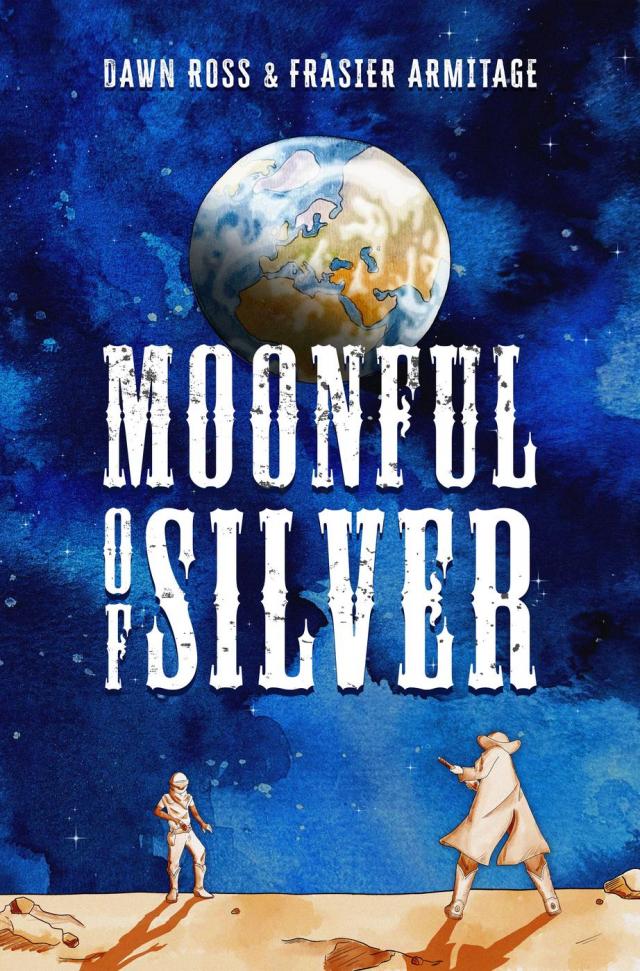
Concept Art (Original Cover Design)
Images from shutterstock, design by Frasier
SNEAK PEEK
StarFire Dragons: Book One
1 – The Blue Blight
A rising vibration hummed through J.D. Hapker’s body as he phased from the space vessel onto the planet. The sensation dissipated and a chill from this world’s atmosphere enveloped him. Regret sank in for not wearing a helmet, as the tips of his ears and nose turned raw from the cold. The air filtered by his nosepiece filled his lungs and radiated throughout him like a morning frost.
Sour looks from the nearby science team turned his way. “What’s he doing here?” their faces seemed to ask.
He wondered that too. He was no scientist—never had been. That burst of inspiration to bond with his new crew fell flatter than this land. He’d rather face an angry spire cat than their silent judgment. But he’d chosen this path so he might as well walk it.
His form-fitting enviro-suit quickly adjusted to the temperature but it took a moment longer for him to regain his bearings. He rested his hands on his hips and ignored the team to scan the distant horizon instead. The lines between the slate-blue land, ocean, and sky merged seamlessly into a vast heavy blanket of twilight fog.
Only stunted plants grew, yet it was more than what had been here a few decades ago when the terraforming experiment had started. Back then, the planet contained only microbial organisms hidden beneath an infinite bleakness of pale-blue ice. No wonder they nicknamed it the Blue Blight.
A heaviness settled over him that had nothing to do with the planet’s strong gravitational force. How had his life come to this? His parents had been so proud when he began the same career path as his father, grandfather, and great-grandfather before him.
It wasn’t enough—not for him. The time he’d spent vacationing with his family in the forests of his homeworld inspired him to explore further. So in a decision his dad had said was rash and irresponsible, Hapker left home for a career in space.
This should have been a new adventure, but his expectations fell short. The decisions were harder, the ethics fuzzier, and his superiors less forgiving. One incident gone awry and now his life had taken a turn as cheerless as this land.
If this second chance didn’t work out, his career in space would be over and he’d have to return home to face the perpetual disappointment of his father.
Hapker pushed down a rising sense of gloom and plodded over to the scientists. Gravity made his trek slow and arduous. No dust billowed from under his feet. He left no marks on this dense terrain. He was like an elephant tromping on stone.
Excited banter reached him as he arrived within earshot of the terra-team. A science officer tapped his finger on the viewscreen with apparent glee. Hapker watched with envy. It had been a long time since he’d been so passionate about his own job.
All conversation cut off at his approach.
Hapker smiled at the lead science officer with features more extreme than any he’d encountered in his travels thus far. “Doctor Canthidius.”
Doctor Holgarth Canthidius curled his lip and his multi-colored eyes narrowed. “What do you want?”
Hapker clenched his jaw. “Watch the attitude, Doctor. It’s my prerogative to check on my crew.”
Canthidius pursed his naturally puckered mouth but didn’t reply. His pale skin turned a bluish hue. Since the man came from the nearly all-ocean planet of Nomare, his resemblance to a fish seemed a cosmic joke. Hapker would have thought him a space alien if he didn’t already know such beings beyond a few lower-life forms hadn’t been discovered yet. As a human, Canthidius was much the same as every other person in the galaxy. However, the passing generations of people spread over a wide variety of ecosystems had diversified their characteristics.
“Did you find something interesting?” Hapker asked.
“Nothing that would interest you, Commander,” Canthidius said.
Hapker hardened his gaze. He was the Vice Executive Commander of the Odyssey, the largest and most advanced science and service vessel of the Prontaean Colonial Cooperative. It was his job to monitor the progress of his crew, even if he didn’t understand all of what they were doing.
Yet he bore the resentment with reluctant acceptance. He had little in common with his new crew. Early in his adult life, he’d served as a Pholatian Protector like his father. Later, he became a high-ranking military officer with the Prontaean Galactic Force. Though he never fit in with the PG-Force’s hard-core military attitudes, his combat and strategic skills meant he resembled them more than these scientists and engineers.
“Give me an abbreviated version anyway,” Hapker said brusquely.
Canthidius droned on with a long explanation full of technical terms, no doubt talking over his head on purpose.
Hapker suppressed a frown. When the comm beeped in his ear, he readily forestalled the doctor with a raised hand and pressed the comm-strip secured below his earlobe. “Hapker here. Go ahead.”






