

Thanatographies, p.11
Thanatographies, page 11
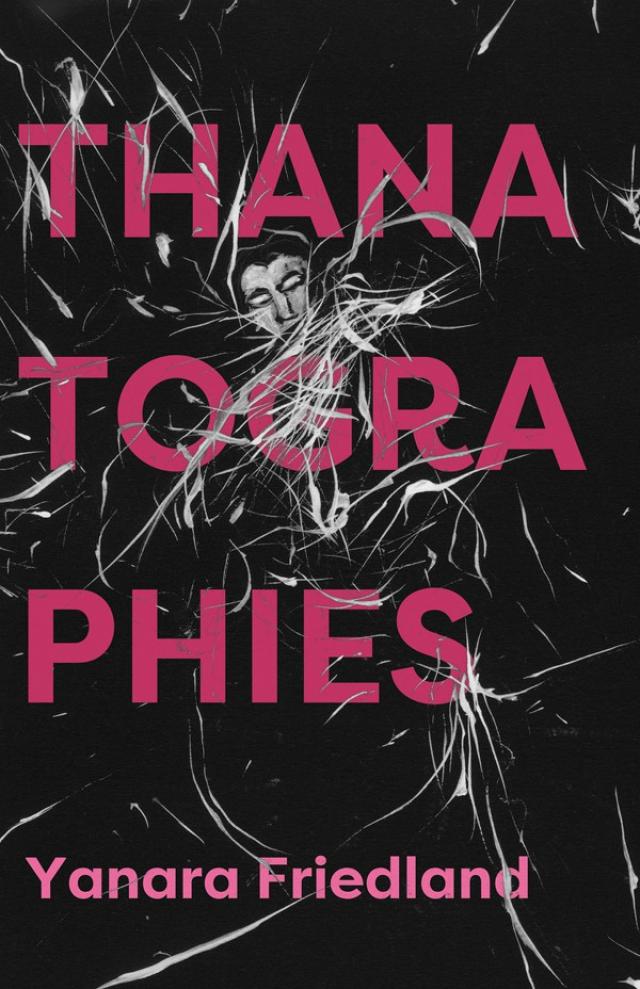


For dinner, there is wine, the story of her father hiding in a swamp during the war, his sudden departures during her childhood, and his immaculate manners. The porcelain from which you eat, the soup and the glasses from which you drink the wine carry you. The chairs are from Berlin. Outside a full moon appears. The moon illuminates his collection of madonnas, some plastic, some rock, strewn across the property. They stare at you when you cross the clearing back to the studio. You are a thief in perfect disguise. You listen closely, your ear to the mouth. You are a worm that courses the earth. Don’t sort the mess, others’ messes, don’t turn on the light. Lie down in this darkness, its futile aliveness. Language loves you. You will be defeated once, defeated twice, you will leave once, you will leave twice. You walk into the forest sideways to be alone. You are eager to be in the presence of this spirit that is part of the house, the dog, and the slope. It is all wide awake and deeply asleep. You cannot be threatened by what you cannot anticipate. From far away, you hear the indelible sound of moaning cows.
You dream of performing a headstand in a shallow creak, your face underwater.
The image arrives first, then you work to contextualize it, she says. The cow bones from the slaughterhouses in Chelsea she had carried back to her apartment. Then they were washed in red iodine on the roof of the skyscraper. The image of a city built on blood and sweat. A trumpet playing klezmer. Her dog accompanied her when she sensed the land, primarily seeing without politeness its horror. When her dog died, they kept him in a freezer, then tied him to a bicycle rack to get him back to the village for his burial. The iris pitch black, the cornea a moonscape, ragged hills surrounding a void. A flash, a bite. Committed to follow the world behind the world.
Wasps circle the breakfast table.
In the forest below, people were shot during the war. There is a large cemetery in the village. Another storm moves through, and you return drenched from your walk, down the slope, past the open roof, Hermann, the shepherd dog, nowhere to be seen.
You dry off in the studio among nests and shells and mermaid wings. The sketch of the sculpture shows a woman arching backward, hand clenched to a fist. You take your notebook and move to the fire. You hope this won’t disturb her. She animates with her hands and eyes, clearing the ashes for another fire, sweeping, kindling, lighting the candle. She sits down and begins to stitch the wings.
When she first arrived here, many years ago, she invited the villagers to an ancient mound, a prehistoric site, close to the forest. The tailor-made costumes, the village wives’ club crocheted a large shawl, others made a hut from the branches of willow, birch, alder, plum, bird cherry and ash. They walked together, singing and in procession, carrying the hut to the flattened mound, in some mouths called a local chakra. They whispered their wishes, burnt herbs to dispel bad energies, abandoned memory. These are the rites. Woods, lakes, swamps, fields, villages. Overgrown, plowed, resettled. These are the sites. History is unrecognizable.
At first the dead are just there. Your grandmother at the Hotel InterContinental, overlooking Tiergarten. Then a circus, in which your loved ones are thrown to the animals. The question of whether to watch or not. A man, who is limbless, falls into a pond, his wife watches. It takes hours to rescue him, and he probably died right away. Another man enters a tube that shoots down into the earth, never comes back. The dreams, despite their brutality, comfort you. To dream is to have a certain health, an open line to the cracked wall. Even nightmares come to you now as blessings, extended forms of seeing. And unlike the waking world, its onslaught of images asking to be considered, these dreams were meant for you specifically. They are yours to receive and they do not belong to you.
The child has returned from the city to the village, her screenings complete. Her face has opened. She complains about her mother’s fashion. She has become a lamb drawing unicorns, taking your child to the village store to buy gum that makes their tongues blue. Carrying her on her back along the road, past the vicious dogs.
On the kitchen counter, a cake from Warsaw. It’s no more Martial law, she says, and laughs. She wants to plant a tree in the neighbor’s house to grow through the roof. What does a tree do in a broken house, she wonders? She tells the child to sit upright. And that Hermann, the shepherd dog, has warm eyes.
In your favorite piece of hers, she used tree trunks with fully intact root systems from logging fields to create an underground shelter. In this underworld, the viewer can touch the woody roots, capillaries, elastic appendages, root hairs, and imagine survival from the trees’ nutrients and water. The air is cool and moist, and the roots appear illuminated. The destruction of trees she had felt in her own body, and she knew women who had felt it in their bodies. It made them insomniac or ill. Sometimes when you can’t sleep, you imagine lying down in this underground city, the roots above.
The trees in the forest below are large and remind you of the hollowed out 650-year-old oak in which two Jewish brothers survived the war. After fleeing from a concentration camp in southeastern Poland, they hid in forests, fields, and for long periods in a large chimney tree with a small entrance that made it accessible. Similarly, large underground caves served as hideouts with long corridors and multiple lakes, repurposed and reequipped with straw and a quern for grinding grain. A gypsum cave sheltered up to fifty-three people, who only came to the surface at night to get food and fuel.
Inside of trees eyes that follow you, shot through cracks, not only eyes of a future survival but of a long history buried in the ground. Do you notice the coldness of air, the smell of tallow candles, remains of wooden steps, metal brackets, cutlery?
The dog and his growth are taken to die today. He takes him to the vet early in the morning, everyone else is still asleep. He spends all day digging a hole for the dog who is dead and needs to be buried. The warm bread is cooling on the stove. It annoys her, this sullen burial rite, his devastation. He hangs up lights, goes out to buy candles. One for the frozen dog from many years ago, the other for the newly dead one. Neither she nor the child seem sad. The dog loved him the most, anyway. “I am a soldier, but also too permeable. I am like a chimney,” she says. He shovels, puts a candle on each of the dog’s grave, then disappears for the rest of the day.
You drive to town to visit the only corner of a synagogue that remains. You have coffee in a hotel lobby, a happy memory from her childhood, where she would meet her father. The fanciest rooms around. There is a mall her child wants to visit. There are shops that carry certain brands that her child has studied. The child knows exactly which brands she prefers, though she doesn’t have enough change for the shoes she has been asking for. You buy farmed salmon, more wine, stop by the mall, then drive back exhausted, tumbling down the slope, past the open roof, the freshly dug grave, drenched madonnas.
Your child is crying, no one knows about what, and casts a wornout stare. The same stare she had in the bathtub once, saying, you feel different, you come from a different place than me.
You remember the old woman at the drugstore, slumped over in a wheelchair, holding a basket staring blankly into space. It was a large sale. She sat by the cleaning products, her mouth half open, her eyes still, as if dead. You went closer but at that moment, her hand moved, and you worried that you were intruding. She seemed to be waiting for someone, holding on tightly to the goods, not letting go of the basket, while people toppled over each other to get to the shelves. No one paid attention to her, and when you left, she was still there.
Once the dog is buried, there is much to do. There is the prehistoric mound, the bottom of the hillside, the road with more dogs. There is the friend in the village and her one-hundred-year-old mother, who was part of the Warsaw uprising. There is the swamp. She has been concerned about it. The swamp dried out last year. When she returned in winter, during the solstice, with instructions from the healers to pour the water infused with dead snakes to the roots, the water returned. But she is unsure if the swamp has fully restored itself.
You all decide to go to the swamp when the rain stops, up the slope, through the gate, past Hermann the shepherd dog, the open roof. You pass fields, puddles, single stone houses. Some horses. The roads are flat, clouds gather along the horizon. Dilapidated stars begin to show themselves, though it is far from dark. The village appears deserted, in the distance, small sticklike figures at the cemetery.
You enter the forest, and the air here is cooler than by the house or the lake. You walk together joyfully, like an ancient hum. You move and feel the bark of trees. You are very small, smaller than ants, backs hunched from the labor of life. The rules are unknown, so you must use your noses, the unthought gestures.
In the forest, she grows worried. She is worried, he is matter of fact. The children stayed at home, seizing the moment. She knows where the swamp is, and it’s not close to the path. Despite the rain, roots and tangled lily pads are laid bare. Phlegm from the ground. She sees the roots first, and the worry is now truth, like a totemic entity rising from lost water.
When you walk over the exposed roots, they make a cracking sound, the sound of air escaping joints. Itchy green tubes shimmer in the waning light and exude a strange scent. The swamp glows in the twilight, frogs croak from another pond. Though you cannot call it a swamp anymore without the water. The water will not return, she is certain of it, and the work didn’t work. The singing didn’t work. The snake water didn’t return the swamp’s water. The work that works out a problem before leaving it behind to deconstruct didn’t work.
The image of the swamp you carry back to the house, past the open roof, Hermann the shepherd dog, the gate, the dead dogs, down the slope to the children watching TV.
You grab your throat in the morning. The house shakes but not from helicopters, which crashed after they cursed them. They still laugh about it. Each room here an instinct, a flare. Over breakfast you ask. Bare sunlight on puddles. You request to lie in the soil and be covered by it to inhabit yourself completely. Why not lie down inside of the earth, enter the womb, the raging hole? He takes it as natural order, this request, takes leave to find a shovel. No further questions asked. The bread will have to wait. Tasks are mutable, sudden bids for burials, feeble dogs on the threshold waiting to be fed. The child is quietly playing with the other child. They can escape these tasks, be in their own serious play. The children are inseparable, widening their circles and playing farther away from the house, away from the madonnas and wasps.
You choose the location together, close to the wetlands area where they made a film about her father hiding in a swamp during the war. Close to the compost pile. She covers you with dirt. You feel the weight of the earth on your skin. Stages to return to a lost bird.
After shoveling the dirt onto your body, she goes to the studio where your child has suddenly fallen asleep. She sits down at her desk and begins to draw a figure. She holds the crayon between thumb and index finger, follows the hand, a gentle course over the sandy surface. No one may disturb her now. The sleeping child does not disturb her. The house waits for her, prepares lunch or dinner or tea, mouthing to the window. Her child is with the living dog, upstairs in her room, where she can be alone for hours. The hand courses over the surface until a pale face appears on the dark paper, like a sun surrounded by night.
The heaviness of the soil surprises you, mosquitoes circle your face. Rotten food behind your head. You will stay in the hole for twenty minutes. That is what you have agreed on. But twenty minutes are different below. The soil tickles and itches, begins to devour you, dead or not. You ask for the time before you go in. For time to return and be exact in its uses. Twenty minutes will be more than enough. A snail sits on top of the soil, its slowness remarkable. You are unable to compare it to anything else. You feel impatient. A bit abandoned. Sky layers itself like a sheet over your stretched limbs.
It is ordinary to lie here. Someone will come to shovel you out in about twenty minutes. You feel thankful for that. You feel the brightness of daylight, the soil’s appetite. A certain work no one will see. A body among bottles and watermelon seeds. The waste of time. Skin is first, then a beat, a pulsing, the heart, you think. The pulse moves the body which can’t move itself. Soil rules. A question passes. How much can you empty your life? Maybe no one is coming. Moist sand shifts between limbs when you try to move them. The snail etches toward your nose.
You come to me, your body inside of my body. Your hair heaving with roots. Devouring heat, eyes last. The murdered, the murderer enter orifices. A void and not peaceful. To be this many. To be this many and speak. To speak the ears of the mouth and the eyes of the throat. To be this many and speak, an offbeat whisper, while the conversation continues. You lower your voice, aware that no one can hear you. The vase of language sifts and drinks and is gone.
NOTES
I have occasionally quoted, translated, or paraphrased from the following authors:
[004] Having an inner life: Lisa Robertson, Office for Soft Architecture (website), accessed July 2024.
[015] The truth of history is that we don’t love each other enough: Teju Cole, Between the Covers Podcast, 2022.
[016] My mother secretes an unbearable anguish: Chantal Akerman, My Mother Laughs, trans. Corinna Copp (The Song Cave, 2019).
[026] Nichts mehr wird kommen: For more information, see Enigma: Reading Ingeborg Bachmann, daad berliner-kuenstlerprogramm (website), accessed December 20, 2023.
[027] If ever you have need of my life: Anton Chekhov, The Seagull, trans. Tom Stoppard (New York: Grove Press, 2018).
[028] All men and beast, lions, eagles: Anton Chekhov, The Seagull, Project Gutenberg (website), accessed January 15, 2024.
[029] Der Prinz of Theben: Else Lasker Schüler (Nabu Press, 2012).
[030] At Hotel Koschel she lived in an attic room: For more information, see Jorg Aufenanger, Else Lasker Schüler in Berlin (Berlin, be.bra verlag, 2019).
[030] A great star will fall into my lap: Reconciliation, trans. Babette Deutsch and Avrahm Yarmolinsky, poets.org (website), accessed November 23, 2025.
[030] The most important thing first: Rosa Luxemburg, Ich Umarme Sie in Grosser Sehnsucht: Briefe Aus Dem Gefängnis 1915–1918 (Bonn: J. H. W. Dietz, 1984). (My translation.)
[033] An absurd and hysterical spectacle: Nell Walden, Herwarth Walden Ein Lebensbild (Berlin: Florian Kupferberg Verlag, 1963).
[033] I feel committed to this exhibition: Herwarth Walden, Erster Deutscher Herbstsalon (Sturm Verlag Berlin, 1913), Internet Archive (website), accessed December 18, 2025. For more information, see Sturm Archiv (Berlin: Deutsche Staatsbibliothek). (My translation.)
[036] The argument is in part a result of the restlessness: For more information, see Ingrid Pfeiffer and Max Hollein, Sturm Frauen Künstlerinnen der Avantgarde in Berlin 1910–1932 (Köln: Wienand Verlag, 2015).
[037] But before any of this, in January of 1917: Based on Nell Walden DER STURM (Baden Baden: Woldemar Klein Verlag, 1954).
[043] Before she developed her own full-body masks, she took classes at the Sturm-Bühne: Based on Jan Reetze, The Mask Dancers: Lavinia Schulz & Walter Holdt (website), accessed February 18, 2017.
[046] I know that a tree without leaves is a tree sleeping: Marie Darrieusseq, Sleepless, trans. Penny Hueston (London: Fitzcarraldo Editions, 2023).
[065] I hate people who sleep: Violette Leduc, La Bâtarde, trans. Derek Coltman (Chicago: Dalkey Archive, 2003).
[071] Forty years of age, plump and of large build: For more information, see Anna Göldi Museum (Ennenda, Glarus).
[081] Berlin-Die Sinfonie der Grosstadt: Walter Ruttmann, Berlin-Die Sinfonie der Grosstad, (1927).
[082] Bachmann’s “Ein Ort für Zufälle”: For more information, see Elke Schlinsog, Berliner Zufälle (Würzburg Konigshausen & Neumann, 2005).
[083] Total hypnosis: Unica Zürn, Gesamtausgabe (Berlin: Verlag Brinkman und Bose, 1999). (My translation.)
[084] Charlotte Salomon’s Leben? Oder Theater: For more information, see Griselda Pollock, Charlotte Salomon and the Theater of Memory (New Haven: Yale University Press, 2017).
[085] Angry, admired and destitute: Based on Walter Kraft, Verse und Prosa aus dem Nachlass (Berlin: Surkamp Verlag, 1999).
[097] Every love story is a ghost story: Laurie Anderson, Heart of a Dog (New York: Nonesuch Records, 2015).
[099] Anxiety is women’s work: Marina Benjamin, Insomnia (Brooklyn: Catapult Books, 2018).
[136] In this underworld the viewer can touch: Joanna Rajkowska, Joanna Rajkowska: Rhizopolis (Warsaw: Zachęta Narodowa Galeria Sztuki, 2021).
[136] The trees in the forest below: Based on Natalia Romnik, Hideouts: Architectures of Survival (Frankfurt: Jüdisches Museum Frankfurt, 2024).
[141] You come to me: from poem written for Joanna Rajkowska’s I, Earth (Turku: Biennale 2023).
ACKNOWLEDGMENTS
Thank you to the editors who published excerpts from Thanatographies:
Rachel Pafe (Reading Kofman in Constellation, Psycho Press); Erin Honeycutt (Cuttpress), Alicia Wright (Annulet: A Journal of Poetics); Rachel Levitsky, Karla Kelsey, and Poupeh Missaghi (Matters of Feminist Practice, Belladonna); Michael Mejia (Western Humanities Review); Lisa Wells and Joshua Marie Wilkinson (The Volta); Evelyn Hampton (Pulpmouth Magazine); Emily Alexander (Mary: A Journal of New Writing); and Michael Slosek (Poetry Foundation).
Thank you Callie’s for a residency and warm writing studio in Berlin in the winter of 2024, and to Western Washington University for a sabbatical that allowed me to finish the manuscript.
I am grateful for the artistic generosity and invaluable feedback of Julie Carr, EJ Colen, Annie Guthrie, Stefania Heim, Pary El-Qalqili, and readers of the FC2 Collective who made this book possible.






