

The visit, p.1
The Visit, page 1


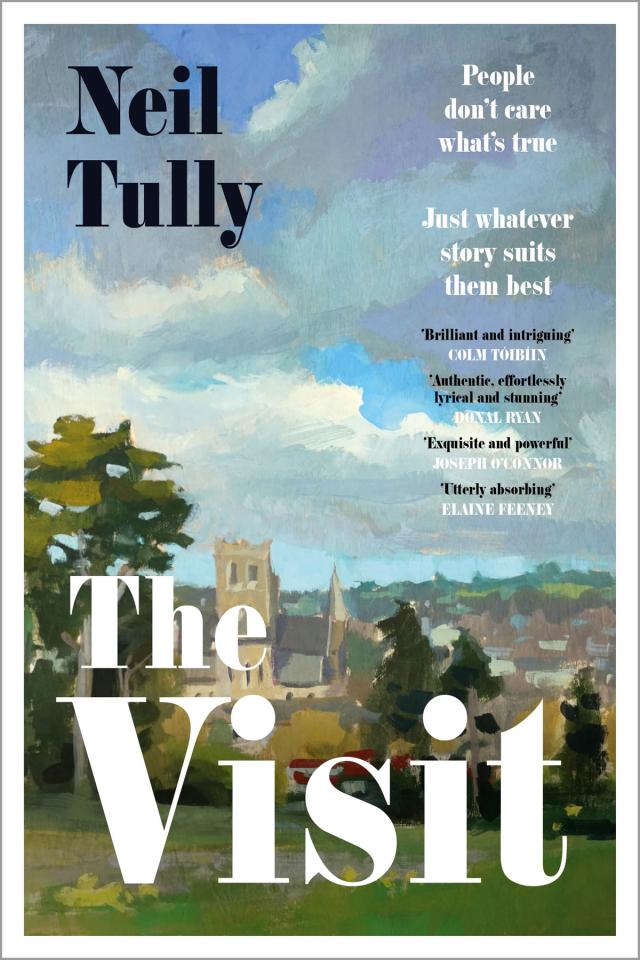
PRAISE FOR THE VISIT
‘The Visit is an engrossing and tender portrait of a small town under pressure . . . Stark and elemental – at the heart of the novel is a sort of quiet yearning and a longing for love and for completion that makes Neil Tully’s novel so brilliant and intriguing’ – Colm Tóibín
‘Compassionate but clear-eyed, brimming with insight and emotional intelligence, this is a novel whose characters will linger with you long after you’ve closed the pages’ – Colin Walsh, author of Kala
‘What a delight it is to read such a wonderful story, written so beautifully. Spare, authentic, effortlessly lyrical, it is a stunning novel, the work of a writer of the first order’ – Donal Ryan
‘Once in a while, you read a novel so accomplished that you want to read the author’s backlist but, to your surprise, it turns out to be a début. That’s how good Neil Tully’s The Visit is. Combining great storytelling with lyrical writing, this deserves to be on everyone’s must-read list for 2026’ – John Boyne
‘An exquisite and powerful debut novel from a compelling new voice in Irish fiction’ – Joseph O’Connor
‘An utterly absorbing and hugely readable novel, The Visit is a story that captures a transitional time in Irish history so incredibly well, that at times I felt I was watching it up close. Jim Field is a compelling protagonist, flawed, human and meticulously drawn. I was gripped from the start. The writing is so good’ – Elaine Feeney, author of How to Build a Boat
‘A strong debut that showcases both the viciousness and salvation of community’ – Sheila Armstrong, author of Falling Animals
‘Intrigue boils beneath the rural calm of this elegant novel; Neil Tully masterfully pulls the reader into a world where menace and the humdrum co-mingle uneasily. The prose is intelligent, gorgeous and empathic; the atmosphere subtly unsettling. The Visit is an accomplished, fully formed debut’ – Nuala O’Connor, author of Seaborne and NORA
‘The Visit makes an incision into 1960s New Ross as Ireland readies to welcome President Kennedy, and defiant Patrick Hatten toils under the weight of his family’s past – and the town’s judgment. A portrait of an Ireland still rooted in tradition, yet hopeful for change, The Visit is an engrossing novel filled with rich prose, compassion and a tension that drives the narrative to the very last page’ – Charleen Hurtubise, author of The Polite Act of Drowning and Saoirse
‘Neil Tully is a deeply humane writer. There’s great lyric beauty in The Visit, but there’s real ballast here as well’ – Seán Farrell, author of Frogs For Watchdogs
‘Neil Tully’s tremendous first novel has been, for me, the surprise of the summer. The Visit is a sheer delight, a considerable feat of the imagination, a proper story beautifully, delicately written and gripping from first page to last. Even in a country already popping at the seams with fine literature, this debut offering must be one of the year’s standouts. It announces Neil as a writer of clearly considerable talent, and deserves to fly with critics and readers alike’ – Billy O’Callaghan, author of My Coney Island Baby
THE VISIT
First published in the UK in 2026 by Eriu
An imprint of Bonnier Books UK
5th Floor, HYLO, 105 Bunhill Row,
London, EC1Y 8LZ
Copyright © Neil Tully, 2026
All rights reserved.
No part of this publication may be reproduced, stored or transmitted in any form or by any means, electronic, mechanical, photocopying or otherwise, without the prior written permission of the publisher.
The right of Neil Tully to be identified as Author of this work has been asserted by him in accordance with the Copyright, Designs and Patents Act, 1988.
This is a work of fiction. Names, places, events and incidents are either the products of the author’s imagination or used fictitiously. Any resemblance to actual persons, living or dead, or actual events is purely coincidental.
A CIP catalogue record for this book is available from the British Library.
Hardback ISBN: 978-1-80444-199-2
Trade Paperback ISBN: 978-1-80444-200-5
eBook ISBN: 978-1-80444-201-2
Also available as an audiobook
1 3 5 7 9 10 8 6 4 2
Typeset by IDSUK (Data Connection) Ltd
Every reasonable effort has been made to trace copyright holders of material reproduced in this book, but if any have been inadvertently overlooked the publishers would be glad to hear from them.
The authorised representative in the EEA is
Bonnier Books UK (Ireland) Limited.
Registered office address: Floor 3, Block 3, Miesian Plaza,
Dublin 2, D02 Y754, Ireland
compliance@bonnierbooks.ie
www.bonnierbooks.co.uk
For Sinéad
Contents
New Ross, County Wexford
Chapter 1
Chapter 2
Chapter 3
Chapter 4
Chapter 5
Chapter 6
Chapter 7
Chapter 8
Chapter 9
Chapter 10
Chapter 11
Chapter 12
Chapter 13
Chapter 14
Chapter 15
Chapter 16
Chapter 17
Chapter 18
Chapter 19
Chapter 20
Chapter 21
Chapter 22
Chapter 23
Chapter 24
Chapter 25
Chapter 26
Chapter 27
Chapter 28
Chapter 29
Chapter 30
Chapter 31
Chapter 32
Chapter 33
Chapter 34
Chapter 35
Chapter 36
Chapter 37
Chapter 38
Chapter 39
Chapter 40
Chapter 41
Chapter 42
Chapter 43
Chapter 44
Chapter 45
Chapter 46
Chapter 47
Chapter 48
Chapter 49
Acknowledgements
About the Author
The crowd deepened. On the road and through fields, people were running. Schoolboys in white shirts and red ties, women racing barefoot through summer grass, their shoes in their hands. Young men balanced on gates and fenceposts, others fought for footing on limestone walls. Cheering rose from somewhere unseen, and tricolours and stars and stripes fluttered in the grey.
The first car rounded the bend and Patrick straightened on the thickest branch of the tall sycamore with a view of the road. He sighted the driver and the passengers. Guards and men in black suits. A nest of rooks squawked in the upper branches. The crowd drowned out the engine – a rope of people coiling, twisting, and knotting as they pushed to glimpse the passengers, warned back from the road by guards in freshly washed navy-blues. Patrick secured his balance against the trunk.
A roar came from beyond the bend, then the second car appeared. A black, open-topped sedan, flanked by motorcycles. The flags fluttered faster, the cheers soared, and every gaze landed on the tanned and shimmering figure – standing and smiling, one hand touching his tie and the other raised as if in benediction. Patrick’s eyes filled. He imagined being down on the road, his father by his side, waving to this man who had stepped from television screens and news-paper pages. This man who seemed capable of slowing time. The car passed so close that he saw strands of brown hair through the rifle scope, moving in the breeze, lighter than it appeared in pictures. He watched with his breath drawn deeply, then exhaled the weight of every hurt and loss and sorrow he’d known, and a terrible immortality called to him.
New Ross, County Wexford
June 1963
1
I heard them before they woke me. Engines that sounded like the town clearing its throat after a heavy night of fags and porter. I cursed my way from bed to the window and opened the curtain to a pair of new yellow tractors, turning from the belly of New Ross and straining against the incline of our terraced street. The glass trembled as they passed and I tried to see what sort of gobshite was taking them through town at six in the morning but couldn’t make out the drivers from upstairs – only two pairs of hands gripping the steering wheels. They took a right at the top of the hill, leaving silence and a vapour trail of diesel behind.
‘What in God’s name is that?’ Siobhán said, her eyes still closed.
‘Somebody got new Masseys and wants to parade them.’
She sat up, drawing her red hair over one shoulder, her back to me. A shallow curve of sunburn marked the base of her neck, shaped by the summer dress she wore at the weekend.
The wire hangers in the wardrobe rattled when I stripped them of my uniform. ‘What’s the plan today?’
‘I’ve to take Catriona to the dentist,’ she said, on her way to examine her eyes in the mirror on the vanity table. She was up half the night, rubbing clove oil onto our little girl’s gum. It took plenty of coaxing to get Catriona to tilt her head back so I could find the problem tooth. The first thing this world has damaged in her, with a little pink marble of infection grown up next to it. ‘Will you hear anything about the Inspector exams?’
‘Probably not yet.’
‘I’m stuck with a sergeant a while longer.’ She smiled in the mirror.
The promotion exam was tougher than expected – the same old arithmetic that used to trip me up in school catching up decades later to do the same again, while obscure clauses of the Road Traffic Act and licensing laws were like remembering my mother’s name. The 27th will be the real exam anyway. Any mistakes and I might as well have turned in blank pages.
Siobhán started with her hair. There are intimacies only a married man is invited to share, and the day I tire of watching is the day I’ll be fit for pasture. She brushed, plaited, and weaved the threads – her fingers working as if with delicate fabric, disguising pins and clips until it all hung perfectly – before carefully unravelling one strand so that it fell down the right side of her face. Both her mother and mine can’t ever stop themselves from tucking it back behind her ear. She caught me looking and took a spare pin from between her teeth. ‘I meant to ask you yesterday, are we short a few pounds this week?’
I turned to the mirror inside the wardrobe door, clocking my huge ears and my face a decade older than hers, then looked myself in the eye and lied to her. ‘The car didn’t sound right coming back from Cork, love, so I let John have a tinker. A couple of gaskets needed changing is all.’
She stood and started making the bed. ‘Right, well you’ll need to leave me some for the dentist.’
‘Grand.’ I put my hand in my left pocket and found it empty of more than coins, then checked the right and patted my chest.
‘Did you see my handkerchief?’
She tutted and smoothed the blanket. ‘Handkerchief. A rag is what it is.’
‘Where is it?’
‘I washed it. God knows it needed it.’ She went to the wardrobe and reached to the top shelf then handed it over – its softness restored by whatever she’d done. The same small tear in the square of gauze-like netting at the centre, the edges decorated with a pattern of flowers, yellowed by the years.
‘That thing is for the bin.’ She brushed something from my lapels and in her eyes was the same distance I saw down in Cork at the weekend, visiting her parents for one last rest before this month’s madness reaches its peak. ‘I’ll make breakfast. Don’t wake herself on your way down, she had a bad night.’
When she was gone, I went back to the window. The sun flooded New Ross rooftops and warmed the Barrow beyond – the dark river flowing between the legs of fishermen standing in its shallow stretches, slicing the morning air with lines cast and recast. Continuing along the quay, where for the past week, men in shirtsleeves with browned arms and faces have been building a platform for Kennedy – choosing every beam as if choosing a name for a child, measuring and nailing with such care it’s as if it’s Christ Himself who’s going to come and stand on it.
I’ll be on duty down in Dunganstown, close enough to smell his aftershave while he visits the farmyard his great-grandfather abandoned last century. The planning has me wrecked. From Mayor Minihan’s men to chip van owners, headquarters and journalists, publicans and lorry drivers, ice-cream sellers and the US Secret Service. All with questions about licences and tickets and overtime and road closures and emergency routes. We’re reminded by the higher ups that every shoe should shine, and that any guard with as much as an unclipped nostril hair risks embarrassing the force. It’s why the tractors set me on edge -– something military-like in their small and loud early morning convoy, as if they were on their way to cause trouble I could do without. Finishing up yesterday evening, it took two goes to get out of my chair, like my legs had given in to the tiredness and gone off to sleep before the rest of me. I sat on the bed and folded the handkerchief.
I wondered if Patrick Hatten cared a jot about Kennedy. The difference between the two about as great as the distance between the stars in the sky and the coffins in the earth. Maurice Kearney came to the station yesterday afternoon, a pencil tucked behind his ear like he’d come straight from his calculations to tell me that Patrick owed three pounds and wouldn’t be given as much as another grain of salt on credit until his account was settled. I paid Kearney from my own pocket, with the money Siobhán noticed missing, and reminded him to come to me if there’s ever a problem. Siobhán doesn’t want to hear another word about Patrick after the trouble he was involved in a couple of months back.
The lad is a bit like a stray dog. I keep an eye on him and throw him a few scraps. There are plenty of people in this town who’d just as soon drop him off in the wilderness and hope there’s no scent to follow home. The problem is that Patrick could find his way out of any wilderness and they wouldn’t like whatever starved thing came back. It’s best to keep him where I can see him. I sorted the dole paperwork for him a few months ago, after his mother died. I’m not sure he even knew such a thing existed. I do call out to him the odd time. He let the place go to some state after burying Maura. She was a sort of ballast at least – like a prison warden, imposing some order on his days. A tidy house the day of her funeral was her legacy, like she knew in advance that she couldn’t trust him to set up properly for visitors. He had knives and forks and glasses washed and dried and left on the table in case anybody came, but no food to feed them if they did. Imagine, setting a table for people and not thinking of what to put on the plates. Nobody came in any case, apart from myself, not touching the glass of murky water he put in front of me, ashamed by the feeling of unease that came over me just from sharing silence out on that lonely acre.
2
Patrick Hatten hung his best trousers over the washing line at the back of the house. They’d soaked in warm water and soap shavings overnight, and, in the sunshine, looked as clean as if he’d just bought them in Broderick’s. They once belonged to his father. He closed his eyes and tilted his chin to the sky and imagined that he’d be proud, seeing his youngest son with work lined up at a time when work is hard found.
The high June sun baked his face, where a thick monobrow roofed narrow eyes and floored a forehead that stretched into short, dark curls. Oh, they’d swim in the Barrow and Booley Bay today, no doubt. They’d take picnics and bikes, cars, or packed buses. Women would pretend to be shy in their swimsuits, worn under loose skirts that they’d slip out of, then wade in water to their thighs, while men drank them in.
He slung a couple of shirts and pairs of socks and underpants over the line then wiped his wet hands along the back of his neck and his chest, his shirt open to his belly button. His skin had started to itch in recent weeks, any exertion or heat bringing on a bout of prickling that he could do little for only sit and scratch and wait for it to pass, watching little pieces of himself float away like dandelion seeds, as if he was slowly turning to dust.
The side of the house was a giant headstone of grey concrete mottled by lichen – the dead remembered in the flaking windowsills that his mother painted and the patchwork of slate roof that his father nailed. He crossed the neglected vegetable patch, where she had grown deformed heads of cauliflower and gnarled fingers of carrots. Where she dropped dead as surely as a magpie shot from the sky last December, so that when he found her – dirt on her hands and the morning light bringing a brightness to her eyes that he’d never seen in life – she was surrounded by loose vegetables, as if they’d rained down in fatal blows.
The radio droned through the window, competing with the buzz from the wasps’ nest behind the toolshed. The gutters and windows needed a clean, the garden needed to be dug and weeded, and the sheds needed a whitewash and animals to shelter. A boundary of birch, ash and Scots pine stood to their ankles in summer grass, separating Patrick’s patch of the world from the tainted land to the east – land that Peter Casey had all but swindled from his parents. To the west, the treetops of Lacken Fairy Woods, only a long puck away. The gate was rarely breached, unless Sergeant Field and his two huge ears came with some excuse to hear his business.
There was no trace of tyres or hooves that might have passed on the road during the night. His eye followed the line of electricity poles, staked endlessly across the county, their tops strung with wire, carrying the electric like some modern aqueduct. If you believed what people said, the source of a better life travelled those wires – more essential than water. All the talk in town and on the radio was of progress. Electric and indoor plumbing, cars for every home, televisions to rival radio. Lemass was said to be leading the country out of darkness and Patrick wouldn’t be left behind. Some money coming in, and the land back in working order was all the progress he needed.






